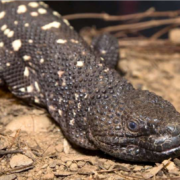

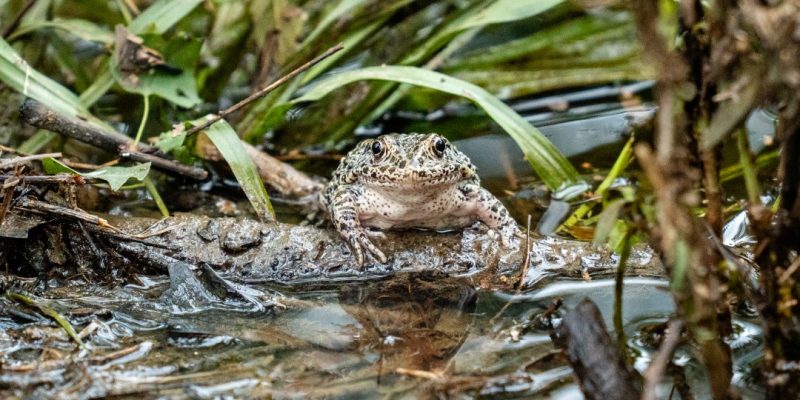
For sixteen years, every dusky gopher frog on Earth that was breeding in the wild was breeding in one pond in Mississippi. Memphis Zoo has now started a third population.
The zoo announced on June 5, 2026 that it had released 498 juvenile frogs at Woodland Cottage in Hancock County, its second Mississippi release site, on land owned privately by Jim Currie.
Glen’s Pond
The history here is the reason the story matters. According to the U.S. Fish and Wildlife Service recovery plan, between the species’ rediscovery in 1988 and 2004, a single site in the De Soto National Forest, called Glen’s Pond, supported the only known population of dusky gopher frogs anywhere.
One pond. One pond away from a species being gone.
The Service’s 2019 recovery plan amendment describes the current picture as eight breeding ponds, of which only the original site still supports a naturally viable population. A population found around a second pond in 2004 has likely been extirpated.
Why does a second release site matter?
Memphis Zoo’s first release site was Ward Bayou Wildlife Management Area in Jackson County. Since 2017 the zoo says it has released more than 8,000 juvenile frogs and 8,000 tadpoles there, and the population is now breeding on its own in the wild.
Woodland Cottage came out of years of habitat restoration led by Currie with the Fish and Wildlife Service and Wildlife Mississippi. The property has multiple ponds inside a healthy longleaf pine ecosystem maintained by prescribed fire and native groundcover management, which is the specific set of conditions this frog needs and almost nowhere still has.
All 498 frogs were bred and raised at Memphis Zoo over the past year. More releases at the site are planned.
“Twenty years ago, the future of the Dusky Gopher Frog was uncertain. Today, because of the dedication of our partners and the commitment of landowners like Jim Currie, we’re seeing new populations established in the wild. This release represents hope for this remarkable species and for what collaborative conservation can accomplish.”
Dr. Steve Reichling, director of conservation and research, Memphis Zoo
The thing the release does not say
There is a disease problem, and it is serious.
The Fish and Wildlife Service’s 2019 amendment identifies the protistan pathogen Dermomycoides as a continuing serious threat, and reports that across three breeding cycles ending in September 2018, fewer than 15 naturally produced metamorphic frogs were observed at Glen’s Pond. Not fewer than 15 per year. Fewer than 15 across three cycles. The amendment says mortality from disease continues to limit natural recruitment in many if not all populations.
That is the honest frame for a release like this one. Putting 498 frogs into a restored pond is not a victory lap. It is spreading the risk across more than one pond so that a single bad year in a single place cannot end the species.
A private landowner restoring longleaf pine on his own property is doing something the federal estate cannot do everywhere, and it is why land like Woodland Cottage is now part of the recovery plan rather than incidental to it.
The dusky gopher frog is listed as federally endangered, since 2001. It is also the species behind the 2018 Supreme Court case over critical habitat designation, which is a different story and a longer one.
Memphis is running two of these amphibian and reptile programs at once; its Louisiana pinesnake release went out two days earlier.
Source: Memphis Zoo; U.S. Fish and Wildlife Service recovery plan (2015) and recovery plan amendment (2019). The 498 figure is the zoo’s, published in a single release we could not cross-check against a second publisher.