
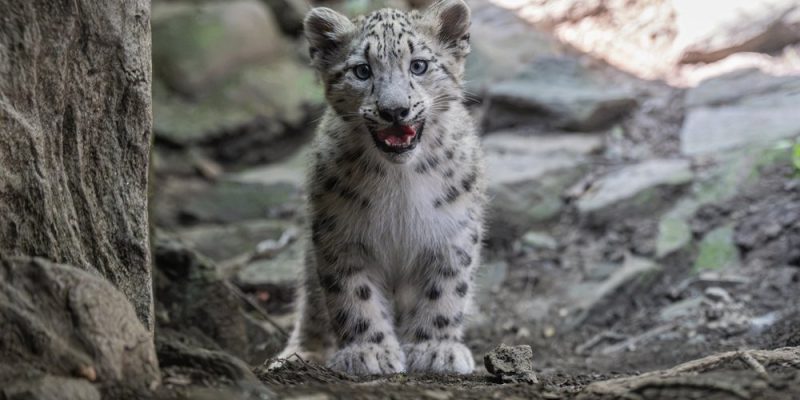
There is a snow leopard cub at the Bronx Zoo, she is four months old, and as of September 30 you can go and watch her work out what her own feet are for. She was born on May 31 to Dari and Moutig, she has passed her physical exams and her routine vaccinations, and she is now out in the Himalayan Highlands, the zoo’s habitat for wildlife of the high mountains of Central Asia. Her arrival brings the Bronx Zoo’s snow leopards to eight.
Eight is a lot of snow leopards. For an animal most people will never see outside a photograph, a zoo holding eight of them is holding a meaningful share of a managed population, and the Bronx has been doing this longer than anyone in the country.
Why is a snow leopard so hard to see?
Snow leopards are built not to be seen. The coat is a smoke-gray white broken by dark rosettes, which against bare rock and snow does exactly what it is supposed to do. The feet are wide and heavily padded and work as snowshoes. The tail is close to the length of the body, thick with fur, and does two jobs at once: counterweight on a steep traverse, and a scarf the animal can wrap around its own face when it lies down in the cold.
Put all of that on an animal living between 500 and 5,800 meters in some of the least accessible terrain on the planet and you get the nickname that follows the species everywhere, which is ghost of the mountain. Field biologists have spent whole seasons inside occupied snow leopard range without laying eyes on one.
Which is the quiet argument for a habitat like the Himalayan Highlands. A visitor in the Bronx on an October afternoon sees in ten minutes what researchers in Mongolia wait months for.
What the Red List actually says about how many are left
The Wildlife Conservation Society puts the wild population at an estimated 5,000 to 7,000 snow leopards and lists the species as Vulnerable. The category is right, and that is worth saying plainly, because the category is the part facilities most often overstate.
The number readers will find elsewhere is different, and the difference is not a disagreement. The IUCN Red List assesses Panthera uncia as Vulnerable under criterion C1 and gives 2,710 to 3,386 mature individuals, with the population decreasing. Mature individuals is a specific quantity: breeding-age adults, which leaves out every cub and subadult in the range. A total-population estimate counts them. So 5,000 to 7,000 animals and 2,710 to 3,386 breeders are not two answers to one question. They are answers to two questions, and anyone who sets them side by side without noticing will conclude that somebody is wrong.
Two further things about that assessment, in the spirit of reading a document rather than quoting it. It was assessed on November 8, 2016 and published in 2017, which makes it ten years old, and a decade is a long time in a field that has added a great deal of camera-trap and genetic survey data since. And the Red List account for the species credits the Wildlife Conservation Society among the contributing organizations, alongside Panthera, the Snow Leopard Trust and the Snow Leopard Network. WCS is not quoting someone else’s number back at itself. It helped build the one on the Red List.
WCS says it convened experts from across Asia in 2025 to reassess the species’ global status, and that those results are due to publish this year. That is the number to watch.
Where the cub fits
The Bronx Zoo was the first zoo in the United States to exhibit snow leopards, in 1903, and has recorded more than 80 births since. It takes part in the Association of Zoos and Aquariums Snow Leopard Species Survival Plan, the cooperative program that reads the studbook for the entire managed population and issues breeding and transfer recommendations designed to keep genetic variation in it. Inside that system a cub is a set of genes a population manager had reasons to want.
The same logic produced a Przewalski’s horse foal at the Bronx Zoo this year, in a program that has already put that species back onto the Mongolian steppe. Snow leopards are not a reintroduction species and nobody is proposing they should be. The point of the breeding program is a healthy, genetically varied insurance population, and a cat the public can stand in front of.
What WCS does about snow leopards once the gates close
The field side goes back to the surveys George Schaller led across snow leopard range in the 1970s and 1980s, which remain the foundation most later work is built on. Fifty-five years later, WCS works in Mongolia, which holds the world’s second-largest snow leopard population, and in Afghanistan, where it is the only international non-governmental organization working on the species at all.
The work is unglamorous in the way effective conservation usually is: camera traps and satellite collars for monitoring, protected area development and management, anti-poaching and anti-trafficking programs, and a great deal of time spent with the communities who share the mountains with the cats.
That last piece matters more than it sounds, because the first threat listed on the Red List is not poaching. It is retaliatory killing by livestock herders. A snow leopard that takes a goat has taken a real loss from a real household, and what that herder decides to do next is the single largest variable in whether the species persists. Habitat degradation, declining wild prey and the illegal trade do the rest of the damage. The cats live mainly on blue sheep, argali and Siberian ibex, and when those thin out, livestock stops being an alternative and becomes the menu.
None of which is visible from the viewing glass in the Bronx. What is visible is a four-month-old cat on a rock ledge, and that is worth the trip.
Quick answers
- When was the Bronx Zoo's snow leopard cub born?
May 31, 2026, to Dari and Moutig. She is female, she has passed her physical exams and routine vaccinations, and she went on view in the Himalayan Highlands habitat on September 30, 2026.
- How many snow leopards does the Bronx Zoo have?
Eight, including the cub. The Bronx Zoo was the first zoo in the United States to exhibit snow leopards, in 1903, and has recorded more than 80 births since.
- Is the snow leopard endangered?
The IUCN Red List categorizes the snow leopard as Vulnerable under criterion C1, which is the category the Wildlife Conservation Society uses as well. The assessment dates from November 8, 2016 and the population is listed as decreasing.
- How many snow leopards are left in the wild?
It depends on what is being counted. The Red List gives 2,710 to 3,386 mature individuals, meaning breeding-age adults only. WCS gives an estimated 5,000 to 7,000 animals in total, which includes cubs and subadults. Both figures can be true at once. WCS convened experts across Asia in 2025 to reassess the species and says those results publish this year.
- What is the biggest threat to snow leopards?
The first threat listed on the Red List is retaliatory killing by livestock herders, followed by habitat degradation, a decline in wild prey, and poaching and illegal trade. The cats depend mainly on blue sheep, argali and Siberian ibex, so when wild prey thins out, livestock losses rise.
- Why are snow leopards called ghosts of the mountain?
Because they are extremely difficult to see. Their gray-white rosetted coat is camouflage against rock and snow, they live between 500 and 5,800 meters in very remote terrain, and field biologists have spent entire seasons inside occupied range without sighting one.