
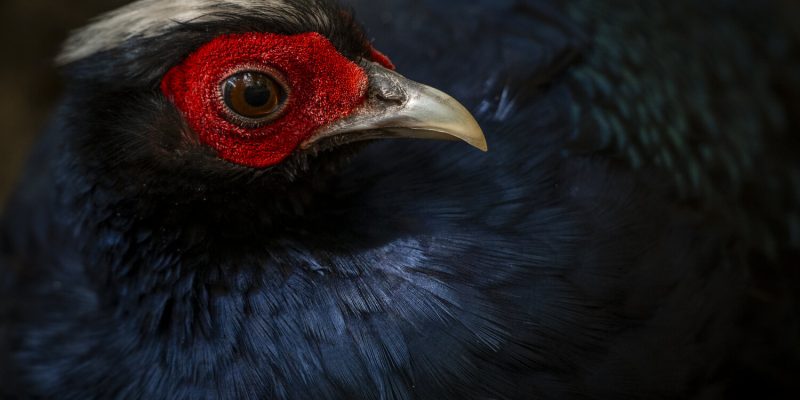
Twenty Edwards’s pheasants flew from Berlin to Vietnam this summer, and for the first time in about a century a bird that survives almost entirely inside European zoos is standing on Vietnamese ground. The species is one of the rarest on earth: the IUCN Red List puts the number of mature wild individuals at zero to 49.
Matthias Papies, a curator at Tierpark Berlin, flew with them. The route ran Berlin to Frankfurt to Ho Chi Minh City, then on to Phu Quoc, about three days door to door. Ten females and ten males, paired on the recommendations of the European Endangered Species Programme, came off the last leg healthy.
Three and a half years of paperwork before anyone boarded a plane
Papies says the flight was the short part. The birds had to be selected, health screened and documented, from CITES permits to veterinary certificates, and the paperwork had to clear inspection again on entry to Vietnam.
“Als ich dann im Flugzeug saß und wusste, dass wir tatsächlich auf dem Weg nach Vietnam sind, wurde mir noch einmal bewusst, dass wir gerade Teil eines ganz besonderen Kapitels im internationalen Artenschutz sind,” Papies said: “When I was sitting on the plane and knew that we were actually on our way to Vietnam, it came home to me again that we were part of a very particular chapter in international species conservation,” in a statement translated from German.
He put the planning at three and a half years, counting every approval. The birds went into quarantine on arrival and were paired there, and that step is the one that decides whether any of this works. The point of the group is not the twenty birds but the generations after them, and the European studbook picks pairs on genetics rather than convenience.
What the Red List actually says
Zoo Berlin describes the species as extinct in the wild in its home range in central Vietnam. That is a fair description of the wild population, but it is not the category the bird carries. BirdLife International assessed Edwards’s pheasant on July 1, 2024, and the IUCN Red List lists it as Critically Endangered under criterion D, with zero to 49 mature individuals and an unknown population trend. The Red List range map flags the species as possibly extant and possibly extinct at the same time, which is its way of saying that nobody has confirmed either.
The distinction matters more here than it usually does, because Extinct in the Wild is a formal Red List category with its own rules and this species does not sit in it. It sits one step short, on a count that could be zero. Either way, the arithmetic behind this shipment is the same.
Ten of the twenty went north in August
The story did not stop when the plane landed. On August 4, ten of the birds, five males and five females, were moved on from Phu Quoc to the Rare Pheasant Breeding Centre at Ban Bang, in Kim Ngan Commune in Quang Tri Province. Quang Tri’s Department of Agriculture and Environment received them alongside the Viet Nature Conservation Centre.
Quang Tri sits inside the historical range. Edwards’s pheasant was recorded in the lowland evergreen forests of central Vietnam, in what are now Ha Tinh Province, Quang Tri Province and Hue City, before habitat loss and snaring removed it. The European population descends from birds exported in the late 1920s, which is the only reason there is anything left to send back.
Viet Nature’s director, Pham Tuan Anh, framed the arrival as giving a species found nowhere but Vietnam a second chance to return to its own forests. Dang Gia Tung, vice president of the Zoo Association of Vietnam, said it was the first time in more than a century that Edwards’s pheasants had left zoos for the species’ historical range. Both were speaking through Vietnamese outlets in English, and we have not seen their original wording.
The releases are still years out
Nothing goes into a forest yet. The plan reported in Vietnam is trial releases at the end of 2028 and a self-sustaining wild population by around 2035. Between now and then the birds have to breed, the chicks have to be reared by their parents rather than by people, and the forest they would go back into has to be protected well enough that the snares do not simply take them again.
Papies was blunt about the sequence. Only once stable numbers exist and suitable habitat is permanently protected, he said, can release begin, which is why patience is part of the work. Asked what he would want to find in Vietnam in twenty years, he said he would want to watch Edwards’s pheasants in the forests of central Vietnam again, and added: “Artenschutz ist Teamarbeit,” or “Species conservation is teamwork,” in a statement translated from German.
The partner list behind the transfer is long and it is mostly zoos: Zoo Berlin and Tierpark Berlin, Vinpearl Safari Phu Quoc, the Viet Nature Conservation Centre, the European Association of Zoos and Aquaria, Prague Zoo, the World Pheasant Association, the Zoological Society of London, Mandai Nature and Conservation Vietnam. Berlin’s own line on it is the one worth keeping: decades of work by zoos and by private keepers inside the European Endangered Species Programme are the reason the species still exists at all, and the reserve population they built has finally been asked to do the thing it was built for.
Tierpark Berlin put little owls back into the Harz foreland this year, which is the same logic over a much shorter distance. Our report on that release is here, and Zoo Berlin’s full interview with Papies is on the zoo’s own newsroom.
Quick answers
- How many Edwards's pheasants are left in the wild?
The IUCN Red List, assessed by BirdLife International on July 1, 2024, gives zero to 49 mature individuals and an unknown trend. The species is listed as Critically Endangered under criterion D, and its range is mapped as possibly extant and possibly extinct at the same time.
- How many birds went to Vietnam, and where are they now?
Twenty flew from Berlin in July 2026, ten males and ten females, arriving via Frankfurt and Ho Chi Minh City at Phu Quoc after about three days. On August 4, ten of them were moved on to the Rare Pheasant Breeding Centre at Ban Bang in Kim Ngan Commune, Quang Tri Province.
- Are any of them being released into the wild?
Not yet. The birds are being bred first. The plan reported in Vietnam is trial releases at the end of 2028 and a self-sustaining wild population by around 2035.
- Where did the European population come from?
From birds exported from Vietnam in the late 1920s, maintained since by zoos and private keepers through the European Endangered Species Programme.