
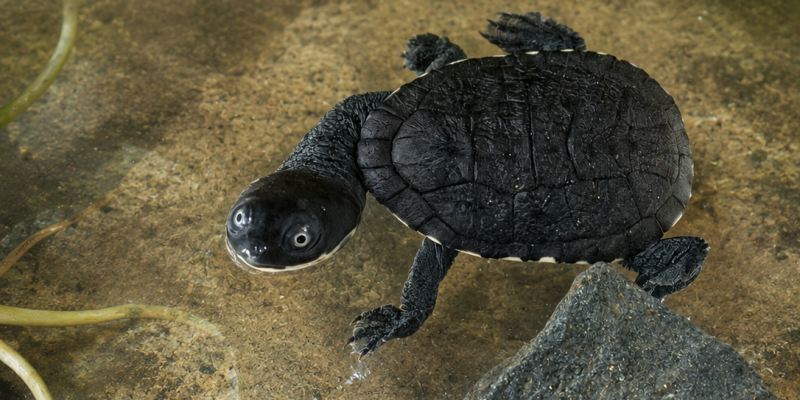
Eleven McCord’s snake-necked turtles have hatched at ZOOM Erlebniswelt in Gelsenkirchen, two in June and nine more in early August. All eleven came from one 19-year-old female named Brunhilde. The zoo announced the hatchings on August 17, 2026.
The species is Critically Endangered on the IUCN Red List, and the reason is almost entirely the pet trade. Eleven hatchlings is a meaningful number when the whole European population in human care is about 180 animals.
The neck is the point
At hatching the turtles measure barely three centimeters. The neck is as long as the shell, which is not a curiosity so much as a different solution to the same problem every turtle has.
Most turtles pull the head straight back into the shell. These cannot. Instead they fold the neck sideways and tuck it under the rim of the carapace, which is why the group is called side-necked turtles, Halswender in German. The anatomy that makes them recognizable is the anatomy that names them.
What happened to them in the wild
ZOOM says the species originally occurred only on the Indonesian islands of Roti and Timor. During the 1990s the wild populations fell by 80 to 90 percent, and today only scattered remnant populations survive.
The zoo names four causes: collection for the international animal trade, habitat loss as swamps and wetlands were converted to rice fields on a large scale, deforestation and erosion destroying further habitat, and introduced predatory fish that eat the young.
The first of those is the one that separates this species from most conservation stories. The Roti Island snake-necked turtle was described as new to science in 1994, and collectors reached it almost immediately. A species can be identified, catalogued and stripped from its only home inside a single decade.
The reserve population, counted
ZOOM published the numbers, which is more than most breeding announcements do.
Across all of Europe, 33 zoos hold roughly 180 of these turtles. In Germany only six institutions keep them: Gelsenkirchen, Berlin, Munster, Karlsruhe, Munich and Stuttgart. German zoos hold 43 animals between them, and 15 of those are at ZOOM Erlebniswelt, which makes Gelsenkirchen the largest single holding in the country.
Set the eleven hatchlings against those figures and the proportion is unusual. A single clutch season at one zoo has added the equivalent of roughly a quarter of the German total.
Where the terminology matters
ZOOM describes the species in German as vom Aussterben bedroht, which is the German rendering of the IUCN category Critically Endangered. The zoo and the Red List agree, which is worth saying because facility descriptions and Red List categories frequently do not line up.
One clarification on range. The turtles of Roti and the turtles of Timor have been treated as separate populations in the scientific literature, and the naming has been revised since the species was first described. ZOOM’s framing of a single species across both islands is the common shorthand rather than an error, and nothing in the conservation picture turns on it: both populations are gone or nearly gone from the wild.
What ZOOM did not say
The release names no keeper, curator or scientist, and carries no quotations at all. It does not say how many eggs were laid, how many failed, how long incubation took, or where the eleven hatchlings will go. It does not name the studbook or breeding program coordinating the European population, and it gives no wild population estimate beyond the 80 to 90 percent decline.
The numbers it does give are good ones. The absence of the rest is worth noting rather than filling in.
Why a German zoo hatching turtles counts
For a species that may be functionally extinct in its native range, a coordinated captive population is not a consolation prize, it is the species. Every hatchling widens the genetic base that any future reintroduction would have to draw on, and reintroduction is a long way off while the trade pressure that emptied Roti still exists.
That logic runs through a lot of European zoo work. Wilhelma in Stuttgart marked a rare case where it went the whole way this year, when the numbat was downlisted two categories on the IUCN Red List after decades of effort. Most programs are still in the part before that, quietly holding a species steady.
Source: ZOOM Erlebniswelt, August 17, 2026, translated from German. Red List category from the IUCN Red List assessment of Chelodina mccordi.
Quick answers
- How many turtles hatched at ZOOM Erlebniswelt?
Eleven McCord's snake-necked turtles, two in June 2026 and nine in early August, all from a 19-year-old female named Brunhilde. The zoo announced it on August 17, 2026.
- Why can't these turtles pull their heads into their shells?
They are side-necked turtles. The neck is as long as the shell, so instead of retracting it they fold it sideways and tuck it under the rim of the carapace.
- What happened to the wild population?
It fell by 80 to 90 percent during the 1990s, mainly through collection for the international animal trade, plus wetland conversion to rice fields, deforestation and introduced predatory fish. Only scattered remnants survive.
- How many are held in zoos?
About 180 across 33 European zoos. Six German institutions hold 43 between them, and 15 of those are at ZOOM Erlebniswelt, the largest single holding in Germany.