
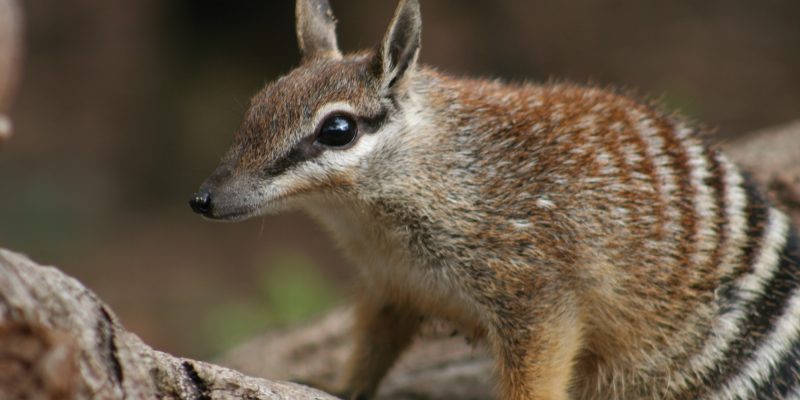
On July 9, 2026, the IUCN moved the numbat from Endangered to Near Threatened on the Red List. That is a drop of two categories at once, and it is the direction almost nothing on that list ever travels. A month later the Wilhelma in Stuttgart, which pays for part of the work behind it, said publicly that this is what the money was for.
The numbat is a striped, squirrel-sized marsupial from Australia that eats termites and almost nothing else. By the late 1970s there were about 300 left in the wild. The IUCN now puts the population at 2,000 to 3,000.
What actually moved the number
The IUCN credits a stack of work rather than any single project: fieldwork by Dr. Tony Friend in the 1980s, a recovery plan written in 1994, and a long campaign by the Western Australian government and the Australian Wildlife Conservancy to push back feral cats and foxes with baiting and predator-proof fencing. Alongside that sits captive breeding at Perth Zoo and a series of translocations that established at least five more self-sustaining populations.
Perth Zoo has sent 325 zoo-born numbats out for reintroduction since 1993, into sites in Western Australia, South Australia and New South Wales.
Where a German zoo comes into an Australian recovery
Since 2025 the Wilhelma has given Perth Zoo 10,000 euros a year. The money comes from the Artenschutz-Euro, a conservation surcharge folded into the price of a Wilhelma admission ticket, and it is spent on one specific and deeply unglamorous problem: termites.
Numbats in the wild eat ants and termites and very little else, and a captive-breeding program that cannot feed them properly is a captive-breeding program that fails. Perth Zoo staff go out into the Australian bush every week to collect the live insects. The Wilhelma’s grant pays for that collection, which is what lets young numbats grow up on something close to a wild diet before anyone tries to release them.
It is a good illustration of what conservation funding usually buys. Not a headline. Somebody’s weekly drive out to dig up termites, for thirty years.
“Die Rückstufung des Numbats auf der Roten Liste ist ein eindrucksvolles Beispiel dafür, dass Artenschutz wirkt, wenn er wissenschaftlich fundiert, langfristig angelegt und international vernetzt ist. Solche Erfolgsgeschichten brauchen wir. Sie zeigen, dass wir den Rückgang bedrohter Arten tatsächlich umkehren können – ganz im Sinne von Reverse the Red.”
The numbat’s downlisting on the Red List is a striking example of the fact that species conservation works when it is scientifically grounded, designed for the long term and internationally connected. We need success stories like this. They show that we really can reverse the decline of threatened species, entirely in the spirit of Reverse the Red.
Dr. Thomas Kölpin, director of the Wilhelma, in a statement translated from German
What is Reverse the Red?
Reverse the Red is an international campaign with an unusually concrete goal. Species tend to move in one direction on the IUCN Red List, from lower categories to higher ones, as their situations get worse. Reverse the Red exists to make species move the other way. The numbat is the campaign’s argument made flesh: a species that went from Endangered to Near Threatened because people spent decades on it.
The IUCN’s own framing of the July update was less celebratory. Prof. John Woinarski, quoted in the Red List announcement, said that “long-term, strategic and collaborative conservation effort works; without it, invasive cats and foxes will continue to drive Australia’s small marsupials and native rodents to extinction.”
Near Threatened is not safe
The Wilhelma is careful about this and so is the IUCN. The numbat still occupies less than one percent of the range it once had. Feral cats and foxes have not gone anywhere, and the fencing and baiting that hold them back only work for as long as somebody keeps paying for them. Perth Zoo’s breeding and release program is continuing rather than winding down.
A species that needs permanent management to stay at 2,000 animals is not a species that has recovered. It is a species that is being held up. The difference matters, and the people running the program are the first to say so.
European zoos have had a run of releases and reintroductions land this summer. Tiergarten Schönbrunn returned 8,000 moor frog tadpoles to Carinthia in July, and ZooParc de Beauval put 570 Critically Endangered snails back on a Madeiran island the same month.
Sources: Wilhelma and the IUCN Red List update of July 9, 2026. The Kölpin quotation is translated from German.
Quick answers
- What changed for the numbat on the IUCN Red List?
On July 9, 2026 the IUCN moved the numbat from Endangered to Near Threatened, a drop of two categories at once.
- How many numbats are left in the wild?
The IUCN estimates 2,000 to 3,000. The population had fallen to roughly 300 animals by the late 1970s.
- What does the Wilhelma pay for?
Since 2025 it has given Perth Zoo 10,000 euros a year from its Artenschutz-Euro admission surcharge. The money buys termites, the main natural food of numbats, which staff collect live in the Australian bush each week.
- Is the numbat safe now?
No. It occupies less than one percent of its original range, feral cats and foxes remain the main threat, and the baiting, fencing and breeding programs that produced the recovery are all continuing.