
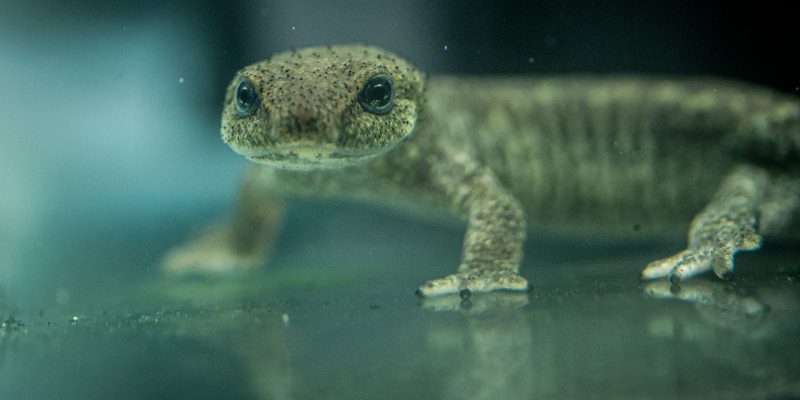
Chester Zoo has released 32 Montseny brook newts into a mountain stream in Catalonia, at a site it will not name. The zoo announced the release on July 21, 2026. More than a hundred more newts are still at Chester, growing to a size where they can follow.
The Montseny brook newt, Calotriton arnoldi arnoldi, lives in one small massif north of Barcelona and nowhere else on Earth. The IUCN Red List lists it as Critically Endangered, and Chester says there may be fewer than 1,500 left in the wild.
Why the location is a secret
Two reasons, and both are specific. The first is disturbance. The second is chytrid fungus, the amphibian disease that has driven population collapses and extinctions across several continents, and which travels on boots and equipment as readily as on animals.
There is a third reason in the fact file Chester published alongside the release: the illegal wildlife trade. A newt found nowhere else, in a known stream, is a collectible.
The released animals carry UV markers so the team can follow their movements and measure whether the reintroduction worked.
The animal itself
It is a chocolate brown amphibian flecked with gold, about 10 centimeters long, roughly the size of a pack of cards. It takes five years to reach breeding age. Dr Gerardo Garcia, Chester Zoo’s animal and plant director, has worked on the Government of Catalonia’s Montseny Brook Newt Recovery Plan since it began.
These newts are fascinating, and also quite cute. But they are extremely vulnerable. Their habitat is fragmented by roads, they are highly sensitive to water quality and they face the constant threat of illegal wildlife trade.
One finding has gone the right way. Garcia says the genetic diversity of the remaining population is far healthier than the numbers would predict.
Usually when numbers get this low, you’d expect genetic diversity to plummet. But research shows it’s surprisingly good. That gave us a strong foundation for the project.
There is also something nobody has explained. Larvae are seen regularly in the wild, then vanish, then reappear later as adults. Conservationists think the newts may spend part of their lives in an underground river system beneath the Montseny mountains, which would mean a species this closely studied still has a hidden half.
What the breeding actually involves
Twelve breeding pairs live at Chester in purpose-built pods under strict biosecurity. Ellie Bland, the zoo’s ectotherms keeper, runs the daily work: water checks, tank cleaning, headcounts and the search for eggs.
The females evolved to lay eggs in fast-running water, so they are experts at putting them in tiny hidden crevices, it’s not always easy to find them.
Chester’s fact file explains why that is so hard. Female Montseny brook newts have an unusually pointed cloaca, which lets them place eggs deep into crags where a current cannot dislodge them and a keeper cannot easily see them. The eggs may also be photosensitive, meaning light exposure could affect fertility and larval development, so finding them is not the same as handling them.
They’re quite quirky. They are visual hunters that target aquatic worms and insects, I pipette feed them and they are very reactive to movement, so we have these huge eyes watching us while we work.
Bland was at the release.
It’s awesome seeing them swim free. Moments like this are why I wanted to work in a zoo in the first place.
Who else is involved
Chester is the only UK organization in the breeding program. The release was carried out under the official Montseny Brook Newt Recovery Plan alongside amphibian specialists from the Catalan government, the Barcelona Zoo Pont de Suert Wildlife Center, the School of Nature of Parets del Valles, the Parc Natural i Reserva de la Biosfera del Montseny, and the Centre de Recuperacio de Fauna Salvatge de Torreferrussa.
Chester’s first newts arrived in 2017, so this is the ninth year of the commitment.
What Chester did not say
The release gives no cost, no figure for how many newts the program has returned to the wild in total across all partners, and no survival data from earlier releases. It does not say how many of the 32 were male and female, or how long the UV markers last.
A release is only an outcome once the released animals breed, and nothing published here says that has been measured yet.
The European pattern
Amphibian and reptile releases are the quiet backbone of European zoo conservation, because the animals are small, the programs are cheap by zoo standards, and the habitat is often within a day’s drive. Tiergarten Schonbrunn raised 8,000 moor frog tadpoles and drove them back to Carinthia this summer, and Tiergarten Nurnberg released European pond turtles in Hesse. None of it makes a poster. All of it is the work.
Source: Chester Zoo, July 21, 2026. Red List category from the IUCN Red List assessment of Calotriton arnoldi.
Quick answers
- How many newts did Chester Zoo release?
Thirty-two Montseny brook newts, at an undisclosed site in Catalonia, announced July 21, 2026. More than a hundred more are still at Chester maturing for follow-up releases.
- Why is the release site secret?
To protect the newts from disturbance, from chytrid fungus, which can devastate amphibian populations and travels on boots and equipment, and from the illegal wildlife trade.
- How rare is the Montseny brook newt?
It lives in one massif north of Barcelona and nowhere else on Earth. The IUCN Red List lists it as Critically Endangered, and Chester Zoo says there may be fewer than 1,500 left in the wild.
- What is the mystery about their life cycle?
Larvae are seen regularly in the wild, then disappear, then reappear as adults. Conservationists believe the newts may spend part of their lives in an underground river system beneath the Montseny mountains.