
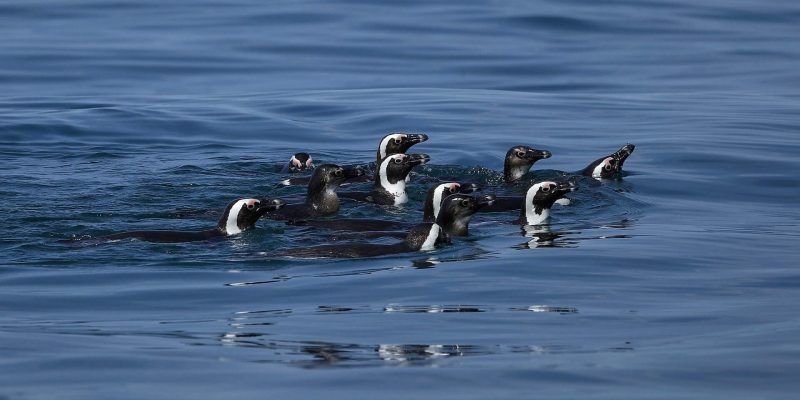
In March 2025 a South African court set aside a government decision on where boats may fish, and replaced it with no-take zones around six African penguin colonies. The case was brought by a seabird hospital and a birding organization.
BirdLife South Africa and SANCCOB, represented by the Biodiversity Law Centre, took the Minister of Forestry, Fisheries and the Environment to the Pretoria High Court over an August 2023 decision on island fishing closures. A settlement was reached the night before a three-day hearing and made an order of court on March 18, 2025.
What the applicants argued
“The applicants’ case turns on the irrationality and unlawfulness of the Minister’s decision to put in place island closures which are not biologically meaningful. This, argue the applicants, requires the court to set aside the decision and put in place scientifically informed fishing closures which strike an optimal trade-off between maximising protection of African Penguins’ foraging areas and minimising impact to Industry.”
SANCCOB, on the heads of argument filed January 2025
The phrase doing the work there is “not biologically meaningful.” The closures existed. They were drawn in places that did not match where the penguins actually go, which tracking data had already established.
What the order does
The Minister’s August 2023 decision was reviewed and set aside. No-take zones for the commercial sardine and anchovy fishery were delineated around six colonies: Dassen Island, Robben Island, Stony Point, Dyer Island, St Croix Island and Bird Island. The closures run ten years, year-round, with a scientific review after six.
Ten years is not arbitrary. It takes the closures to 2035, the year scientists have predicted the African penguin will be extinct in the wild.
The outcome was not a clean win. Robben Island got an extended 20km radial closure that SANCCOB says may actually reverse that population’s decline. Dassen kept its existing closure without the northern extension the applicants sought. Dyer Island retained a split zone that lets vessels under 26 meters keep fishing inside the preferred foraging range.
“This order is an important step in moving the dial in the long impasse between conservation and industry which has seen inaction since 2018.”
Kate Handley, executive director, Biodiversity Law Centre
“Today’s order is a significant step forward in our fight to save the African Penguin from extinction. However, while we celebrate today’s success, we remain acutely aware that our journey is far from over.”
Nicky Stander, head of conservation, SANCCOB
The second fight, which is a different one
Five months later the same two organizations were publicly at odds with the Minister again, over something else entirely: ship-to-ship fuel transfer in Algoa Bay.
The numbers they cite are hard to argue with. St Croix Island held almost 8,000 breeding pairs in 2015. Since bunkering began in the bay in 2016 the colony has fallen to around 700 pairs. When bunkering stopped in 2024 over an unrelated tax compliance issue, the St Croix population doubled. It halved again when bunkering resumed in 2025.
Four oil spills in Algoa Bay have been attributed to bunkering, oiling several hundred penguins and other seabirds.
“the Algoa Bay closure will be meaningless unless the negative consequences of bunkering are avoided”
Dr Alistair McInnes, seabird conservation program manager, BirdLife South Africa
Why a zoo audience should care about a fisheries case
Because more than forty accredited zoos and aquariums fund SANCCOB, and this is what that money bought. Not just a hospital. A litigant.
Institutional funding of a field organization is usually described as paying for animal care. It also pays for the standing, the staff time and the science that let two NGOs take a cabinet minister to the High Court and win a ten-year change in national fishing policy.
Sources: SANCCOB; BirdLife South Africa; Biodiversity Law Centre. The August 2025 bunkering dispute is a separate matter from the fishing-closure case.