
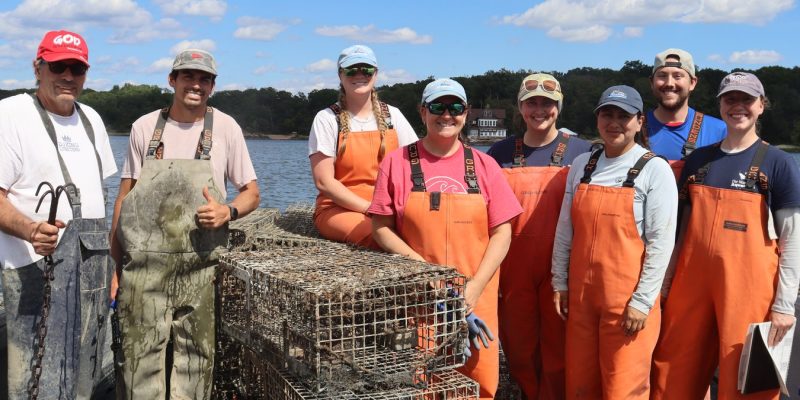
A coalition that includes The Maritime Aquarium at Norwalk has pulled more than 4,000 lost and abandoned lobster traps out of Long Island Sound. That is more than 200,000 pounds of marine debris, recovered across 218 trips since 2022.
The traps are the point. A lobster trap that comes loose from its line does not stop working. It sits on the bottom and keeps catching, which is why the practice has a name.
What ghost fishing means
Ghost fishing is fishing gear that has been lost or abandoned and continues to catch animals with nobody to empty it. A trap keeps its shape and its entrance funnels for years. Animals go in for bait, cannot get out, die, and can become bait for the next ones. The aquarium notes that lost gear damages marine habitat as well as catching animals.
The coalition has been counting what it finds: more than 46,000 animals representing 86 species inside the recovered traps. That figure is the reason the recovery work doubles as research rather than just cleanup.
Who is doing it
The Lobster Trap Recovery and Assessment Partnership, which everyone involved calls L-TRAP, brings together the Cornell Cooperative Extension of Suffolk County, Save the Sound, Project Oceanology, Remote Ecologist, commercial lobstermen from Connecticut and New York, and the aquarium’s research scientists.
The commercial captains are not a courtesy inclusion. Locating a trap on a seafloor is the hard part, and for most of the program’s life the method has been the memory of the people who fish the Sound for a living.
“Recovering more than 4,000 traps demonstrates what is possible when conservation organizations, scientists, and the fishing community work toward a shared goal. We can accomplish far more together than we can alone, and all share in the benefits,” says Justin Susarchick, senior research scientist at The Maritime Aquarium. “Every trap removed from the Sound helps to reduce marine debris, protect wildlife, and improve our understanding of the environmental impacts of abandoned fishing gear.”
The legal groundwork came in 2019, when Connecticut passed legislation authorizing the recovery of lost and abandoned lobster traps. Gear on the bottom still belongs to somebody, and without that authorization a recovery trip is a legal problem rather than a conservation one.
The new tool is a fish finder
On September 4, staff from the aquarium and Project Oceanology joined Captain Donald J. King on the water for a combined removal and data-collection trip. It was also the debut of side-scan sonar on the program: a Humminbird XPLORE 12 unit that builds a detailed image of the seafloor from sound bounced sideways off it.
Local knowledge is highly effective where a captain knows the ground and useless where nobody does, and the unfamiliar parts of the Sound are where the untouched gear is. Sonar is how the program gets past the edge of anyone’s memory. The equipment is being tested under a 2023 grant from the National Fish and Wildlife Foundation’s Long Island Sound Futures Fund, a program the foundation runs with the Environmental Protection Agency and the Long Island Sound Partnership, and which has put $80 million into 688 projects since 2005.
“Recovering our 1,000 traps was an important milestone for the L-TRAP team, and to now celebrate 4,000 traps recovered is an incredible accomplishment that shows what can happen when organizations come together around a shared goal,” says Callie Scheetz, director of curriculum and instruction at Project Oceanology.
What happens next?
More trips, and considerably more of them. The coalition has 120 recovery trips planned for 2026 and 235 for 2027, against 218 completed in total over the program’s first four years. If those numbers hold, L-TRAP will do more in 2027 than it did in its entire history to date.
The aquarium’s own connection to the Sound is not incidental. Its exhibits are built around the water outside its doors, and it has spent recent years putting the Sound’s species and its problems in front of visitors, from an Atlantic puffin exhibit to a research program that spends its days hauling other people’s lost gear off the bottom.
Sources: The Maritime Aquarium at Norwalk, “Coalition Removes More Than 4,000 Abandoned Lobster Traps from Long Island Sound,” September 9, 2026; National Fish and Wildlife Foundation, Long Island Sound Futures Fund.
Quick answers
- What is ghost fishing?
Fishing gear that has been lost or abandoned and keeps catching animals with nobody to empty it. A lobster trap holds its shape for years, so animals enter for bait, cannot get out, and can become bait for the next ones.
- How many traps has L-TRAP recovered?
More than 4,000 since 2022, across 218 trips, amounting to more than 200,000 pounds of marine debris removed from Long Island Sound.
- Who is in the coalition?
The Lobster Trap Recovery and Assessment Partnership includes The Maritime Aquarium at Norwalk, the Cornell Cooperative Extension of Suffolk County, Save the Sound, Project Oceanology, Remote Ecologist, and commercial lobstermen from Connecticut and New York.
- What is the sonar for?
Recovery crews have mostly relied on commercial captains' knowledge of where traps were lost, which works less well in unfamiliar water. A side-scan sonar unit, tested for the first time on September 4, 2026, images the seafloor and may help find gear nobody remembers losing.