
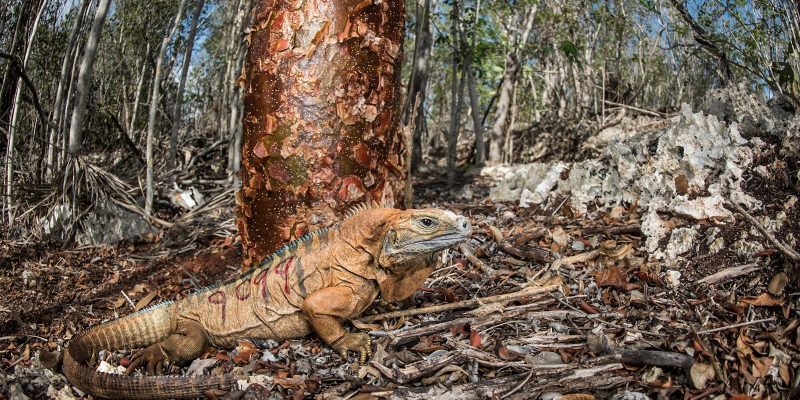
Nine hundred and forty-four Jamaican rock iguanas have been released into the Hellshire Hills since the recovery program began. The Fort Worth Zoo and its partners are now counting toward the thousandth, which the zoo expects to go back to the wild before the end of the year.
That is a strange number to be able to write about a species that spent most of the twentieth century presumed gone. The Jamaican rock iguana was long thought extinct until 1990, when a small surviving population turned up in the dry limestone forest of the Hellshire Hills, on the island’s south coast. Everything since has been built on that one remnant.
What headstarting actually means
The word turns up in almost every iguana recovery program, and it describes a specific piece of engineering rather than a general good intention. A headstarted animal is one raised in protected conditions past the stage of life when it is most likely to be eaten, and released only then. For an iguana the dangerous years are the first few, when a hatchling is small enough for an introduced predator to take.
So hatchlings are raised at the headstart facility at Hope Zoo Kingston. They grow there until their size is its own defense, and then they go back into the Hellshire Hills, inside their native range. The releases are the visible end of a program that also runs habitat protection, population monitoring and predator management, none of which produce a photograph.
Fort Worth has been in this since 1993
The zoo joined three years after the rediscovery and has stayed in it for thirty-three years. It is a founding member of the International Iguana Foundation, which supports iguana conservation projects worldwide, and one of its conservation biologists, Dr. Stesha Pasachnik, represents both the zoo and the foundation in work with partners in Jamaica.
Thirty-three years is the part worth pausing on. An iguana released this season came out of a population rebuilt by people who started before most of today’s visitors were born, and the payoff arrives one animal at a time. There is no version of this work that fits inside a grant cycle.
The zoo has counted to a thousand before
Fort Worth has a habit of these long arithmetic projects. In 2021 it marked the thousandth Texas horned lizard hatched in its program for the Texas state reptile, and it has repatriated Roti Island snake-necked turtles to Indonesia. The same reptile department produced eight gharial hatchlings this year, a fourth consecutive season.
What links them is not the species. It is a willingness to keep a ledger open for decades, and to treat the thousandth animal as a milestone inside a program rather than the end of one.
What happens at a thousand
Mechanically, nothing. The counter rolls over and the crews go back out. The zoo’s own framing is that each iguana is a reminder of what long-term collaborative conservation can accomplish, which reads like boilerplate until you set it against the alternative, where the species stayed extinct because nobody went back to look in 1990.
For a visitor in Fort Worth, the connection to all of this is the Museum of Living Art, the zoo’s herpetarium, where the reptile department doing the field work is also the reptile department on display. The iguanas going back into the Hellshire Hills are not there. The expertise that raises them is.
Source: Fort Worth Zoo, Join us on the Countdown to 1,000 Jamaican Rock Iguanas, published July 2, 2026.
Quick answers
- How many Jamaican rock iguanas have been released?
944 as of the Fort Worth Zoo's July 2026 announcement. The 1,000th is expected to be released into the Hellshire Hills before the end of the year.
- Was the Jamaican rock iguana really extinct?
It was long thought to be. A small surviving population was rediscovered in the Hellshire Hills in 1990, and the entire recovery program is built on that remnant.
- What is headstarting?
Raising young animals in protected conditions past the age at which they are most likely to be eaten, then releasing them. Jamaican iguana hatchlings are raised at the headstart facility at Hope Zoo Kingston before going back to the Hellshire Hills.
- How long has the Fort Worth Zoo been involved?
Since 1993, three years after the species was rediscovered. The zoo is a founding member of the International Iguana Foundation, and its conservation biologist Dr. Stesha Pasachnik works with partners in Jamaica.