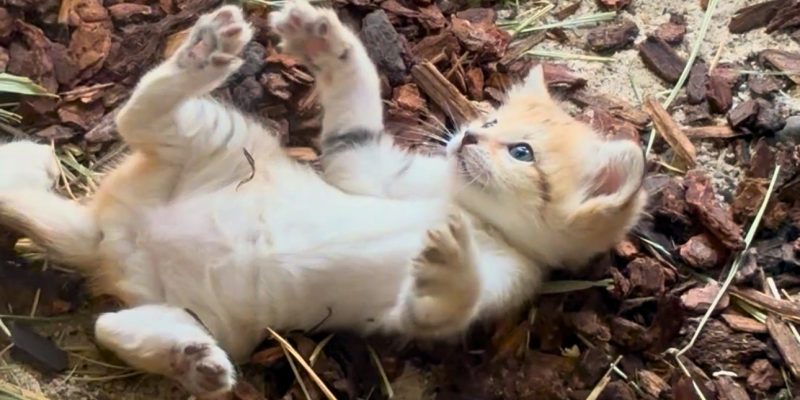
Utah’s Hogle Zoo has a sand cat kitten, born Tuesday, June 2, 2026 to first-time parents Cleo and Asim, and the zoo is asking visitors to do something unusual when they come to see it: lower their voices.
That is not a mood-setting request. It is about the animal’s ears.
Why whisper near a sand cat?
Sand cats (Felis margarita) have disproportionately large ear canals, and their hearing is roughly five times more acute than a domestic cat’s. In the desert, that is how a cat the size of a house pet finds dinner: it detects prey moving underneath the sand, then digs it out. The ears are a hunting instrument before they are anything else.
The same equipment that locates a gerbil through six inches of sand does not switch off in a building full of people, and a newborn’s hearing is more sensitive still. So the Small Animal Building, where Cleo and the kitten can be seen, now carries a whisper warning. It is the rare zoo sign that asks visitors to change their behavior for a reason the sign can actually explain.
How is the kitten doing?
At the announcement a month after the birth, well. The kitten remained unnamed while the care team waited to determine its sex, which in very young cats is not immediately obvious and is not worth stressing an animal to establish early.
“Cleo is a fairly laid-back sand cat who loves to play and enjoys a good nap spot. She’s curious and seems content to go with the flow. Her laid-back approach has served her well as a first-time mom, helping her navigate the unknowns of parenthood. She is a very attentive mother and can frequently be seen grooming her kitten and closely supervising playtime.”
That is Brittany Wildman, animal care supervisor for the Small Animal Building. Cleo arrived at Hogle Zoo in May 2025 on a breeding recommendation from the Association of Zoos and Aquariums’ Sand Cat Species Survival Plan, the cooperative program that tracks parentage across accredited institutions and decides which animals should pair, so that the population in human care keeps its genetic range.
What does the Red List actually say about sand cats?
This is a case where it pays to read which assessment you are looking at, because there are two and they disagree.
Globally, the IUCN Red List lists the sand cat as Least Concern, assessed in April 2014 and published in 2016, with a population trend recorded as unknown and no global figure given. A separate Mediterranean regional assessment, dating to 2008 and flagged by the Red List itself as needing updating, lists the species as Near Threatened within that region.
Neither of those is alarming on its face, and the zoo makes no claim otherwise. What the pair of them shows is a species nobody has counted. The sand cat’s range runs across the Sahara, the Arabian Peninsula and parts of Central Asia, through Algeria, Niger, Morocco, Kazakhstan, Iran and a dozen countries besides, and it is a small, nocturnal, pale animal that lives where very few researchers go. An unknown trend is an honest answer, and it is also an argument for keeping a well-managed population in accredited zoos while the question stays open.
Built for the extremes
Sand cats live where daytime surface temperatures reach 124 degrees Fahrenheit, about 51 Celsius, and fall to near freezing after dark. They avoid both ends by being underground and under cover during the worst of it, and dense fur on the soles of their feet insulates them from the hot sand while spreading their weight across it.
The kitten is on view with Cleo in the Small Animal Building. It is a building that has been busy lately, and it rewards the slow walk through. Hogle Zoo announced the birth on July 2, 2026.
Quick answers
- When was the Hogle Zoo sand cat kitten born?
Tuesday, June 2, 2026, to first-time parents Cleo and Asim.
- Why does the zoo ask visitors to whisper?
Sand cats have disproportionately large ear canals and hearing roughly five times more acute than a domestic cat. A newborn is more sensitive still, so the Small Animal Building carries a whisper warning.
- Does the kitten have a name?
Not at the July 2, 2026 announcement. The care team was waiting to determine whether the kitten is male or female before naming it.
- Where can you see the kitten?
In the Small Animal Building at Utah Hogle Zoo, with its mother Cleo.
- Are sand cats endangered?
The IUCN Red List lists the sand cat as Least Concern globally, assessed in April 2014 and published in 2016, with a population trend recorded as unknown and no global figure given. A separate Mediterranean regional assessment from 2008, which the Red List flags as needing updating, lists the species as Near Threatened within that region.
- Where do sand cats live?
Across the Sahara, the Arabian Peninsula and parts of Central Asia, including Algeria, Niger, Morocco, Kazakhstan and Iran.
- How do sand cats hunt?
By ear. They detect prey moving underneath the sand and dig it out.