
The largest assessment of coral reefs ever assembled landed on August 31, 2026, and its central finding is not the one people expect. The problem is no longer only how much coral dies in a bleaching event. It is that reefs are no longer being left alone long enough to grow back in between.
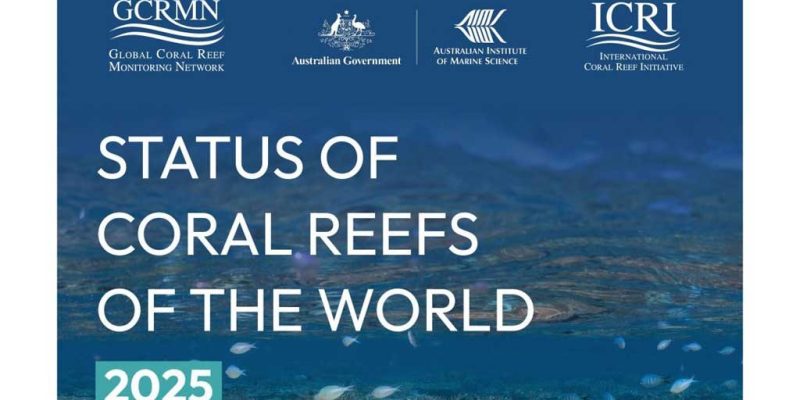
The report is Status of Coral Reefs of the World: 2025, published by the Global Coral Reef Monitoring Network with the Australian Institute of Marine Science and the International Coral Reef Initiative. On September 7, Nature Seychelles became one of the first organizations in the Western Indian Ocean to spell out what it means for the reefs it has spent fifteen years rebuilding.
What the report measured
The numbers behind it are the reason it carries weight. It draws on more than 40 years of data: 21.1 million observations from 87,299 surveys, representing 36,886 reef sites across 124 countries, territories and economies. Nothing on that scale has been attempted before.
From 1980 to 2024, average global hard coral cover fell from 30.2 percent, measured across 1980 to 2009, to 27.3 percent across 2020 to 2024. That is a relative decline of about 9.5 percent, and the report names climate-driven heat stress as the primary cause.
Hard coral cover is exactly what it sounds like: the share of the seabed occupied by living stony corals, the animals that build the reef structure everything else lives in. It is the closest thing reef science has to a single vital sign.
Four bleaching events, and a staircase
Since 1998, every global bleaching event has taken a bite out of global hard coral cover, and the report puts a figure on each one. The first, in 1998 and 1999, cost about 6.5 percent. The second, in 2010 and 2011, about 9.9 percent. The third, in 2016 and 2017, about 6.6 percent. The fourth, in 2023 and 2024, about 8.9 percent.
What changed is the spacing. Disturbances that used to arrive roughly every ten years now arrive every five to six.
“Coral reefs once had decades to recover after major bleaching events. Today, they’re lucky to get five or six years,” said Dr Manuel González Rivero, the report’s lead author. “And for many reefs affected by the unprecedented marine heatwaves in 2024, this year’s El Niño likely means they’ll have had little more than a year to begin recovering before being hit again. This is creating a staircase of decline that becomes harder to reverse with every bleaching event.”
González Rivero’s other point is the one that shapes what anybody can do about it. “Climate change is driving more frequent and severe marine heatwaves, but local pressures such as poor water quality, overfishing and coastal development are making reefs even less able to withstand them,” he said. “So we have to do two things at once: reduce emissions at the global level and implement science-based conservation measures at the local level.”
The finding that is actually good news
Buried in a report full of decline is a genuinely encouraging result. Between 2017 and 2019, in the window after the third global bleaching event, global hard coral cover rose by about 6 percent. Reefs have not lost the ability to come back. They have lost the time.
That distinction matters for anyone deciding where to spend money. If reefs were simply dying and staying dead, restoration would be palliative care. Because they demonstrably recover when given a gap, the argument for buying them a gap, through marine protection, water quality, fishing controls and active restoration, is an argument about outcomes rather than sentiment.
What it looks like from Seychelles
Dr Nirmal Shah, Nature Seychelles’ Chief Executive, put the mechanism in plain terms. “Coral bleaching is a stress response,” he said. “When ocean temperatures rise too high, corals expel the tiny algae that live in their tissues that supply corals with their energy and give them their colours. Without these algae, corals lose this colour and look ‘bleached’.”
Bleached is not dead. Corals that keep their tissue can take the algae back if conditions ease, which is precisely why the interval between events is the variable that decides everything. “The surviving corals need time to bounce back,” Shah said. “So, when the next major bleaching event hits before this recovery, the reef is left in a weaker state to face the challenge.”
Nature Seychelles has been working that problem since 2010, when its Reef Rescuers project began growing and outplanting coral fragments onto damaged reefs around Cousin Island Special Reserve. It has since added ARC, a land-based coral aquaculture facility that uses micro-fragmentation to speed growth in controlled conditions, and a coral spawning lab run with Canon and Coral Spawning International. We wrote about the spawning work at ARC earlier this month.
Is there zoo or aquarium money behind this?
We trace the accredited zoos and aquariums funding every conservation story in this region, and on this one the honest answer is that we did not find any. The report is the work of a monitoring network convened under the International Coral Reef Initiative, with the Australian Institute of Marine Science and the Australian Government on its cover. Nature Seychelles names Canon and Coral Spawning International on the spawning lab and no zoological institution anywhere on this work. We are not going to imply one.
That is worth stating carefully, because the overlap in expertise is real and easy to mistake for funding. Land-based coral aquaculture, micro-fragmentation and induced spawning are aquarium husbandry techniques, developed and refined in accredited facilities, and North American aquariums run coral programs built on exactly the same methods. We have covered several, including elkhorn coral spawning at the Florida Aquarium. Those institutions are not funding the work in Seychelles, and saying so is the whole point of checking.
For scale on the other side of the ledger: the Association of Zoos and Aquariums reports that in 2025 its 235 accredited and certified facilities spent approximately $372.4 million on conservation across 139 countries. No published breakdown isolates the African share, so no African figure appears here.
What happens next
The report models the century under different recovery intervals. At the current frequency of a global bleaching event every five to six years, reefs stay on a declining path. Ambitious emissions cuts combined with effective local management of overfishing, coastal development and water quality is the pathway that holds hard coral cover.
The stakes are unusually easy to state. Coral reefs cover less than 0.2 percent of the ocean floor and support at least 25 percent of all marine species. Around 104 million people now live within five kilometers of one, a 46 percent increase over two decades.
“We know what works,” said Ambassador Ilana Seid, Palau’s Permanent Representative to the United Nations, where the report was released. “Local conservation efforts, effective marine management, and the integration of Traditional Knowledge with scientific innovation have already shown positive results in many parts of the world and offer powerful solutions. The challenge before us is no longer identifying what needs to be done, but finding the collective will to do it.”
September is Coral Bleaching Awareness Month, moved this year from November. If you visit an aquarium with a coral propagation lab this month, the trays of fragments under the lights are the same technique Nature Seychelles is using on Cousin Island, doing the same job: growing coral faster than the ocean is currently allowing it to grow.
Sources: the Global Coral Reef Monitoring Network, Marine heatwaves are closing the window for coral reef recovery, landmark global report warns, published August 31, 2026, and Nature Seychelles, Warming oceans are closing the window on coral reef recovery, global report warns, published September 7, 2026.
Quick answers
- What does Status of Coral Reefs of the World: 2025 say?
That global hard coral cover fell from an average 30.2 percent across 1980 to 2009 to 27.3 percent across 2020 to 2024, a relative decline of about 9.5 percent, and that reefs no longer get enough time between marine heatwaves to recover.
- How big is the study behind the report?
It draws on more than 40 years of data: 21.1 million observations from 87,299 surveys across 36,886 reef sites in 124 countries, territories and economies. It was published on August 31, 2026 by the Global Coral Reef Monitoring Network.
- Can coral reefs still recover from bleaching?
Yes. Global hard coral cover rose about 6 percent between 2017 and 2019, after the third global bleaching event. The report's concern is the interval: disturbances that used to arrive every ten years now arrive every five to six.
- Do zoos or aquariums fund this coral work in Seychelles?
We looked and did not find any. Nature Seychelles names Canon and Coral Spawning International on its spawning lab and no zoological institution. North American aquariums run coral programs using the same techniques, but they are not funding this work.