
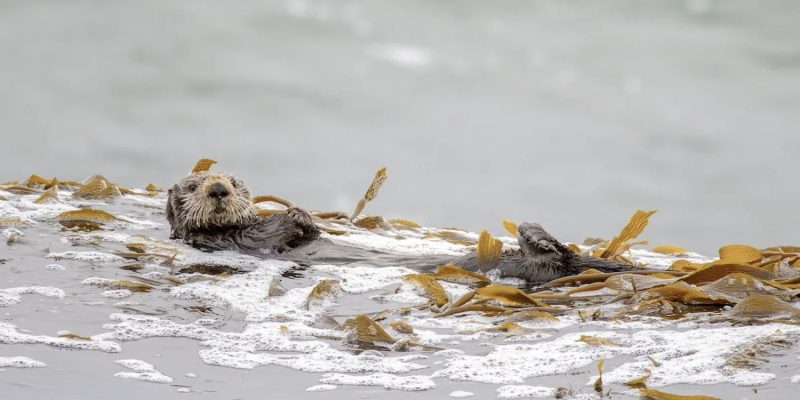
Sea otters vanished from Oregon more than a century ago, hunted out for their fur. Four organizations have now started the unglamorous work that would have to come before anyone puts them back.
The Seattle Aquarium, the Oregon Coast Aquarium, the Elakha Alliance and the Wildlife Conservation Network’s Sea Otter Fund announced a joint research partnership on September 17, timed to Sea Otter Awareness Week. The work runs through the end of 2028.
The design is a comparison. Teams will survey the Oregon coastline, where sea otters are absent, against the Washington coastline, where otters were reintroduced in the 1970s and have been slowly rebuilding since. The point is to measure what an otterless coast actually looks like before any otter arrives, so that a later change can be attributed to something.
Sea otters provide powerful benefits to their environment. When otters are present, kelp forests and eelgrass meadows thrive. There is more food for other animals in the system, and the system itself is more resilient to climate change. That is what we would hope and expect to see if they are reintroduced in Oregon.
Dr. Shawn Larson, Senior Conservation Research Manager, Seattle Aquarium
Why bother measuring a coast with no otters on it?
Because without it, a reintroduction can succeed and nobody can prove it.
Sea otters eat urchins. Urchins eat kelp. Remove the otter and urchin populations expand until the kelp forest is grazed down to bare rock, which is a documented pattern along the Pacific coast rather than a theory. Put the otter back and the sequence is supposed to run in reverse.
But “supposed to” is doing a lot of work in that sentence, and a kelp forest also responds to marine heatwaves, disease and fishing pressure. If you have no measurements from before, every later argument about whether the otters did anything is a matter of opinion.
Right now, we need an underwater baseline to track the impacts of sea otters as they come home. After reintroduction, we expect to see sea otters rebuild the ecological resilience of our coasts. But we won’t see the change unless we start the science now.
Dr. Jen Miller, Director, Sea Otter Fund
How they are actually doing it
Scuba divers and remotely operated vehicles, in both states. Teams will count sea otter prey, including urchins, crabs and abalone, and capture thousands of images of rocky reef and soft-sediment habitat.
The Oregon Coast Aquarium is supplying a scientific dive team that has years of experience in Oregon water, which is a genuinely hard place to dive.
We see this as much more than a three-year project. Our hope is to continue this work into the next decade and beyond, so that if sea otters are reintroduced to Oregon, we can document and better understand changes before, during, and long after their return.
Jim Burke, Director of Animal Care, Oregon Coast Aquarium
That is the honest framing. Three years buys a baseline. It does not buy an answer.
What this is not
It is not a reintroduction, and nobody involved says it is. No otters are being moved, no permits are being sought, and no agency has decided Oregon will get sea otters back. This is the evidence-gathering that would have to exist first, and the Elakha Alliance is explicit that the goal is a foundation for a decision rather than the decision itself.
By comparing the conditions of these coastal habitats, we can better understand the ecological changes associated with the presence and absence of sea otters and build a stronger scientific foundation for restoration in Oregon.
Jane Bacchieri, Executive Director, Elakha Alliance
The Seattle Aquarium has worked on sea otters for more than thirty years. The Oregon Coast Aquarium has been running its own tagging work on sevengill sharks in the same water. And the species keeps turning up in aquarium care on this coast, from two rescued otters at Monterey Bay to a flipper amputation that had not been tried before.
The southern sea otter is listed as threatened under the Endangered Species Act; US Fish and Wildlife Service has the status detail.