
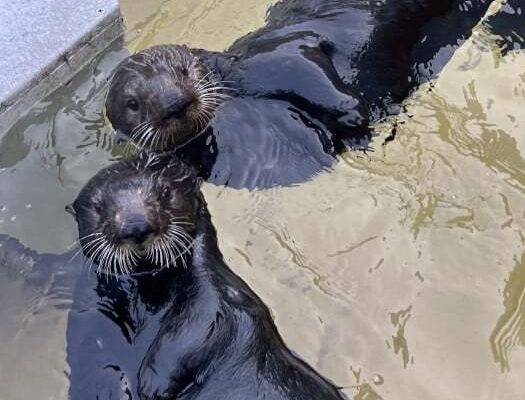
Monterey Bay Aquarium has two new southern sea otters on exhibit, and the route they took to get there says a great deal about how the aquarium world moves animals. Suri and Willow made their public debut on April 14, 2026, and now share the Sea Otter Exhibit with raftmates Ivy, Opal and Selka.
Rescued as pups, four years ago
Suri was found as a four-week-old dependent pup at Asilomar State Beach in Pacific Grove in January 2022. Willow turned up on Carmel State Beach as a six-week-old that March. Both were taken into Monterey Bay Aquarium’s rehabilitation program.
The U.S. Fish and Wildlife Service determined that neither could be returned to the wild. That decision starts a long search rather than ending one: an unreleasable sea otter needs a permanent home at a facility equipped for it, and those placements are not quick.
A four-year curriculum
What happened next is the part worth following, because none of it was idle holding.
The pair went first to the Aquarium of the Pacific in Long Beach for care. In October 2022 they moved to the AZA-accredited Shedd Aquarium in Chicago to serve as ambassadors for southern sea otters and to learn cooperative care behaviors: voluntarily walking onto a scale, going into a kennel on cue. Those are the behaviors that let staff run a health exam without stressing the animal, and an otter that has them is a healthier otter for life.
In April 2025 they transferred back to the Aquarium of the Pacific, this time to sharpen a different set of skills: foraging, tool use, social behavior and maternal behavior.
That last item explains the whole itinerary. Suri and Willow have returned to Monterey Bay as candidates for the aquarium’s Sea Otter Surrogacy Program, in which resident females raise stranded wild pups and prepare them for release. Four years of deliberate preparation across three institutions were aimed at that job.
Sea otter surrogacy is one of the more remarkable techniques in the field, and rehabilitation-to-placement pipelines like it are how orphaned wild animals end up in permanent care rather than nowhere.
Their names, and their personalities
Suri is named for Big Sur. Willow is named for the Willow Creek Picnic Area and Beach in Monterey, near where she was found. Aquarium staff describe Suri as bold, independent and explorative, and Willow as social, industrious and resourceful.
Seeing them
Both otters are in the Sea Otter Exhibit, though staff expect them to move in and out of the exhibit area while they settle, so they may not always be visible. Anyone who cannot get to Monterey can watch the aquarium’s Sea Otter Cam, which pauses intermittently while staff check in on the pair.
Worth knowing what you are looking at: a southern sea otter using a rock to crack shellfish is one of the few examples of tool use you can watch in a public exhibit, and Willow spent a year specifically getting better at it.
Quick answers
- Where did Suri and Willow come from?
Both were rescued as dependent pups on the Monterey Peninsula. Suri was found at Asilomar State Beach in Pacific Grove in January 2022 at four weeks old, and Willow turned up at Carmel State Beach that March at six weeks old.
- Why were they not returned to the wild?
The U.S. Fish and Wildlife Service determined that neither otter could be released. An unreleasable sea otter then needs a permanent home at a facility equipped for it, and those placements are not quick.
- When did they go on exhibit at Monterey Bay Aquarium?
They made their public debut on April 14, 2026. They share the Sea Otter Exhibit with raftmates Ivy, Opal and Selka.
- What is cooperative care?
It is training that lets an animal take part in its own health care voluntarily, such as walking onto a scale or entering a kennel on cue. Suri and Willow learned those behaviors at Shedd Aquarium, and they let staff run a health exam without stressing the animal.