
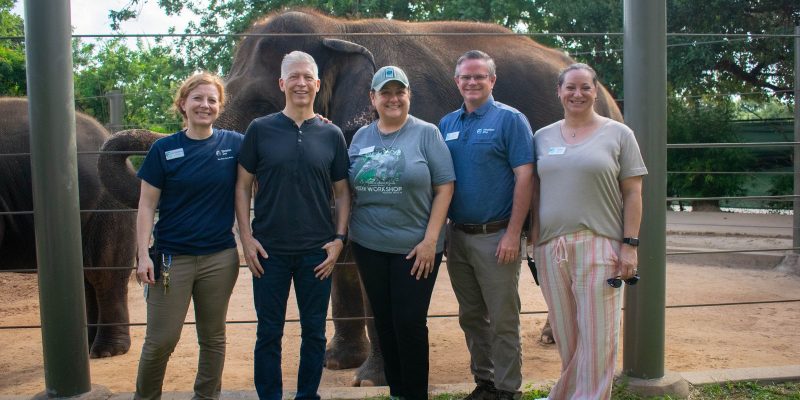
On World Elephant Day 2026, the Houston Zoo set out what it intends to do next about the virus that kills more young elephants in human care than anything else. The plan runs on three fronts at once: get the existing vaccine to every elephant that needs it, build versions that cover the other strains, and develop one that works for African elephants.
The virus is elephant endotheliotropic herpesvirus, EEHV. It is not an exotic problem at the edge of elephant medicine. It is the leading cause of death in young Asian elephants both in zoos and in the wild, and it kills fast, often within days of the first symptom.
Why an elephant virus is being fought from Houston
The work began with a loss. In 2008 a two-year-old Asian elephant calf named Mac died at the Houston Zoo of EEHV. Dr. Paul Ling, a virologist at Baylor College of Medicine, read about it, recognized a problem his laboratory could work on, and approached the zoo. The partnership that came out of that conversation has run for more than sixteen years and has produced diagnostics, prevention protocols and a treatment protocol developed at the zoo itself.
The milestone came in 2024, when Tess, a 40-year-old female Asian elephant at the Houston Zoo, received the first dose of an experimental EEHV mRNA vaccine developed with Baylor. Evidence that it works followed months later and from somewhere else entirely: two vaccinated juvenile elephants at the Cincinnati Zoo were naturally exposed to EEHV and recovered without clinical disease.
That is the shape of a real result, and it is worth being precise about why. A vaccine trial in elephants cannot be run the way a vaccine trial is normally run. There is no ethical way to expose a calf deliberately, and there are not enough calves to power a conventional study. So the evidence arrives the way it arrived here: an animal is vaccinated at one institution, meets the virus on its own at another, and does not die. The Oregon Zoo vaccinated its own herd in 2026, the first on the West Coast to do so, which is the distribution half of the same project.
What the next four years are meant to add
Three things, according to the zoo. The current vaccine targets the strain deadliest to Asian elephants, and there are several strains, so the first task is more variants of the vaccine alongside wider distribution of the one that exists.
The second is a surveillance system, which the zoo describes as a real-time EEHV radar for tracking strains globally using non-invasive samples such as saliva or feces. The reason that matters is geographic rather than technical. In elephant range countries, drawing blood from a wild or semi-wild elephant is often not possible, so a test that works on a sample picked up off the ground is the difference between monitoring the virus where elephants actually live and monitoring it only in zoos.
The third is African elephants. Houston keeps Asian elephants, and the current vaccine was built for them, but the mRNA platform can be retargeted. The zoo and Ling’s laboratory have begun a four-year plan to expand Baylor’s capacity to generate prototype vaccines and run clinical trials, aimed at the strains deadliest to African elephant calves.
Where the money comes from
The Houston Zoo describes itself as the principal convener rather than the owner of this work, with Baylor, colleagues across the Association of Zoos and Aquariums, and institutional partners around the world. The funding line is stated plainly: over sixteen years, donors have contributed more than $7.4 million to the zoo’s elephant work.
That figure is the argument this beat keeps running into. A vaccine for a herpesvirus that affects a few thousand animals has no commercial market and no pharmaceutical sponsor. It exists because a zoo lost a calf, kept a virologist’s phone number, and spent gate and donor revenue on it for sixteen years.
How threatened are the elephants this is for?
The IUCN Red List, version 2026-1, assesses the Asian elephant, Elephas maximus, as Endangered. African elephants are assessed as two separate species: the African savanna elephant, Loxodonta africana, is Endangered, and the African forest elephant, Loxodonta cyclotis, is Critically Endangered. The zoo’s announcement refers to African elephants as a single group, which is the ordinary usage and not a claim about taxonomy, but the split is worth knowing, because a vaccine aimed at African elephant calves is aimed at two species in different trouble.
Every calf that survives EEHV is one animal. The reason to care about the radar system and the African variants is that the same work, done once, applies to every calf born after it.
Source: Houston Zoo, Working Together to Save Elephants, by Alex Pugh, August 12, 2026. Red List categories from the IUCN Red List of Threatened Species, version 2026-1.
Quick answers
- What is EEHV?
Elephant endotheliotropic herpesvirus. It is the leading cause of death in young Asian elephants both in human care and in the wild, and it can kill within days of the first symptom.
- Is there a vaccine for EEHV?
There is an experimental mRNA vaccine developed by the Houston Zoo with Baylor College of Medicine. Tess, a 40-year-old Asian elephant in Houston, received the first dose in 2024. Two vaccinated juveniles at the Cincinnati Zoo were later exposed naturally and recovered without clinical disease.
- What is the Houston Zoo planning next?
Wider distribution of the current vaccine, new variants covering additional strains, a global tracking system using non-invasive samples such as saliva or feces, and a four-year plan with Baylor to develop a vaccine for African elephants.
- Who pays for this work?
Philanthropic donors in Houston and peer institutions. Over sixteen years they have contributed more than $7.4 million to the Houston Zoo's elephant work. The virus affects too few animals to attract commercial pharmaceutical funding.