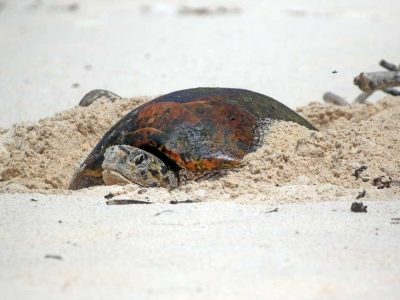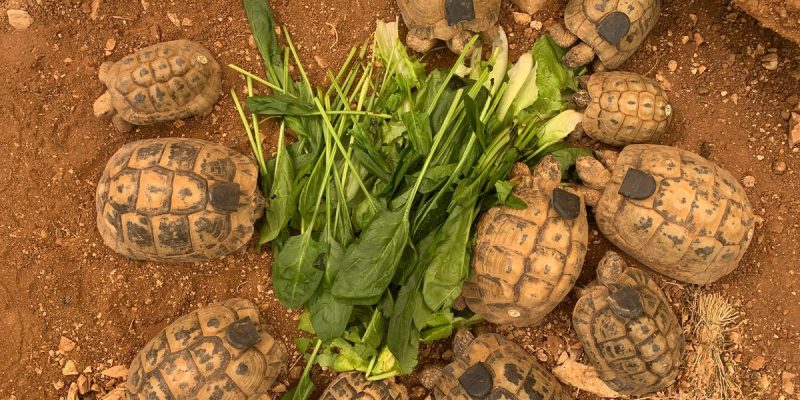
Thirty-six tortoises that had spent years living inside people’s houses in Israel were put back outside last week, and a number of them went out carrying a tracker and a QR code glued to the shell.
The Israel Nature and Parks Authority released the animals on Wednesday, November 11, after months in a temporary acclimatization enclosure at the Ein Prat Nature Reserve. The authority published its account of the operation the following day. All thirty-six are Mediterranean spur-thighed tortoises, Testudo graeca, the common land tortoise of the eastern Mediterranean and a protected species in Israel.
It began with a firefighter who meant well
This was not a raid. It started with a conversation. An authority ranger, Roi Gilad, met a former firefighter who told him that during his working life he had been pulling tortoises out of burn areas and taking them home to care for them. Some had burns. Some had damaged limbs. He had put real effort into healing them, and over the years the tortoises in his house multiplied.
Gilad explained that holding a spur-thighed tortoise without a permit is against the law in Israel, and that good intentions do not stop captivity from harming the animal. The firefighter agreed to hand the tortoises over. The next day a resident of the Gush Adumim area did the same. She had also kept tortoises for years, and the authority says several of hers arrived in poor health, some with deformed shells of the kind that follow a long stretch of the wrong food and the wrong conditions.
Why it then took months
The animals went to a temporary enclosure at Ein Prat, where staff from the reserve, authority rangers and veterinary staff ran them through rehabilitation, weighing, veterinary testing and medical monitoring. The holdup was not paperwork. It was disease.
“אחד האתגרים המרכזיים בהשבת צבים שהוחזקו בשבי הוא החשש להעברת מחלות לאוכלוסיות הבר. צבים עלולים לשאת מחוללי מחלות גם ללא סימנים חיצוניים, ושחרור בלתי מבוקר עלול לגרום להדבקה ולפגיעה בצבים אחרים.”
“One of the central challenges in returning tortoises that were held in captivity is the fear of transferring diseases to the wild populations. Tortoises are liable to carry disease agents even with no external signs, and an uncontrolled release is liable to cause infection and harm to other tortoises.”
That is Dr. Tomer Nissimian, a veterinarian with the authority, in the authority’s own Hebrew release. The translation is ours. Every tortoise was tested to rule out infectious disease, he says, and the professional approval to release came only after the animals were found fit.
Released outside the reserves, deliberately
The obvious place to put a rehabilitated wild animal is a nature reserve. The authority did the opposite. Following guidance from its science division, the tortoises were released into open ground with a community character, in the area they had been given up from, and specifically not inside nature reserves. The reasoning runs both ways: it keeps any residual risk away from established wild populations, and it puts the animals somewhere they can actually be checked on.
A tracker and a QR code on the shell
Which is where the hardware comes in. Shaked Bahbout, a ranger and the ecological coordinator at the Nahal Prat Nature Reserve, described what was attached and why.
“חשוב להבין שלא ניתן פשוט לקחת צב שהוחזק בבית ולשחרר אותו לטבע. העברה או שחרור ללא בדיקה מקצועית עלולים לפגוע בו ובצבים אחרים.”
“It is important to understand that you cannot simply take a tortoise that was kept in a house and release it into nature. A transfer or a release without professional examination is liable to harm it and to harm other tortoises.”
Again, the Hebrew is the authority’s and the English is ours. Some of the animals were fitted with AirTag units, which report a position whenever they pass near a supporting device, and the tortoises also carry QR codes. Anyone who comes across a marked tortoise can scan the code, read about the project and file the sighting. Bahbout’s point is that this is what turns a release into something the authority can measure: it lets them follow how the animals settle and judge whether the whole exercise worked.
It is a cheap piece of design. A consumer tracker and a printed sticker turn every hiker in the Judean hills into a volunteer monitor, on an animal that moves slowly enough to be photographed and lives long enough to be worth following. The authority’s announcement places the releases in Judea and Samaria, the term the Israeli government uses for the West Bank.
What the assessments actually say
The authority’s release calls the spur-thighed tortoise a protected animal whose populations in Israel are at risk, and names habitat damage, roadkill and illegal collection from the wild as the pressures. It claims no conservation category, which is just as well, because the two that exist do not agree and the gap between them is instructive.
Globally the species sits on the IUCN Red List as Vulnerable, and that assessment carries a date of 1996. It is thirty years old. Israel’s own national assessment is both newer and more severe: the Israeli Biodiversity Risk Assessments Project lists the Mediterranean spur-thighed tortoise as Endangered under criteria A2acde+3cde+4acde, updated in August 2025, having moved up from Vulnerable. We default to the assessment over a facility’s wording as a rule, and here the national one is the document with the recent fieldwork behind it.
Two numbers from that assessment explain why thirty-six animals are worth months of staff time. The project puts the species’ generation span at 38.3 years and sexual maturity at roughly twelve and a half years. And it records that only 9.8 percent of the tortoise’s Israeli range falls inside a protected area, which is the quiet context for a release that deliberately went outside the reserves. For this animal, most of the habitat that matters was never going to be inside a fence.
Who funds this
We look for the accredited zoos and aquariums behind field conservation wherever we cover it, because that money is often the reason a program exists at all. There is none to report here. The authority’s account names its own people and nobody else: a ranger, a reserve team, a district veterinarian and a science division. No zoological institution appears anywhere in it, and we are not going to imply one. This was a government wildlife agency doing the work with its own staff, which is a perfectly good answer and worth saying out loud rather than leaving blank.
It is also not the first time this authority has turned confiscation into a release. We covered it in October when eight sea turtles went back into the Mediterranean after treatment. The species and the circumstances are different. The pattern is the same one: an animal taken out of the wild, months of unglamorous veterinary work, and a return that only counts if somebody keeps watching afterward.
Quick answers
- What happened to the 36 tortoises?
They had been kept for years in private homes in Israel, which is illegal without a permit. Two keepers handed them over voluntarily after a conversation with a parks authority ranger. The animals spent months in an acclimatization enclosure at Ein Prat Nature Reserve and were released on November 11, 2026.
- Why did the release take months?
Disease. The authority’s veterinarian, Dr. Tomer Nissimian, says tortoises can carry disease agents with no external signs, so an uncontrolled release risks infecting wild animals. Every tortoise was tested to rule out infectious disease before approval to release was given.
- Why were they not released inside a nature reserve?
On guidance from the authority’s science division they went into open ground with a community character, in the area they were given up from, rather than into reserves. That keeps residual disease risk away from established wild populations and makes the animals easier to monitor. Only about 9.8 percent of the species’ Israeli range sits inside a protected area in any case.
- What are the trackers and QR codes for?
Some tortoises carry AirTag units, which report a position when they pass near a supporting device. The QR codes let any member of the public who finds a marked tortoise scan it, read about the project and report the sighting. Together they let the authority follow how the animals settle.
- How threatened is the spur-thighed tortoise?
The global IUCN Red List lists Testudo graeca as Vulnerable, but that assessment is dated 1996. Israel’s own national assessment, updated in August 2025, lists it as Endangered under criteria A2acde+3cde+4acde, having moved up from Vulnerable. The species has a generation span of 38.3 years and reaches maturity at about twelve and a half.