The Nigerian Conservation Foundation has opened applications for the 2027 edition of the Chief S.L. Edu Memorial Ph.D. Research Grant, and the deadline is 11 December 2026. If you are a Nigerian citizen with a master’s degree and a place on a doctoral program at a Nigerian university, the application is online and free to submit.
This is one of the longer-running conservation research awards in West Africa, and it is worth knowing about for a reason beyond the money: it is one of the few funding routes in Nigeria aimed squarely at the people who will be doing the country’s conservation science in ten years’ time, rather than at a project that ends when the grant does.
Who can apply?
The conditions are specific. Applicants must be Nigerian citizens. They must hold a master’s degree or equivalent in the natural sciences, the social sciences, or law with an environmental or environmental-protection focus, in each case related to natural and environmental resource management. They must already have secured admission to a Nigerian university for a Ph.D. in one of those fields, and they must be members of the foundation.
The 2027 theme is “Conserving Species, Restoring Landscapes and Supporting Livelihoods,” and proposals have to speak to it. The submission itself is a 3,000-word project proposal covering title, statement of the problem, objectives, methodology and expected outputs, plus a 200-word justification tying the work to biodiversity conservation and resource management, and a curriculum vitae of no more than two pages.
One requirement catches people out, and the foundation flags it in bold on its own call: a progress report from the applicant’s supervisor, on letterhead, saying how far the research has actually got and what the supervisor’s role in it has been. The foundation says plainly that a reference letter is not a substitute for that progress report. A scanned admission letter is also required, and paper applications are not accepted. One proposal per applicant.
What the grant is for
The award is named for Chief Shafi Lawal Edu, who founded the Nigerian Conservation Foundation in 1980. The foundation became a registered charitable trust in 1982 and is today the BirdLife International partner in Nigeria, an associate of WWF, and a member of the International Union for Conservation of Nature. It also works with the Royal Society for the Protection of Birds, Wetlands International, and Fauna & Flora International.
The stated aim of the grant is to reward scholarship that advances habitat restoration, resource management, climate resilience and biodiversity conservation. In practice that has covered a fairly wide spread of disciplines, which is the point of including social science and environmental law alongside ecology: a great deal of what decides whether a Nigerian forest or wetland survives is not biological.
Who funds it, and is a zoo involved?
The grant is sponsored by Chevron Nigeria Limited, which the foundation names on both the call and the application page, and whose corporate line appears on the award certificates handed to the previous cohort. It is an oil company underwriting a conservation research award, which is worth stating plainly rather than leaving in a logo.
We looked for an accredited zoo or aquarium behind this grant and did not find one. The foundation’s own partnerships page names IUCN, WWF, the RSPB, BirdLife International, ECOWAS, the European Union, the United States Fish and Wildlife Service and UNDP among its institutional partners, and lists no zoological institution anywhere on it. That is consistent with what we have found before on this organization’s work, and it is a real finding rather than a gap in the reporting. Zoo money does reach Nigerian conservation: a pangolin release we covered ran with the Chicago Zoological Society behind it. It is simply not what is paying for this.
What happens after the deadline
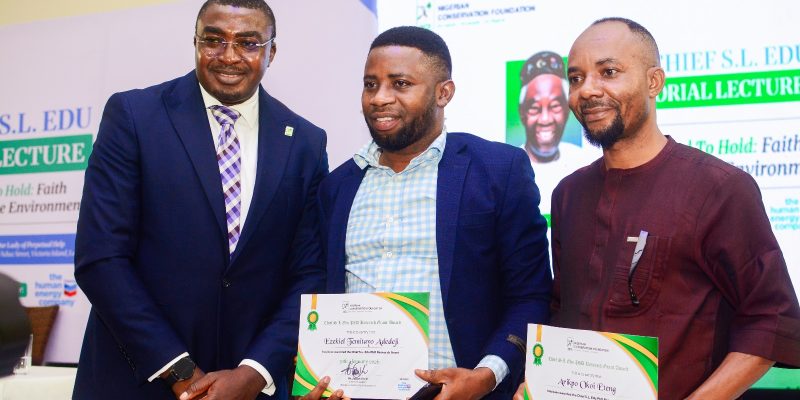
The foundation says every application will be acknowledged but that only successful applicants will be contacted. Awards in the previous cycle were presented at the Chief S.L. Edu Memorial Lecture, where recipients collected certificates signed by the foundation’s director-general, Dr Joseph Onoja, so the announcement is tied to that annual event rather than to a rolling notification.
Applications go through the foundation’s online grant form, and the full conditions are on the call for applications. Membership of the foundation, which is a precondition, is handled separately on its own site. The window closes on 11 December 2026.
Quick answers
- What is the Chief S.L. Edu Memorial Ph.D. Research Grant?
A research award run by the Nigerian Conservation Foundation and sponsored by Chevron Nigeria Limited, supporting doctoral research in the natural sciences, the social sciences and environmental law that advances sustainable natural resource management in Nigeria. It is named for Chief Shafi Lawal Edu, who founded the foundation in 1980.
- When is the deadline?
11 December 2026, for the 2027 edition. Applications are submitted online and paper applications are not considered.
- Who is eligible?
Nigerian citizens who hold a master’s degree or equivalent in the natural sciences, the social sciences or environmental law related to natural and environmental resource management, who have already secured admission to a Nigerian university for a PhD in one of those fields, and who are members of the Nigerian Conservation Foundation.
- What is the 2027 theme?
Conserving Species, Restoring Landscapes and Supporting Livelihoods. Proposals have to be written in line with it.
- What has to be submitted?
A 3,000-word project proposal covering title, statement of the problem, objectives, methodology and expected outputs; a 200-word justification tying the work to biodiversity conservation and resource management; a curriculum vitae of no more than two pages; a scanned admission letter; and a progress report on letterhead from the applicant’s supervisor. The foundation states explicitly that a reference letter does not substitute for the supervisor’s progress report. One proposal per applicant.
- Is a zoo or aquarium behind this grant?
No, and we looked. The sponsor is Chevron Nigeria Limited. The foundation’s own partnerships page names IUCN, WWF, BirdLife International, the RSPB, Wetlands International, Fauna and Flora International, ECOWAS, the European Union, the United States Fish and Wildlife Service and UNDP, and no zoological institution anywhere on it.