
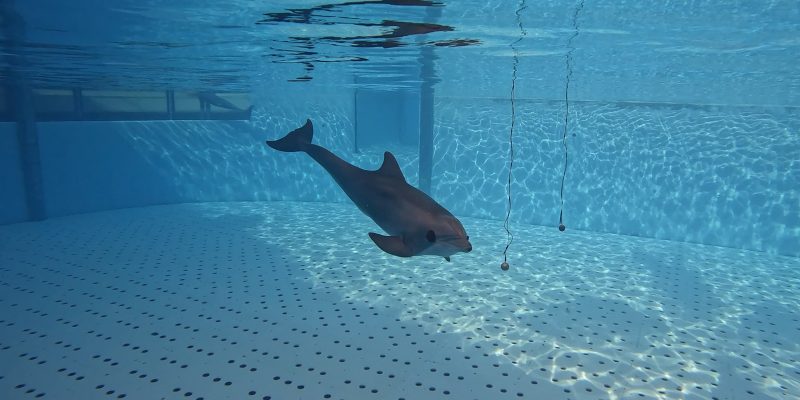
Two bottlenose dolphins at Loro Parque were shown four spheres that looked identical, made of plastic, aluminum, brass and steel. Using sound alone, they told them apart.
The study was published in The Journal of the Acoustical Society of America on August 12, 2026, by researchers from the University of Southern Denmark working with Loro Parque Fundación.
How you watch a dolphin think
The dolphins are named Achille and Clara, and their participation was voluntary. High-sensitivity hydrophones recorded their echolocation clicks while synchronized underwater cameras tracked head orientation and swim path.
What the equipment captured is the fraction of a second before a decision: the animal turning its head, changing its trajectory, and adjusting the clicks it was producing, actively tuning its own sonar to get a better answer.
“hemos podido descubrir que los delfines ajustan activamente sus movimientos y la produccion de sonido para ‘ver’ la composicion de los objetos mientras nadan”
we have been able to discover that dolphins actively adjust their movements and their sound production in order to “see” the composition of objects while swimming
Sara Torres, project lead scientist, in a statement translated from Spanish
Note what is being distinguished. Not the size or shape of the spheres, which were the same, but what they were made of. The dolphins were reading material density through water.
It is not the first cognition work to come out of the park; Loro Parque animals were also the subjects of an earlier study on how animals perceive space and time.
The comparison nobody had run
This is the first time bottlenose dolphin performance has been compared against the harbor porpoise under the same experimental protocol.
Both species use similar exploration strategies, turning the head and varying the approach. But their signals differ in frequency and structure, and that gives them measurably different discrimination abilities. Two animals doing the same job with different instruments.
Why it is not an aquarium curiosity
The stated application is underwater noise. Shipping, sonar, seismic surveys and construction have made the ocean far louder than it was, and the working assumption has been that this interferes with cetaceans. Interferes how, and with what exactly, has been much harder to establish.
You cannot run this experiment on a wild dolphin. Establishing the baseline requires an animal that will participate repeatedly, under instrumentation, over months. That is the argument for doing it where it was done.
“Este conocimiento basico es fundamental para entender como los cambios y el ruido en el medio acuatico afectan a los cetaceos, y nos permite desarrollar medidas de conservacion mucho mas eficaces y adaptadas a la biologia de cada especie”
This basic knowledge is fundamental to understanding how change and noise in the aquatic environment affect cetaceans, and it lets us develop far more effective conservation measures adapted to each species’ biology
Sara Torres, in a statement translated from Spanish
The work was funded by the Office of Naval Research, the Human Frontiers Science Program and the Carlsberg Foundation.
Source: Loro Parque. Quotations translated from the Spanish.