
Researchers expected broadnose sevengill sharks to spend their summers in northern waters and head down to California for the winter. Acoustic tags placed by the Oregon Coast Aquarium and Oregon State University’s Big Fish Lab showed that some of them did not. This past year, tagged sharks were recorded wintering on Stonewall Bank, about 15 miles offshore from Newport.
That is the kind of finding that only exists because somebody put a tag in a shark, and putting a tag in a shark takes a boat, a stretcher, and about seven minutes.
Why the Pacific Northwest needed a shark lab
Taylor Chapple, an associate professor in Oregon State’s Department of Fisheries, Wildlife and Conservation Sciences, started the Big Fish Lab about six years ago at the university’s Hatfield Marine Science Center in Newport.
“Historically, there’s been very little shark research done in the Pacific Northwest,” Chapple said, “so we’re doing a couple of things. One is just getting the fundamental baseline information about where they’re at and where they’re going. But more broadly, what we’re interested in is the role that these sharks play in our marine ecosystems, whether that’s a role as a predator or that’s a role as a prey as well.”
The lab’s work covers shark movements, behaviors and population dynamics, which is the study of how a population’s numbers and makeup change over time. One of its primary study animals is the broadnose sevengill shark (Notorynchus cepedianus), a heavy-bodied coastal shark named for the seven gill slits on each side of its head, where most sharks have five.
Chapple had a gap to fill there, and he knew where to go.
“I didn’t have a clue about sevengills, but I knew that the aquarium had experience with them,” he said. “So I contacted Jim Burke, and he and his team have been really essential for the projects that we have going.”
Burke is the Oregon Coast Aquarium’s Director of Animal Care, and he brings something a university cannot hire quickly: “I have over 20 years of working in Willapa Bay and understanding where the sharks hang out.”
Seven minutes on deck
The Aquarium’s research vessel, the Gracie Lynn, recently ran north to Willapa Bay, just inside the Long Beach Peninsula on the Washington coast, carrying Burke and other Aquarium staff along with members of the Big Fish Lab team. The mission was to tag sevengills and collect samples from each individual.
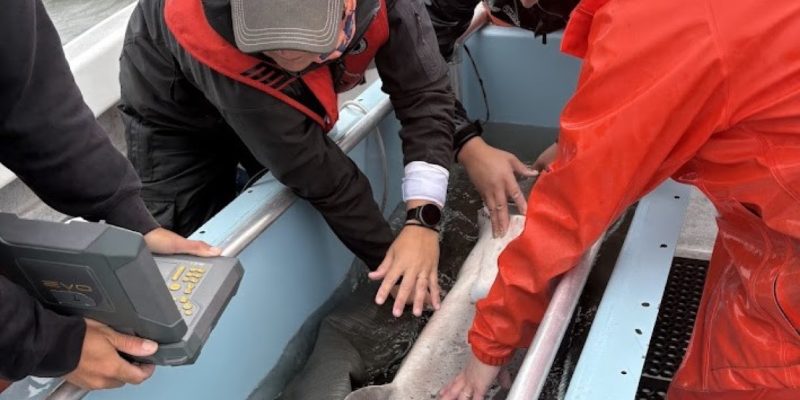
The method is simple to describe and fast to execute. Set a line with a baited hook, attached to a couple of high-visibility buoys. Watch the floats. When one jerks, haul the line up and guide the shark into a stretcher held alongside the vessel, then bring the stretcher aboard into a large tank of saltwater pumped straight from the bay.
Everything after that is designed around keeping the animal calm. The team covers the shark’s eyes and adjusts the water it is lying in.
“We increase the oxygen percentage in the water to 120 to 125 percent,” Burke said. “That helps them calm down and be more docile.”
A calmer shark spends less energy, which lets the crew finish faster and get it back in the bay sooner. That is the whole priority, and it shows in how the work looks.
“A little bit like being on a NASCAR pit crew,” said Doug Batson, the Aquarium’s Dive Safety Officer. “Once you get the animal on board, it’s like everybody’s got a job and you’re just trying to kind of dance around each other, get your samples, get your tag in, all those things.”
Typical time on board: six or seven minutes.
What a tag and a sample actually tell you
The samples answer the diet question. Chapple said they reveal what a shark has been eating over a stretch of weeks, months, or up to a year, which builds a picture of preferred prey and of what prey was available.
The acoustic tag answers the movement question. An implanted tag pings a coded signal that gets logged whenever the animal swims within range of a receiver, so a shark tagged once can be placed on a map over and over for years without anyone ever seeing it again. That is how the Stonewall Bank surprise turned up: not from a sighting, but from a shark that kept checking in through a winter it was supposed to spend in California.
Why an aquarium goes shark fishing
“We want to contribute to new and influential biological science and research, especially as it pertains to our exhibits and animals,” Burke said. “We aim to educate people about marine life, ocean current events, and conservation, and joining these research efforts supports that goal.”
The partnership is also a matter of geography.
“I feel it’s really fortunate for Oregon to have Dr. Chapple and the Big Fish Lab here on the coast,” Burke said. “They’re great neighbors to work with. I think between our efforts and theirs, we can really make some progress in better understanding shark behavior.”
Say the word shark and most people picture something to be avoided at all costs. The work happening out of Newport is the slow correction to that: a species being counted, mapped and understood by the people best placed to handle it, at a coast where almost nobody had looked before. A guest cannot walk onto the Gracie Lynn. But the boat sails out of Newport, the lab is up the road at Hatfield, and the shark that skipped its winter migration is 15 miles off the same beach.
More from the Oregon Coast Aquarium: a fishing vessel joined a trained team to free an injured humpback whale.
Quick answers
- What is a broadnose sevengill shark?
A heavy-bodied coastal shark named for the seven gill slits on each side of its head, where most sharks have five. It is a primary study species for Oregon State University's Big Fish Lab.
- How are the sharks tagged?
A baited line with high-visibility buoys is set. When a buoy moves, the shark is guided into a stretcher, lifted aboard into a saltwater tank, sampled and fitted with an acoustic tag, then released. Time on board is typically six or seven minutes.
- What did the tagging find?
Researchers expected sevengills to summer in northern waters and winter in California. This past year some tagged sharks instead spent the winter on Stonewall Bank, about 15 miles offshore from Newport, Oregon.