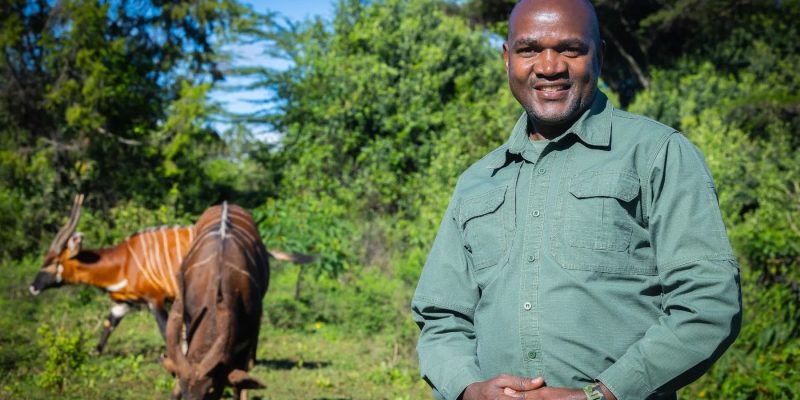
There are more mountain bongos living in zoos than there are in the Kenyan forests they came from, and the single largest herd of them stands on a ranch in Nanyuki under the care of a Ugandan wildlife veterinarian named Robert Aruho. In July he was appointed co-chair of the international scientific body that decides, among other things, how endangered the mountain bongo is.
The Mount Kenya Wildlife Conservancy announced the appointment from Nairobi on July 14, 2026. Dr Aruho, the conservancy’s head, joins the International Union for Conservation of Nature’s Species Survival Commission Antelope Specialist Group, which the conservancy says covers more than 90 antelope species and their habitats.
What the Antelope Specialist Group actually does
A specialist group is the part of the IUCN that does the unglamorous work the Red List is built on. Its members are the scientists who write and review the assessments for a particular set of species, which is how a category like Endangered or Near Threatened gets attached to an animal in the first place, and they also set recovery priorities and review reintroduction proposals. For antelopes, that is a remit stretching from the dik-dik to the eland across most of Africa and a good deal of Asia.
Worth noting for precision: the IUCN’s own page for the group lists three people under group leadership, Dr David Mallon, Dr Aruho and Mrs Violeta Barrios Aquino, without assigning chair or co-chair titles to any of them. The co-chair wording and the figure of more than 90 species both come from the conservancy’s announcement.
Barrios Aquino is the chief operating officer of Sahara Conservation, which is the organization the Saint Louis Zoo paid the start-up costs for in 2004 and then hosted in the United States. That is the clearest example anywhere of a zoo not merely funding a field organization but creating one. It is background rather than a funding line for this appointment, and we are not going to imply otherwise.
What he built before the appointment
Dr Aruho spent more than ten years at the Uganda Wildlife Authority as a senior wildlife veterinarian and head of species programs, and has more than two decades in wildlife veterinary medicine. At Mount Kenya he took over a mountain bongo breeding program that began in 2004 and has grown it past 100 animals, which the conservancy describes as the world’s largest conservation breeding population of the subspecies.
In April he ran the most recent addition to it. Four young males were flown from Europe to Nairobi and taken to the conservancy, chosen for genetics, mean kinship, age and behavior rather than convenience. That transfer is a story in itself, and we wrote it up when Kenya launched its national recovery plan for the species in September.
Which zoos are paying for the herd he runs
This is the rare African conservation story where the money traces cleanly, and it traces to zoos.
The four males that arrived in April came from Prague Zoo, National Zoo Bojnice in Slovakia, Zoo Frankfurt, Tierpark Berlin and Givskud Zoo in Denmark, moving under the European Association of Zoos and Aquaria’s Ex situ Program. The selection itself was made by the program coordinator based at Chester Zoo in the United Kingdom, Dr Nick Davis, working with the species committee. Safari Park Dvur Kralove in Czechia organized the transport, quarantined the animals in its own export facility, and funds the Kenyan conservancy directly through a charity run and a dedicated wildlife account.
The herd Dr Aruho inherited has the same shape. It started with 18 animals repatriated from North America under the American Zoo and Aquarium Association’s Bongo Species Survival Plan, coordinated with the Rare Species Conservatory Foundation, with Fort Worth Zoo staff handling the coordination, screening and transport and the animals consolidated at White Oak Conservation in Florida before they flew.
For scale on the other side of the question, the Association of Zoos and Aquariums reports that in 2025 its 235 accredited and certified facilities spent approximately $372.4 million on conservation across 139 countries. No published breakdown isolates how much of that reached Africa, so we are not going to estimate one.
A note on the category
The conservancy’s announcement calls the mountain bongo a critically endangered subspecies, and that is the phrasing almost everyone uses. The IUCN Red List assessment is a separate document and says something narrower. It treats the bongo as a single species, Tragelaphus eurycerus, and lists it as Near Threatened with 15,000 to 25,000 mature individuals and a decreasing trend. It was assessed on July 7, 2016, with an errata version published in 2017 because a map had been left out.
That global figure is dominated by the far more numerous lowland bongo of Central and West Africa, and the Red List carries no separate global entry for the Kenyan subspecies, Tragelaphus eurycerus isaaci. So the critically endangered label is a statement about the mountain bongo in particular rather than a reading off the global list. Both things are true at once.
There is a tidy circularity in it. The 2016 assessment was written by the IUCN SSC Antelope Specialist Group, it is now ten years old, and the group that owns it has just added a co-chair who spends his working life with the subspecies it does not separately list.
What the people involved said
“Conservation challenges have become increasingly global, requiring stronger collaboration across governments, scientists and conservation organizations,” Dr Aruho said in the announcement. “I am honoured to serve as Co-Chair of the Antelope Specialist Group and look forward to working with colleagues worldwide to strengthen science-led conservation, support species recovery, and build greater collaboration that benefits threatened antelope populations and the ecosystems they sustain.”
Humphrey Kariuki, an IUCN Patron of Nature and the conservancy’s patron, called it “a proud moment not only for Mount Kenya Wildlife Conservancy but also for Kenya and the wider conservation community across Africa,” adding that “under his leadership, the Mountain Bongo recovery program has become one of Africa’s leading conservation success stories.”
Kenya’s national recovery plan sets a self-sustaining wild population of 750 mountain bongos by 2075. Whoever is doing this job then will be several administrations removed from the people who wrote that number. The animals that get them there are, for now, mostly behind fences.
Quick answers
- What is Dr Robert Aruho's new role?
Co-chair of the International Union for Conservation of Nature's Species Survival Commission Antelope Specialist Group. The Mount Kenya Wildlife Conservancy announced it on July 14, 2026. The IUCN's own page for the group lists him under group leadership alongside Dr David Mallon and Mrs Violeta Barrios Aquino, without assigning titles.
- How many mountain bongos are at the Mount Kenya Wildlife Conservancy?
More than 100. The conservancy describes it as the world's largest conservation breeding population of the subspecies, and reported 101 animals as of March 2026. The Kenya Wildlife Service puts the wild population at fewer than 100.
- Which zoos fund the mountain bongo program?
The herd began with 18 animals repatriated from North America under the American Zoo and Aquarium Association's Bongo Species Survival Plan, with Fort Worth Zoo staff coordinating and White Oak Conservation holding the animals before the flight. Four young males arrived in April 2026 from Prague Zoo, National Zoo Bojnice, Zoo Frankfurt, Tierpark Berlin and Givskud Zoo, selected by the EEP coordinator at Chester Zoo. Safari Park Dvur Kralove ran the transport and funds the conservancy directly.
- Is the mountain bongo critically endangered?
That label is used for the mountain bongo specifically and is not a reading off the global Red List. The IUCN assessment treats the bongo as one species, Tragelaphus eurycerus, and lists it as Near Threatened with 15,000 to 25,000 mature individuals, assessed on July 7, 2016. There is no separate global entry for the Kenyan subspecies, Tragelaphus eurycerus isaaci, and the global figure is dominated by the lowland bongo.
- What did Dr Aruho do before this?
He spent more than ten years at the Uganda Wildlife Authority as a senior wildlife veterinarian and head of species programs, and has more than two decades in wildlife veterinary medicine.
- What is Kenya's target for wild mountain bongos?
Kenya's national recovery and action plan for 2026 to 2030 sets a 50 percent increase in the national population by 2030 and a self-sustaining wild population of 750 animals by 2075.