
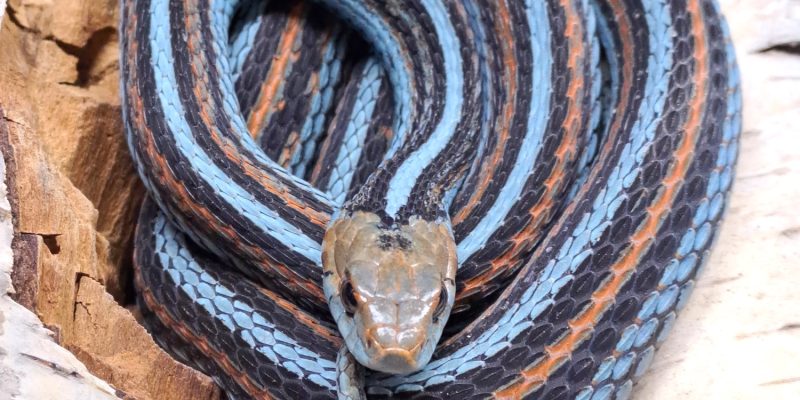
On Tuesday, July 21, 2026, a zoo in Stuttgart opened a new outdoor enclosure for two snakes from San Mateo County, California. The Wilhelma’s new terrarium for San Francisco garter snakes cost 150,000 euros, covers 24 square meters, and is planted with twenty California plant species grown from seed imported from California.
It is a strange thing for an American reader to come across in a German press release, and it is one of the more interesting habitat builds in Europe this year.
The snake
The San Francisco garter snake, Thamnophis sirtalis tetrataenia, is a subspecies of the common garter snake, and it does not look like one. It carries turquoise-blue and orange stripes down a black body. It is also one of the first animals the United States ever formally protected: it was listed as endangered on March 11, 1967, under the law that preceded the Endangered Species Act.
Its entire range is the San Francisco Peninsula, from the San Francisco and San Mateo county line south into the northern edge of Santa Cruz County, and today it survives mostly in isolated pockets along the San Mateo coast. The U.S. Fish and Wildlife Service lists illegal collection, development, road construction, water impoundments, agriculture, saltwater intrusion, drought, lost prey and invasive bullfrogs and largemouth bass among the pressures on it. Habitat loss has cut the remaining groups off from each other, which stops genes moving between them.
The largest single population lives on a fenced tract owned by San Francisco International Airport, where water, reedbeds, meadow and scrub sit behind a security perimeter that happens to make excellent snake habitat. The Wilhelma puts that population at around 1,300 animals.
Which list, and what it says
Worth being precise here, because two different systems are in play. The protection that governs this animal is American and federal: endangered under the Endangered Species Act since 1967. The IUCN Red List does not assess this subspecies separately, so there is no IUCN category to quote for it. NatureServe rates it Imperiled. The Wilhelma’s release calls the snake “vom Aussterben bedroht,” threatened with extinction, which is a fair description of its situation rather than a citation of any particular list.
What they built
The enclosure sits next to the Wilhelma’s California sea lions and was put together by the zoo’s zoology, botany, grounds, technical and education departments working jointly. Two snakes moved in on opening day, both bred at Allwetterzoo Münster in Germany. They stay outdoors year-round, with a frost-free hibernation box they can retreat into on their own.
The build had to be unusually precise for the reason that juvenile garter snakes fit through very small gaps. A net over the top keeps out herons and crows, and a buried barrier stops rodents digging in.
The planting is the part worth pausing on. Seed for twenty plant species typical of the snake’s wetland habitat was imported directly from California and raised at the Wilhelma. The meadow includes narrow-leaved milkweed, one of the main food plants for monarch caterpillars in North America. Around the pool and in the surrounding beds grows American mugwort, a silver-gray plant reaching 1.8 meters that is dried and burned in traditional ceremonies by Indigenous peoples in North America.
The zoo did not have to do any of that. A functional enclosure for two snakes does not require an imported California plant community. They built one anyway.
Who paid for it
The 150,000 euros came from the Ingrid Kandler Foundation, held within the foundation network of the Kreissparkasse Esslingen-Nürtingen, a regional savings bank.
“Wir freuen uns sehr über die große Unterstützung hier aus der Region – zumal die Spende von der Ingrid Kandler Stiftung und der Kreissparkasse Esslingen-Nürtingen nicht nur der Wilhelma, sondern der Erhaltungszucht eines vom Aussterben bedrohten Reptils zugutekommt.”
We are delighted at the strong support from here in the region, especially since the donation from the Ingrid Kandler Foundation and the Kreissparkasse Esslingen-Nürtingen benefits not only the Wilhelma but the conservation breeding of a reptile threatened with extinction.
Dr. Thomas Kölpin, director of the Wilhelma, in a statement translated from German
Why a reserve population sits in Europe at all
Zoos and private keepers together maintain a backup population of this snake outside California. The coordinating body for the joint breeding program is Citizen Conservation, an organization that links zoos, researchers and private keepers, and which the Wilhelma works with closely.
That last category is the unusual one. Private keepers are not normally part of a formal conservation breeding structure, and building a program that treats them as partners rather than as a problem is a deliberate choice. For a species whose wild decline is partly driven by illegal collection, it is also a pointed one.
The Wilhelma has been on a run of conservation work this year. Its funding of the Perth Zoo numbat program was part of the case for that species being downlisted two IUCN categories in July.
Source: Wilhelma, with listing detail from the U.S. Fish and Wildlife Service. The Kölpin quotation is translated from German.
Quick answers
- Why does a German zoo keep San Francisco garter snakes?
Zoos and private keepers maintain a reserve population of the subspecies outside California. The joint breeding program is coordinated by Citizen Conservation, which the Wilhelma works with.
- What protection does the San Francisco garter snake have?
It has been listed as endangered under United States federal law since March 11, 1967. The IUCN Red List does not assess the subspecies separately; NatureServe rates it Imperiled.
- How big is the new enclosure and what did it cost?
24 square meters, at a cost of 150,000 euros, funded by the Ingrid Kandler Foundation within the foundation network of the Kreissparkasse Esslingen-Nurtingen.
- Where do the Wilhelma's snakes come from?
Both were bred at Allwetterzoo Munster in Germany. They moved in on the day the enclosure opened, July 21, 2026.