
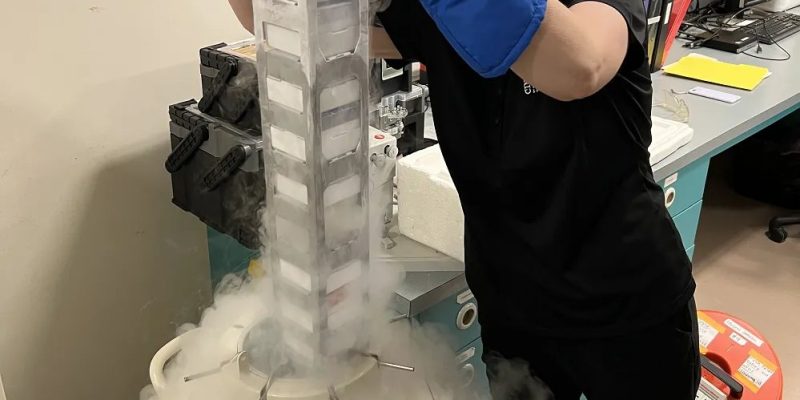
The Cincinnati Zoo and Botanical Garden has won a three-year National Leadership Grant from the Institute of Museum and Library Services, and the money is going somewhere most people do not picture when they picture a zoo: a tank of liquid nitrogen holding plant tissue at around 196 degrees below zero Celsius.
The grant goes to the Plant Research Division of CREW, the zoo’s Center for Conservation and Research of Endangered Wildlife, and its subject is a category of plant with an awkward and useful name.
What is an exceptional plant?
A seed bank works because most seeds can be dried out, frozen and brought back years later. An exceptional plant is one where that does not work. Its seeds either refuse to survive drying, or refuse to survive freezing, or the plant barely produces viable seed at all. For those species the usual insurance policy is unavailable, and the only options left are keeping living collections alive in the ground, which is expensive and vulnerable to a single bad storm, or finding another way to put the species on ice.
The other way is cryopreservation: cooling and storing living plant tissue in liquid nitrogen, where biological time effectively stops. It is the most effective alternative to seed banking that exists for exceptional species, and CREW has been doing it long enough that its collection, the Frozen Garden, is one of the oldest and most diverse collections of cryopreserved wild plant species anywhere.
“CREW’s Frozen Garden is one of the oldest and most diverse collections of cryopreserved wild plant species, with a particular focus on preserving oak species for future generations,” said Dr. Megan Philpott, director of CREW’s Exceptional Plant Signature Project.
Why oaks
Every oak species on earth is an exceptional plant. Acorns are the reason: they are large, wet, alive and entirely unwilling to be dried and frozen. Which means that for a genus holding several hundred species, many of them threatened, conventional seed banking offers nothing at all.
The route around it starts with growing oaks in test tubes. The grant funds work on germinating acorns for collections held outside their natural environment, then using the resulting seedlings to start tissue culture collections that can actually be cryopreserved. CREW will also collect acorns in partnership with botanic gardens and arboreta across the country to answer a question nobody has systematically answered: how much does the environment of the mother tree affect whether her acorns germinate, take to tissue culture and survive freezing? An acorn from a drought-stressed tree in one state may behave nothing like an acorn from the same species in another.
Four freezers in four places
The second half of the grant is about not keeping everything in Cincinnati. CREW will work with three other United States cryobanks, the Atlanta Botanical Garden, The Huntington in San Marino, California, and the Lyon Arboretum in Honolulu, to test how a network of backup collections would work in practice. Any archivist would recognize the reasoning: a collection that exists in one building is one flood, one fire or one failed compressor away from not existing.
The findings go into two free public tools. The Exceptional Plant Conservation Network already publishes protocols and information for practitioners worldwide, and a newly established Comparative Cryopreservation Database will let researchers compare freezing methods across species, so that the next laboratory working on a difficult plant starts from somebody else’s results rather than from scratch.
That is the part worth noticing. National Leadership Grants are awarded for work meant to be useful beyond the institution that does it, and CREW’s deliverable here is partly a database. The same laboratory has spent years on reproductive science for big cats. It turns out the hard problems for a frozen cell are not that different whether the cell came from an animal or an acorn.