
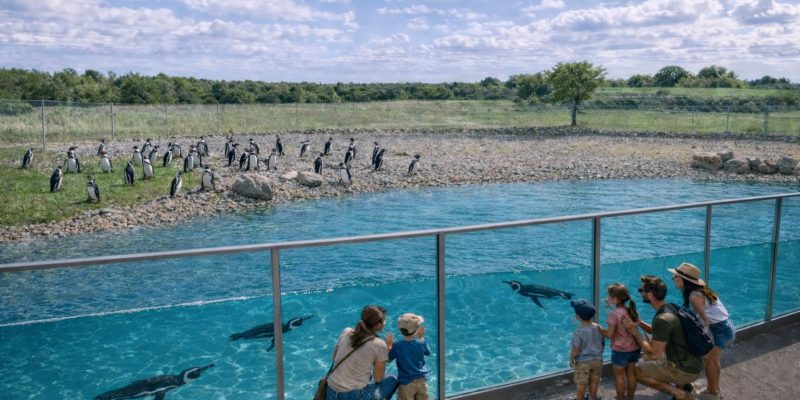
Yorkshire Wildlife Park has opened a 1.2 million pound habitat for African penguins and moved twenty birds into it, ten males and ten females. The park in Branton, near Doncaster, had never kept the species before.
The centerpiece is the water. The pool holds 552,000 liters, a volume of 552 cubic meters, and runs to a maximum depth of two meters. African penguins are pursuit divers, and depth is the difference between a bird that paddles and a bird that swims the way it would at sea.
Twenty birds, five pairs already formed
Five pairs arrived already bonded: Joe and Houdini, Max and Samantha, Sid and Natalie, Gwyn and Rachel, and Salty and Little Min. That matters more than it sounds. African penguins pair for years, and a group that arrives with established pairs in it settles faster and is likelier to breed than twenty unattached birds put in a pool together.
“It’s fantastic to see the penguins enjoying their new home. They’ve settled in really well since arriving,” said Dr Charlotte MacDonald, the park’s Director of Animals. “African penguins are fantastic birds with lots of character, and we know they’re going to be a real favourite with visitors.”
Why this species and not another
Because there is very little time left. The IUCN Red List category for the African penguin is Critically Endangered, on an assessment BirdLife International completed on July 4, 2024 and published in the Red List’s second update of that year. The assessment counts 19,800 mature individuals and a decreasing trend, and the uplisting followed the breeding population falling below 10,000 pairs for the first time on record.
Yorkshire Wildlife Park’s own announcement dates that change to earlier in 2026. The assessment is two years older than that, and we default to the assessment. It is a small thing and it does not touch the substance: whichever date you use, this is a bird that has moved a full category in the wrong direction inside the working life of the keepers now looking after it.
The park also cites projections that African penguins could be extinct in the wild by 2035 if the decline continues. That figure comes from population modeling rather than from the Red List assessment itself, and BirdLife has framed the same forecast as roughly a decade.
What does 1.2 million pounds buy in a penguin habitat?
Mostly water and glass. The park has published the pool volume and depth and the total cost, and it has not published the land area, the number of nest sites, or the filtration specification, so we are not going to guess at them. The design images the park released before opening show a long glass panel along one side of the pool at visitor height, which is the feature that turns a penguin exhibit from a pen with birds standing in it into somewhere you watch them fly through water.
That is the argument for building the thing at all. African penguins in European collections are managed as a breeding population, and the same birds that a British park puts in front of visitors are the ones keeping a genetically useful reserve going while the wild colonies in South Africa and Namibia shrink.
ARTIS in Amsterdam rebuilt its own African penguin habitat this year around much the same reasoning. Our report on the ARTIS rebuild is here. Yorkshire Wildlife Park’s announcement is on the park’s own newsroom.
Quick answers
- How many African penguins are at Yorkshire Wildlife Park?
Twenty, ten males and ten females. Five pairs arrived already bonded: Joe and Houdini, Max and Samantha, Sid and Natalie, Gwyn and Rachel, and Salty and Little Min.
- What did the habitat cost?
1.2 million pounds. The pool holds 552,000 liters, a volume of 552 cubic meters, and is up to two meters deep.
- How endangered is the African penguin?
The IUCN Red List lists Spheniscus demersus as Critically Endangered on an assessment BirdLife International completed on July 4, 2024, counting 19,800 mature individuals and a decreasing trend. The uplisting followed the breeding population falling below 10,000 pairs for the first time on record.