
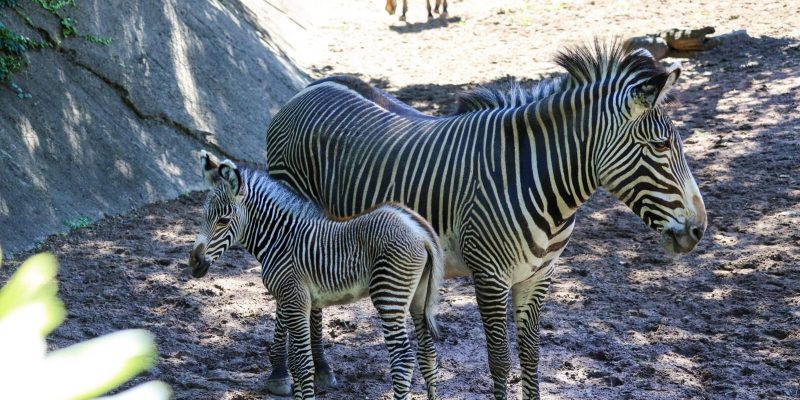
A female Grevy’s zebra foal was born at Lincoln Park Zoo on June 22, 2026, to 19-year-old Adia. Mother and foal are meeting their developmental milestones and are being monitored by the zoo’s animal care and veterinary staff.
It is Adia’s sixth foal and her fourth with 15-year-old Wester. The pairing came from a Grevy’s Zebra Species Survival Plan recommendation, the AZA program that manages the species across accredited North American zoos.
The rarest zebra
Grevy’s zebra is not the zebra of the safari poster. It is the biggest of the three zebra species, standing up to five feet at the shoulder and weighing as much as 950 pounds, and its stripes are noticeably narrower and more numerous than a plains zebra’s, running in fine lines right down to a white belly.
It is also the one in trouble. The IUCN Red List assesses Grevy’s zebra as Endangered under criteria A2acd, and puts the number of mature individuals at 1,956. The zoo’s own framing, fewer than 2,000 left in Kenya and Ethiopia, matches the assessment closely, which is worth saying because facility numbers and Red List numbers often do not line up.
Two details from the assessment are worth adding to it. The count of 1,956 is specifically mature individuals rather than total animals, and the assessment dates from 2016, which makes it a decade old. The Red List lists the population trend as stable.
The threats are habitat loss, competition with livestock for grazing and water, disease transmission and hunting. Grevy’s zebra lives in dry country where the constraint is usually water, which puts it in direct competition with people and their herds in exactly the places both need.
Zebras that do not live in herds
Grevy’s zebras do not form the permanent herds that plains zebras do. Females with foals may be found together, and males form small bachelor groups, but adult males hold large territories rather than families. Females prefer to be alone when they give birth.
Gestation runs about 390 days, the longest of any equid, horses and donkeys included. That is thirteen months of investment in a single foal, which is a large part of why a birth like this one counts.
The species has good eyesight and heavily enameled teeth suited to tough, dry grasses, and spends roughly 60 percent of the day grazing.
Where to see the foal
She is in the zoo’s South Loop habitat with Adia, her two-year-old sister Yabelo and an adult female, Delrie. The easiest way to pick her out, apart from her size, is her color: her stripes are reddish brown now and will darken to black as she matures.
Lincoln Park Zoo is open 365 days a year and admission is free.
Zebra coverage in accredited collections tends to run to the rarer species for exactly the reason above. Audubon Zoo has been working with Hartmann’s mountain zebra, another species managed through an AZA program.
Quick answers
- When was the Grevy's zebra foal born at Lincoln Park Zoo?
June 22, 2026. She is the sixth foal for 19-year-old Adia and her fourth with 15-year-old Wester.
- How many Grevy's zebras are left?
The IUCN Red List assesses Grevy's zebra as Endangered and puts the number of mature individuals at 1,956, in a 2016 assessment that lists the population trend as stable.
- How do you tell a Grevy's zebra from other zebras?
It is the largest of the three zebra species, up to five feet at the shoulder and 950 pounds, and its stripes are narrower and more numerous, running down to a white belly.
- Where can you see the foal?
In the South Loop habitat with her mother Adia, her two-year-old sister Yabelo and adult female Delrie. Lincoln Park Zoo is open 365 days a year and admission is free.