
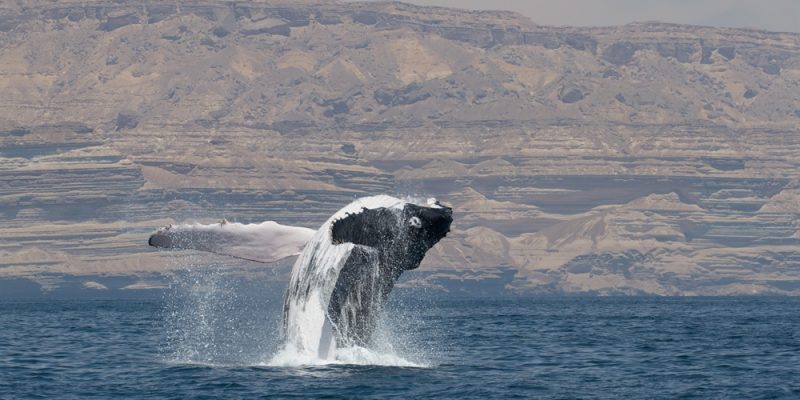
Every humpback whale in the world makes a long seasonal migration between cold feeding grounds and warm breeding grounds. Every humpback whale except one group. In the Arabian Sea, off the coast of Oman, a small population stays put all year, breeds on a Northern Hemisphere schedule, and sings a song that is not heard anywhere else on Earth. New genetic work led by the Wildlife Conservation Society now says those whales have been on their own evolutionary path for tens of thousands of years, and makes the case that they should be recognized as a fourth subspecies of humpback whale.
The study was published in Frontiers in Marine Science on August 10, 2026, and the Wildlife Conservation Society announced it on September 28. It is the product of more than twenty-five years of whale research in Oman.
What the genetics actually showed
The team assembled 2,285 humpback whale sequences from across the species’ global range and compared them. The stretch of DNA they read is the mitochondrial control region, a short, fast-changing piece of the genome that sits outside the cell nucleus and is inherited only from the mother. That inheritance is the reason it was the right tool here. Migration routes in whales are learned from the mother and passed down, so a maternally inherited marker records exactly the thing this population is defined by: where its mothers go, and for how many generations they have been going there.
From a 462-base-pair consensus region the researchers recovered 254 distinct haplotypes across 98 variable sites. The Arabian Sea animals came out clearly apart from the three humpback subspecies recognized today, which are Megaptera novaeangliae novaeangliae in the North Atlantic, M. n. kuzira in the North Pacific and M. n. australis in the Southern Hemisphere. Fixation index values, the standard measure of how genetically separated two groups are, ran from 0.1213 against Southern Ocean populations up to 0.2441 against the North Pacific. The Arabian Sea population also showed the lowest genetic diversity of any ocean region examined, which is what a small, closed population looks like from the inside.
The estimated split is old. Depending on the group compared, the Arabian Sea lineages diverged somewhere between about 43,000 and 113,000 years ago.
“Arabian Sea humpback whales have long been an enigma to the scientific community,” said lead author Dr. Rita Amaral, who coordinated the genetic analysis with the Wildlife Conservation Society. “Their ecology is unlike that of any other known humpback whale population, and this new genetic work represents an important milestone in understanding how that uniqueness developed.”
A whale collected in 1883, and the name it carried
The most satisfying part of the paper is not in the modern samples. In 1883 the French zoologist Paul Gervais described a new species of humpback whale, Megaptera indica, from an animal that stranded at Basora Bay in the Shatt al-Arab delta, near present-day Basra in Iraq. Remains of that original specimen are held by the Muséum National d’Histoire naturelle in Paris. The team sequenced ancient DNA from it.
The 1883 whale was a humpback, and it was closely related to the whales swimming off Oman today. A name proposed almost a century and a half ago, for an animal nobody could place, turns out to have been describing this population all along. If the Society for Marine Mammalogy’s Taxonomy Committee accepts the case, the fourth subspecies will be called Megaptera novaeangliae indica, after that whale from Basra. Formal recognition rests with that committee and has not happened yet.
Which zoos paid for this?
Our standing practice on conservation science is to trace the money back to the accredited zoos and aquariums funding it, and to say so plainly when there are none. Here the answer is split, and worth setting out exactly.
The genetic analysis in this paper was funded by the International Whaling Commission. Sampling of the Paris museum specimen was funded by the United States Marine Mammal Commission and facilitated by that museum’s mammalogy department. No zoo or aquarium wrote a check for the laboratory work.
What the zoo world supplied instead was the institution and the people. The study was led by the Wildlife Conservation Society, which is not only a field science organization: it runs the Bronx Zoo, the New York Aquarium, the Central Park Zoo, the Prospect Park Zoo and the Queens Zoo. The lead author’s affiliation on the paper is the society’s Bronx address, and the senior author, Dr. Howard C. Rosenbaum, is Executive Director of its New York Bight Program. The co-authors come from the Environment Society of Oman, Oman’s Environment Authority and several independent research groups. This is what the argument for charismatic species in accredited collections looks like when it is followed all the way through: a public zoological institution in New York carrying a twenty-five-year research program on a whale population most of its visitors will never see.
“These findings are built on more than 25 years of dedicated research in Oman,” said Suaad Al Harthi, Executive Director of the Environment Society of Oman and a co-author. “What began with small-boat surveys to photograph individual whales and collect tiny tissue samples has developed into a much broader program using satellite tracking, acoustic monitoring, health assessments, and other techniques.”
Why the distinction matters now
Being unique and being isolated are the same fact seen from two sides. The paper is blunt that the population is small, that there is no evidence it has grown in the past two decades, and that it is at risk of extirpation without coordinated action. The threats it names are entanglement in fishing gear, vessel strikes, underwater noise and pollution, alongside disease. Climate-driven shifts in the monsoon and in ocean upwelling could also change the supply of sardines and other prey.
Entanglement is the one that travels. It is the same hazard that put a humpback anchored to the seafloor off the Oregon coast in front of a rescue team this summer, and the same reason a blue whale skeleton now stands at a marine science center in Newport. What differs in the Arabian Sea is arithmetic. A population this small does not absorb losses.
A note on the listing
The announcement describes Arabian Sea humpbacks as having the status of an Endangered species. The assessments the paper cites are narrower than that, and the difference is worth keeping straight. The IUCN Red List entry cited in the study is for the Arabian Sea subpopulation specifically, assessed as Endangered by Minton and colleagues in 2008. Under the United States Endangered Species Act it is the Arabian Sea Distinct Population Segment that is listed as Endangered, following the 2015 status review. Both of those categories attach to this population rather than to humpback whales as a species, which is precisely the point the new genetics is making. It also means the conservation case does not depend on the taxonomy committee’s verdict. The bodies that manage these whales have been treating them as a separate unit for years.
The International Whaling Commission already recognizes the Arabian Sea animals as a discrete breeding and feeding population and has recommended a Conservation Management Plan for them. Oman is working toward stronger habitat protection, including through the International Maritime Organization’s designation of Particularly Sensitive Sea Areas.
“The growing body of research on Arabian Sea humpback whales has given Oman an increasingly clear understanding of both the importance of this population and the pressures it faces,” said Aida Al Jabri of the Environment Authority of Oman. “This evidence is now helping us move from scientific understanding toward practical conservation action.”
There are not many places left where a well-studied large whale can still surprise the people studying it. A song nobody else sings, a migration nobody makes, and a name waiting in a Paris museum drawer since 1883 is a good haul for one paper.
Quick answers
- What did the study find?
That humpback whales in the Arabian Sea are genetically distinct from the three currently recognized humpback whale subspecies and have followed their own evolutionary path for roughly 43,000 to 113,000 years. The authors propose recognizing them as a fourth subspecies, Megaptera novaeangliae indica.
- Why are Arabian Sea humpback whales different from other humpbacks?
They are the only known humpback whale population that does not make long seasonal migrations. They feed and breed in the same tropical and subtropical waters year-round, follow a Northern Hemisphere breeding cycle, and sing a song that has been recorded nowhere else.
- Is the fourth subspecies official?
Not yet. Formal recognition of a marine mammal subspecies rests with the Society for Marine Mammalogy's Taxonomy Committee, which has not ruled.
- How was the research done?
Researchers compared 2,285 humpback whale mitochondrial DNA control region sequences collected across the species' global range, recovering 254 haplotypes from a 462-base-pair region, and separately sequenced ancient DNA from the 1883 type specimen of Megaptera indica held by the Museum National d'Histoire naturelle in Paris.
- Are Arabian Sea humpback whales endangered?
The assessments the paper cites are of this population rather than of humpback whales as a species. The IUCN Red List entry is for the Arabian Sea subpopulation, assessed as Endangered by Minton and colleagues in 2008, and the United States lists the Arabian Sea Distinct Population Segment as Endangered under the Endangered Species Act.
- Which zoo or aquarium funded the work?
None paid for the laboratory analyses. Those were funded by the International Whaling Commission, and sampling of the Paris specimen by the United States Marine Mammal Commission. What the zoological world supplied was the institution and the scientists: the study was led by the Wildlife Conservation Society, which operates the Bronx Zoo, the New York Aquarium, the Central Park Zoo, the Prospect Park Zoo and the Queens Zoo.