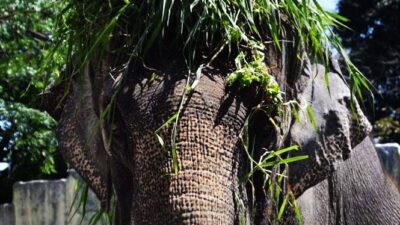

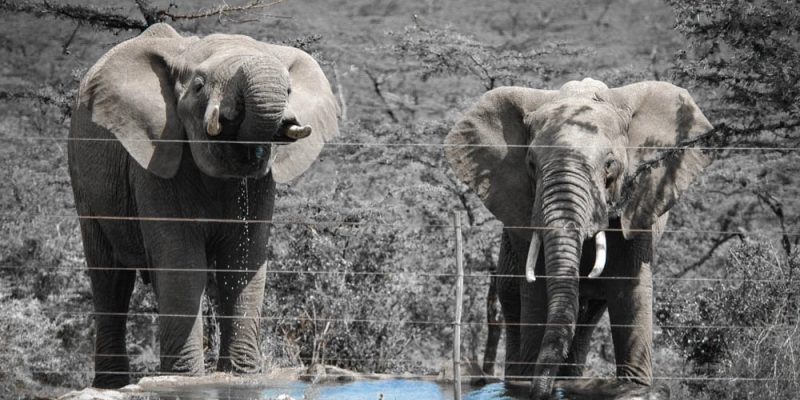
The usual answer to an elephant that walks through a fence is a taller fence. Ol Pejeta Conservancy in Laikipia, Kenya is about to spend a season testing the opposite idea. On three stretches of its boundary where elephants break through most often, crews are pulling out tall multi-wire fence and putting back fence two and three feet high.
The conservancy set out the design of the experiment on September 12, 2026. It is running the work with support from the Elephant Crisis Fund and in collaboration with Save the Elephants, and the question it asks is narrower and more useful than whether a fence holds. It asks which specific parts of a fence change what an elephant decides to do.
Why would a shorter fence work better?
Because height is not what stops an elephant. Reach is.
Ol Pejeta maintains about 120 kilometers of electric perimeter fence, built to manage wildlife movement while leaving designated corridors open. Elephants account for more than 35 percent of every recorded interruption to it. Bulls lift and twist the wires with their tusks. Others push the posts over with their feet. Both of those require the animal to get close enough to put a tusk or its body weight against the structure.
A short fence set 1.5 to 3 feet high, carrying fewer strands and fitted with angled outriggers that stand out from the line, is built around that fact. The outrigger holds the animal away from the posts and wires. Ol Pejeta has had short-fence sections in place for several years in some locations and has watched elephants leave them alone, but the design has never been tested against a tall fence under controlled conditions with the results written down.
Where the fence actually breaks
Not evenly, and that is the finding that shapes the trial. Analysis of the conservancy’s own breakage records puts the recurring failures on particular sections of the northern and eastern boundaries, and specifically where the fence runs along community farmland. Some of those sections are breached several times a month. The locations line up with elephant movement data and with the things that draw elephants in: crops, water and salt licks.
The population behind that pressure has not been stable either. Ol Pejeta counted roughly 209 African savanna elephants in 2010 and about 551 in 2022, a rise driven largely by animals moving in seasonally from the wider landscape during drought. When rain and vegetation improved across Laikipia the animals dispersed again: 189 in 2023, 356 in 2025. Human-elephant conflict has made up around a quarter of reported human-wildlife conflict incidents at the conservancy in recent years, running at 84 in 2021 and 91 in 2022, falling to 37 in 2023, then climbing again to 48 in 2024 and 51 by October 2025.
That is the real cost of a broken fence. It is not the wire. It is a household’s crop, and a neighbor’s willingness to keep living next to a conservancy.
What is the experiment actually testing?
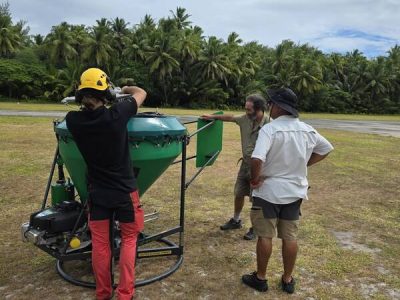
Three hotspots are in the trial: Kibocha, Pelican and Garissa. At each one a three-kilometer run of existing tall fence comes out and goes back as two different short designs, 1.5 kilometers of a three-foot build and 1.5 kilometers of a two-foot build. Construction began after delays caused by heavy rain.
Those sections are then subdivided further, so that outrigger height, outrigger spacing and the way vegetation under the wire is managed can be compared against one another while post spacing, post depth and electrical voltage are held constant. That is what makes this an experiment rather than another round of trial and error.
Measurement runs on three tracks at once. Infrared camera traps along the experimental sections record what happens before a breach: how many elephants approach, how they respond to the configuration in front of them, and whether the approach ends in a retreat or a break. Fence technicians walk daily inspections and voltage checks, logging damage by GPS with the length and nature of it and the animal responsible. Monthly maintenance costs are tracked alongside both.
That third track is the one that usually gets left out. A fence elephants never break but that swallows a maintenance budget is not a solution, and neither is a cheap fence that fails. Ol Pejeta is explicit that it is looking for a design that works on all three axes at once: elephant behavior, conservation outcome and cost.
What about everything that is not an elephant?
A barrier built for the largest land mammal on earth sits in a landscape full of animals that weigh a few kilograms. Dropping a fence line to two feet and changing what grows underneath it changes the barrier for all of them.
The project is therefore also assessing the effect of each configuration on non-target species, naming honey badgers, porcupines, tortoises and aardvarks as the kind of animal it has in mind. That matters most if the design is eventually recommended elsewhere, which is the stated point of running it at Ol Pejeta at all. If short fence deters elephants at lower construction and maintenance cost, it becomes an option for protected areas that could never afford the tall version.
Is anyone in the zoo world paying for this?
Not directly, on the published record.
Ol Pejeta names two supporters of this project: the Elephant Crisis Fund and Save the Elephants. The Elephant Crisis Fund was created by Save the Elephants and the Wildlife Conservation Network in partnership with the Leonardo DiCaprio Foundation, now Re:wild, which funded its launch in 2013. None of those four is a zoo or an aquarium.
One accredited zoo does appear a step further back. The fund’s published supporters list names Oakland Zoo among its funders, alongside The Walt Disney Company and a set of private foundations. That is money into the fund, not money identified with this fence trial, and neither Ol Pejeta nor the fund names Oakland Zoo or any other zoological institution in connection with the work described here. We went looking for a zoo behind this one and did not find a named one. That is a finding, not a gap.
How threatened is the animal on the other side of the wire?
The IUCN Red List assesses the African savanna elephant, Loxodonta africana, as Endangered globally, with a decreasing population. Ol Pejeta’s account of the project claims no category for the species and does not need to, because its framing is about coexistence rather than rarity. Both facts are worth holding together. The animals pushing over posts on the northern boundary belong to an Endangered species, and the households losing crops to them are the ones whose tolerance decides whether that species has a future outside fenced land.
Results will take a season or more. What exists until then is an unusually well-specified question, which in applied conservation is most of the work. For related coverage from the same conservancy, see our report on Ol Pejeta’s technical apprenticeship program in Laikipia.
Quick answers
- What is Ol Pejeta testing?
Whether a fence two or three feet high stops elephants better than a tall one. At three breakage hotspots, Kibocha, Pelican and Garissa, a three-kilometer run of tall fence is being replaced by 1.5 kilometers of a three-foot design and 1.5 kilometers of a two-foot design.
- Why would a shorter fence deter an elephant?
Because elephants break fences by getting close enough to lift and twist wires with their tusks or push posts over with their feet. Short fences carry angled outriggers that hold the animal away from the posts and wires, so reach rather than height is what the design is working on.
- How is the experiment being measured?
On three tracks. Infrared camera traps record elephant approaches and whether they end in a retreat or a break. Fence technicians run daily inspections and voltage checks and log damage by GPS. Monthly maintenance costs are tracked alongside both, so cost is judged with effectiveness.
- Which zoos fund this work?
None that are named. Ol Pejeta credits the Elephant Crisis Fund and Save the Elephants. Oakland Zoo appears on the Elephant Crisis Fund's published supporters list, but neither the conservancy nor the fund names any zoological institution as a funder of this fence project.