
The Metro Richmond Zoo took the Zoological Association of America’s 2025 Long-Term Commitment and Significant Propagation of a Species Award for its work with Diana monkeys, an award announced at the ZAA annual conference in San Antonio, Texas, from September 30 to October 4, 2025. More than 450 zoo professionals attended.
The number behind the award is 39. That is how many Diana monkeys have been born at the Virginia zoo since 1997, which makes it one of the primary institutions in the United States breeding the species at all.
What is a Diana monkey?
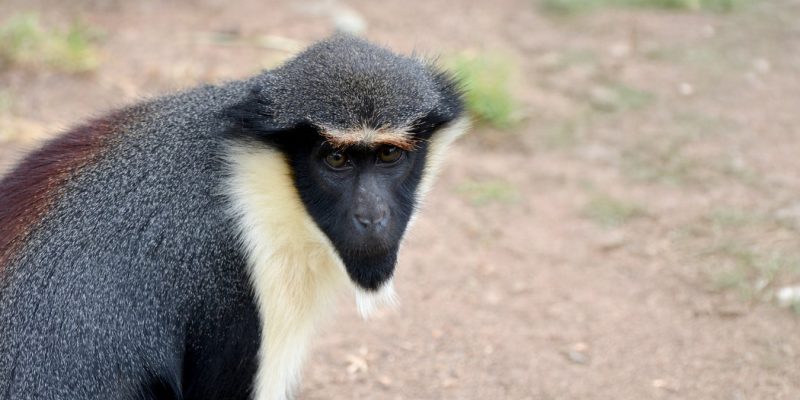
A West African forest guenon, and one of the more striking primates in any collection. The animal is slate gray with a deep chestnut saddle low on the back, a black face, and a white throat and beard that reads from a distance like a bib. Guenons are the large genus of African monkeys that also includes the vervet and the De Brazza’s, and the Diana is among the most arboreal of them, living high in the canopy of the rainforests of Liberia, Ivory Coast, Ghana and Sierra Leone.
That canopy habit is part of why the species is in trouble. A monkey that rarely comes down is a monkey that cannot cross a cleared gap, so logging does more than shrink the forest: it cuts the population into pieces that no longer breed with each other.
The IUCN Red List, version 2026-1, assesses the Diana monkey (Cercopithecus diana) as Endangered, with a decreasing population. The zoo’s own description of the species as endangered is exactly right, which is worth saying plainly, because it is not always how these releases go.
Twenty years of accreditation, and a hippo case study
The zoo was separately recognized at the conference for 20 years of continuous ZAA accreditation. It has held it since the association was founded in 2005 and has renewed it every five years since.
The other thing Metro Richmond brought to San Antonio was not an animal at all. The zoo’s communications manager and general manager presented a case study on Poppy, the pygmy hippo calf whose first year at the zoo turned into international coverage, and walked the room through her measurable effect on attendance, media pickup and conservation fundraising. It was, in other words, a public relations talk given to other zoos about how to handle the moment when one of your animals becomes famous.
Then they attached a number to it. During the presentation the zoo announced a $50,000 donation to pygmy hippo conservation, to be split among several non-governmental organizations. The zoo did not name the recipients.
A calf goes viral, the gate receipts and the merchandise and the coverage follow, and $50,000 of it comes back out as funding for the wild population of a species the IUCN also lists as Endangered. Poppy’s own story ran through our pages when the zoo held a public party for her first birthday that December.
Why the propagation award is the harder one
Breeding awards go to institutions that have kept at something long past the point where it is novel. Thirty-nine births over 28 years is roughly one Diana monkey every nine months, sustained across staff changes, facility changes and four rounds of accreditation renewal. The Metro Richmond Zoo has been running this program since two years after it opened, and the anniversary timeline it published in its thirtieth-year retrospective lists the first Diana monkey birth in 1999 and the 25th in 2018.
For a species whose wild population is being cut into fragments by logging, a North American breeding line that has run without a break since the Clinton administration is not a footnote. It is the reason there is anything to put back.
Source: Metro Richmond Zoo, Metro Richmond Zoo Shines at 2025 Zoological Association of America Conference, published October 22, 2025. Red List categories from the IUCN Red List of Threatened Species, version 2026-1.
Quick answers
- What is a Diana monkey?
A West African forest guenon with a black face, a white throat and beard and a chestnut saddle on the lower back. It lives high in the rainforest canopy of Liberia, Ivory Coast, Ghana and Sierra Leone.
- How endangered is the Diana monkey?
The IUCN Red List, version 2026-1, assesses Cercopithecus diana as Endangered, with a decreasing population.
- What award did the Metro Richmond Zoo win?
The Zoological Association of America's 2025 Long-Term Commitment and Significant Propagation of a Species Award, for Diana monkeys. The zoo has had 39 born since 1997.
- What was the $50,000 donation for?
Pygmy hippo conservation, announced during the zoo's conference presentation about Poppy and to be split among several non-governmental organizations. The zoo did not name the recipients.