
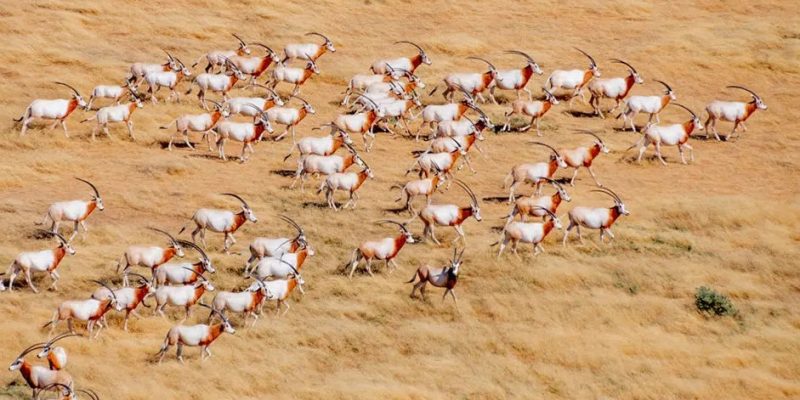
In 2004 the Saint Louis Zoo put money into starting a foundation for a desert nobody was working in. Nineteen years later the scimitar-horned oryx came off the Extinct in the Wild list.
The IUCN downlisted the species from Extinct in the Wild to Endangered in December 2023, on the strength of a reintroduction in the Ouadi Rime-Ouadi Achim Faunal Reserve in Chad that has put more than 600 animals back on the ground. It is one of a handful of times in the history of the Red List that a species has walked back from that category.
Where the organization came from
The Saint Louis Zoo does not describe its role in the past tense, and the wording on its own page is worth reading closely:
“Beginning in 2004, funds through the Zoo’s WildCare Institute made significant investment in start-up costs for a foundation focused on the perils of wildlife in the region. Soon, other zoos followed and Sahara Conservation, the first non-governmental organization devoted exclusively to wildlife conservation in this important desert ecosystem, was born. The Saint Louis Zoo served as the organization’s U.S. headquarters.”
Saint Louis Zoo WildCare Institute, Saharan Wildlife Recovery Center
Read that again. A zoo did not fund an existing NGO. It paid the start-up costs of an organization that did not exist, then housed it. Lisa Kelley, vice president for conservation, education and science at the zoo and director of the WildCare Institute, sits on Sahara Conservation’s U.S. board today.
Sahara Conservation lists the Saint Louis Zoo twice, once as a strategic partner alongside the Environment Agency Abu Dhabi, the European Union, the World Bank and the republics of Chad and Niger, and again as a technical and delivery partner. No other institution appears twice.
Where the animals came from
The founding herd was assembled from animals that existed only because collections had kept them. The zoo’s own framing of the Recovery Center’s mission is blunt about it: to link zoo expertise and resources with conservation action in the Sahara, drawing on the fact that genetically healthy herds of scimitar-horned oryx remained in human care in zoos and private collections around the world.
The Zoological Society of London worked on feasibility studies for this from 1985, and animals from ZSL Whipsnade Zoo went into the founding herd.
“continued to provide scientific and conservation support to the reintroduction programme”
Dr Andrew Terry, director of conservation and policy, ZSL
Tim Wacher, ZSL’s senior conservation biologist, supported the post-release monitoring that produced the population figures the downlisting rests on.
How many zoos, exactly
Sahara Conservation’s partners page names more than forty accredited zoos and zoo associations. A partial list, because the full one runs long: Al Ain Zoo, Buffalo Zoo, Dallas Zoo, the Detroit Zoological Society, Dublin Zoo, Erlebnis-Zoo Hannover, Fort Wayne Children’s Zoo, Fossil Rim Wildlife Center, Kansas City Zoo, Lion Country Safari, The Living Desert, Marwell Wildlife, the Maryland Zoo, Nashville Zoo, the North Carolina Zoo, Oklahoma City Zoo, the Royal Zoological Society of Scotland, San Diego Zoo Wildlife Alliance, Zoo Wroclaw, the Zoological Association of America, and Conservation Centers for Species Survival.
The organization describes its own partner base as including zoological institutions and associations from around the world. It puts them in the same sentence as national governments and multilateral organizations, which is roughly the right weighting.
Why this one is the answer to the question
People ask what zoos are for. The honest answer is usually complicated. This one is not.
A desert antelope was gone from the wild. The animals that could rebuild it were in zoos. A zoo paid to create the organization that would do the rebuilding, other zoos followed, and twenty years later there are more than 600 of them in Chad and the Red List category has moved.
The work continues in Niger, where the same organization runs addax and dama gazelle programs in Termit and Tin Toumma.
The same pattern of institutional funding shows up wherever this beat looks closely, including the parrot and snail work at Loro Parque Fundación.
Sources: Sahara Conservation; Saint Louis Zoo WildCare Institute; ZSL.