
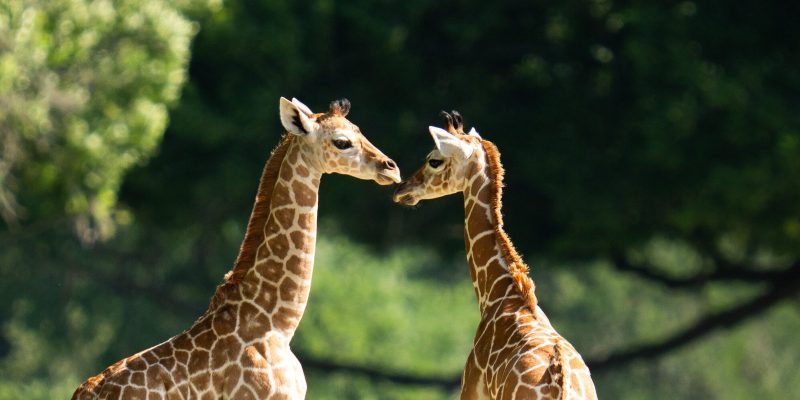
Fossil Rim Wildlife Center has two new reticulated giraffe calves, and the staff who look after them chose the names by drawing lots. Both names turned out to describe something you can actually see on the animal.
Paisley, the older of the two, was born on May 13 to a first-time mother, Betty Jane. Animal Care Specialist Karlen picked the name because she liked it, and then it fit better than intended: Paisley carries four clover-shaped markings on her chest, which is about as close to a paisley print as a giraffe is going to get.
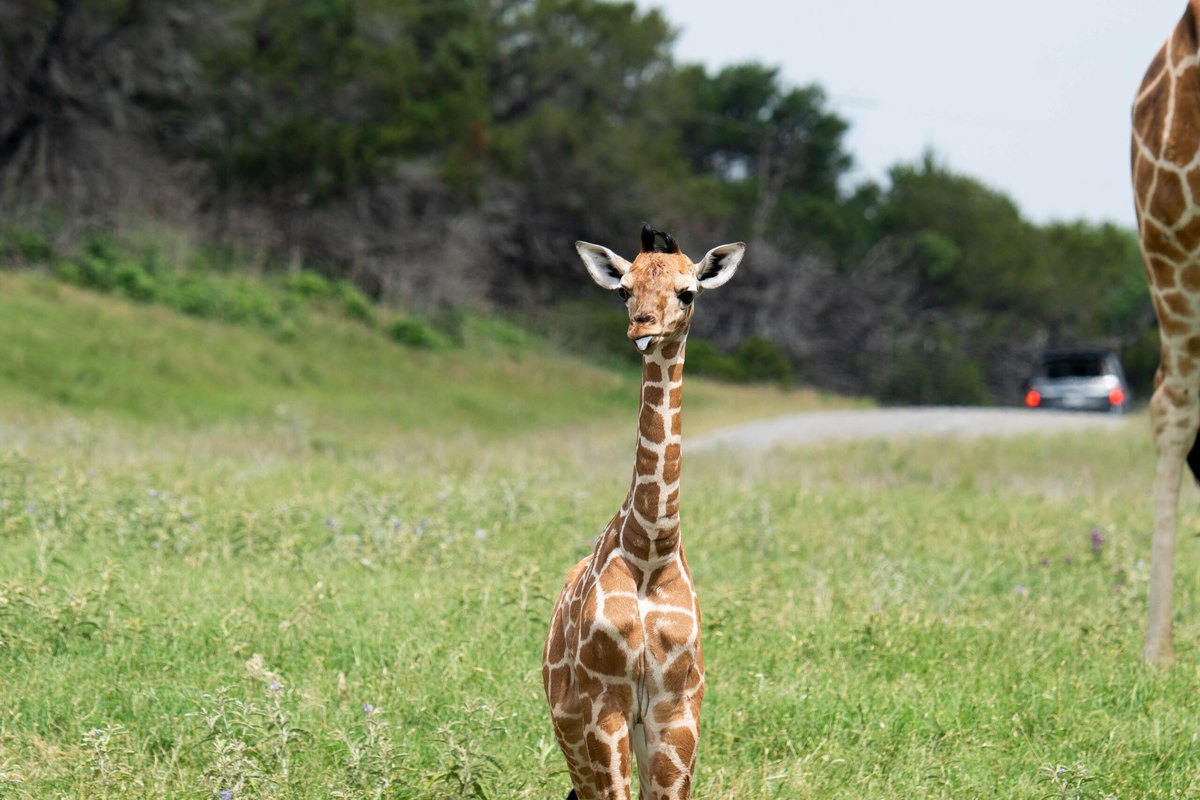
Pretzel, Jan’s calf and the younger of the two, was named by Environmental Engagement Specialist Anna for the way giraffes sleep. A resting giraffe folds its legs under itself and tucks its head back against its own hindquarters, which leaves it looking like something twisted into a loop. Pretzel’s coat earned the name twice over: it is unusually light, nearly every patch has tiny dots inside it like salt grains on a pretzel, and there is an arrow-shaped marking on her shoulder.
The spots are an identification system
Naming a calf after its markings sounds like a sentimental choice. It is closer to a working method.
A giraffe’s coat pattern is unique to the individual and does not change over its life. The patches grow with the animal, but their shape and arrangement stay put, which makes a giraffe effectively barcoded from birth. Keepers use it to tell a herd apart at a glance, and researchers studying wild populations use the same property deliberately: photograph the same flank from the same angle on different days and you can build a census, track individuals between sightings and estimate survival, without ever putting a collar or a tag on anything.
So Karlen counting four clovers on Paisley’s chest and Anna noticing the salt-grain dots on Pretzel is the same observation a field researcher makes, done at closer range.
What to look for on a visit
The two calves have become, in the center’s description, completely inseparable, and spend almost all their time together. The center says they are not yet bold enough to hand-feed, and expects that to come as they gain confidence.
Fossil Rim runs as a drive-through, which changes the encounter. The animals are not behind a barrier arranged around a viewing angle; the road goes through the pasture and the giraffes decide how close to come. For a calf still working out whether a stopped car is interesting or alarming, that is also a gradual training process, conducted by the public without anybody describing it that way.
The species behind the calves
Reticulated giraffes are not doing well in the wild, and the gap between how common they look in American collections and how they are faring in Africa is wide. The IUCN Red List assesses the reticulated giraffe as Endangered, in an assessment dated March 16, 2018, counting 11,048 mature individuals across Ethiopia, Kenya and Somalia, with the population decreasing. The assessment treats the animal as a subspecies, Giraffa camelopardalis ssp. reticulata. Since then the IUCN has moved to recognizing four giraffe species rather than one, so a species-level reassessment under the name Giraffa reticulata is pending rather than published.
Reticulated describes the coat and means net-like: large, flat, liver-colored patches divided by narrow white lines, with the sharp edges that other giraffe populations lack. It is the pattern most people picture when they picture a giraffe, which is part of why the conservation status surprises people.
Fossil Rim is a non-profit that works on breeding programs for endangered and threatened species, and giraffes sit alongside smaller and less famous animals on the same site; the center bred a litter of black-footed cat kittens earlier in 2026. The IUCN assessment has the full picture on the giraffes.
Source: Fossil Rim Wildlife Center, August 14, 2026.
Quick answers
- What are the names of the Fossil Rim giraffe calves?
Pretzel and Paisley. Fossil Rim held a drawing among staff for the right to name them.
- Why are they called Pretzel and Paisley?
Paisley has four clover-shaped markings on her chest. Pretzel was named for the folded posture giraffes take when they lie down, and her light coat has tiny dots inside nearly every patch, like salt on a pretzel, plus an arrow-shaped marking on her shoulder.
- Who are the calves’ mothers?
Paisley, the older calf, was born on May 13 to a first-time mother, Betty Jane. Pretzel is Jan’s calf.
- Can giraffes be identified by their spot patterns?
Yes. The pattern is unique to the individual and does not change as the animal grows, so researchers photograph wild giraffes to identify them, build censuses and track survival without collars or tags.
- Is the reticulated giraffe endangered?
Yes. The IUCN Red List assesses it as Endangered, in an assessment dated March 16, 2018, counting 11,048 mature individuals across Ethiopia, Kenya and Somalia, with the population decreasing.
- Can you feed the giraffes at Fossil Rim?
Fossil Rim is a drive-through wildlife center. As of August 2026 the center said the two calves were not yet bold enough to hand-feed, and expected that to change as they gained confidence.