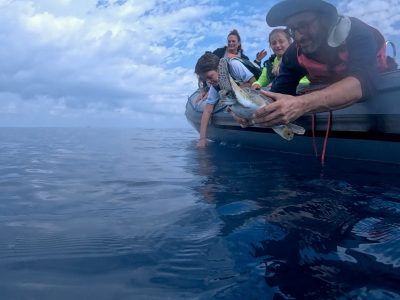

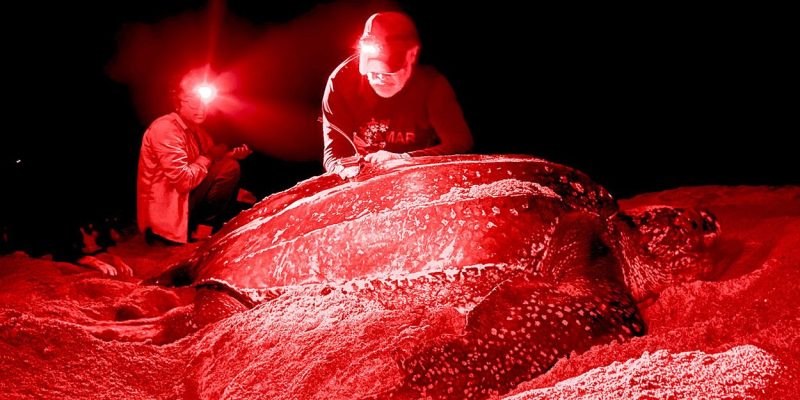
A New England Aquarium team tagged 23 nesting leatherback sea turtles in Puerto Rico this year, four more than its previous record.
Researchers from the aquarium’s Anderson Cabot Center for Ocean Life and its rescue and rehabilitation team spent late April and May on the island for a sixth field season, working with community-led conservation groups to track how and where leatherbacks nest in the Atlantic. They sighted 26 nesting turtles in total.
“I feel like every year I say this, but it’s probably our most successful season to date,” said Dr. Kara Dodge, the research scientist who has led the project since it started.
Finding turtles in the dark
Leatherbacks nest at night, which means patrolling beaches after dark. The team has relied on thermal drone surveys flown by Luis Crespo of Amigos de las Tortugas Marinas, whose work was first backed by the aquarium’s Marine Conservation Action Fund.
This year the aquarium bought its own thermal drone and brought the capability in-house. Crespo trained Monica Zani, a research scientist and drone pilot from the center’s right whale team, to fly it.
“When we started flying at night, we were trying a new technique that others weren’t sure would work. Now other project sites are picking up the same technology,” Crespo said. “Having someone from the Aquarium team learn to fly alongside us this season means the technique keeps spreading, and it was full circle to work with the Aquarium, as they were extremely supportive of this work from the start.”
New nesters and old hands
The behavior differed sharply between groups. “We had, basically, the ‘new girls’ who had likely never nested before, and they were all over the north shore. They were really messy,” Dodge said. “But then, the experienced nesters came back over and over to the same beach.”
That difference is the research question. Sea turtle population estimates usually come from counting nests, which only works if you understand how often an individual nests and how widely she spreads those nests across a season.
The team also re-encountered five turtles satellite-tagged earlier, in 2023 by the St. Croix Sea Turtle Project and in 2024 by the aquarium, and re-tagged three of them.