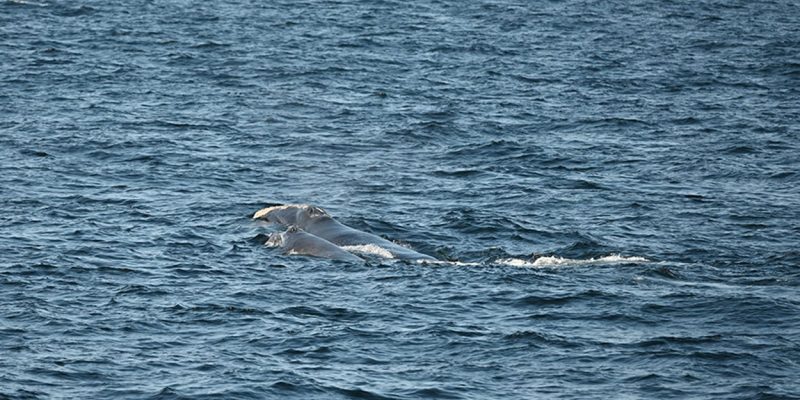
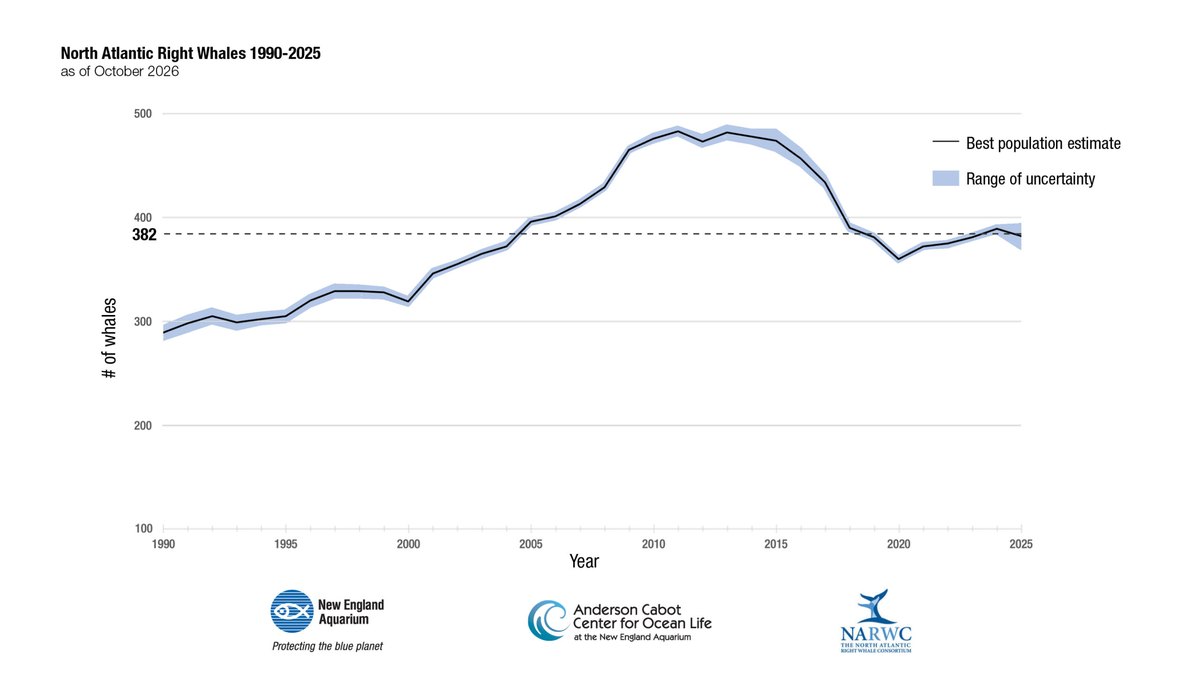
There are an estimated 382 North Atlantic right whales left. That number, released by the North Atlantic Right Whale Consortium and carrying a margin of plus or minus 11, is for 2025, and it is about seven animals below the 2024 figure once that year was recalculated with newer sighting data. A 1.8 percent decline.
In the same window, 24 calves were born. That is the most in more than a decade.
Both of those things are true, and holding them together is the whole of what the Consortium said this week.
What exactly was announced?
Every autumn at its annual meeting the Consortium publishes a fresh population estimate for the species, and revises its earlier estimates as sightings accumulate. This year’s numbers: 382 for 2025, against a recalculated 389 for 2024. The count of reproductive females, the figure that governs whether the species can rebuild at all, held steady at 73.
“The newly released right whale population estimate underscores that more work is needed to protect this species. The population is not yet on a clear path to recovery and is incredibly vulnerable to entanglements and vessel strikes, threats we know how to reduce. Recovery for this species depends on sustained protective actions in both the US and Canada.”
That is Heather Pettis, who leads the right whale research program at the New England Aquarium’s Anderson Cabot Center for Ocean Life and chairs the Consortium.
Why does a flat line count as bad news?
Because of the shape behind it. The Consortium’s series starts below 300 in 1990 and climbs for twenty years to a peak close to 480 around 2011. Then it falls hard, bottoming near 368 by 2020. What has happened since is not recovery so much as a halt: the line has steadied and ticked up slightly, and it is now roughly back where it stood in the mid-2000s.
For a whale that can live into its sixties and produces a calf every few years at best, steady is not safe. It means the species is replacing what it loses and little more, and that every avoidable death moves the line directly. The North Atlantic right whale is assessed as Critically Endangered on the IUCN Red List. NOAA Fisheries maintains a species profile covering the current protection measures in United States waters.
What killed whales this year?
Two deaths were detected in 2026. One was an entanglement and one is unexplained.
Division, Catalog #5217, was a four-year-old male. He was last seen free of gear on 5 July 2025 in the Gulf of St. Lawrence and was sighted severely entangled off Georgia late that year. Authorized responders in the southern United States tried repeatedly to free him and could not. He was found dead off North Carolina in January 2026. Fisheries and Oceans Canada and experts at the National Oceanic and Atmospheric Administration later determined the gear came from a Canadian snow crab fishery.
Weeks later, in early February, a second carcass washed ashore on a barrier island off Virginia. Anderson Cabot Center scientists identified her as a three-year-old female, since cataloged as #5393. The cause of death is unknown. She was the 2023 calf of a female called Porcia, Catalog #3292, whose three previous calves have all died, two of them in fishing gear.
Beyond the two deaths there were eight recorded human-caused injuries. Three whales were carrying gear when seen. Four had shed gear but remained injured. One, a calf born in 2025 to a female called Check Mark, was struck by a vessel. Catalog #5192, still entangled, was seen off Montauk, New York, in September in extremely poor condition and is not expected to survive.
What are the scientists asking for?
Continuity, and they were unusually direct about the politics of it. The Consortium’s statement notes that recent proposed changes to federal regulations and laws, including a weakening of the Endangered Species Act, could expose right whales to further harm.
“Actions to further delay entanglement protections and deregulate vessel strike measures will stall meaningful progress that is already underway to protect the species and ensure a thriving blue economy. Right whales cannot afford to wait any longer for adequate protection.”
Pettis again. Philip Hamilton, a senior scientist at the Anderson Cabot Center, put the same point from the whales’ side.
“With 24 calves born this year, the whales are doing their part. But the overall lack of growth in the population is even more concerning when seen in the context of a number of proposed management setbacks in the US this year. It’s disheartening to see our efforts to protect these animals backslide.”
Those are the researchers’ positions, stated in their own words, and readers can weigh them against the regulatory record themselves.
Who counts the whales?
The Consortium, which is not a government body and not a single institution. It began in 1986 as a group that agreed to share data, with the New England Aquarium as a founding member, and now includes research and conservation organizations, the shipping and fishing industries, technical experts, United States and Canadian government agencies, and state and provincial authorities. It is cited internationally as a model for how to organize this kind of work around a single species.
The counting itself runs through the North Atlantic Right Whale Catalog, maintained at the Anderson Cabot Center, which holds a file on every known animal: photographs, lineage, injuries, who its mother was. That is why a carcass on a Virginia beach can be identified as Porcia’s 2023 calf, and why 24 calves is a number anybody can check rather than an impression.
The 2026 to 2027 calving season is already underway and already producing. Its first mother and calf pair turned up five days before survey teams were due to start looking, spotted by two boaters who picked up the phone. Twenty-four calves is what this population can do when it is left alone to do it.
Quick answers
- How many North Atlantic right whales are left?
An estimated 382, with a margin of plus or minus 11, for 2025. That is about 1.8 percent below the 2024 estimate of 389 once that year was recalculated using newer sighting data.
- How many right whale calves were born in 2025 and 2026?
Twenty-four, the most in more than a decade. The last was a calf born to a female called Silt, Catalog #1817, first sighted in Canadian waters in September 2026.
- What is the North Atlantic Right Whale Consortium?
A data-sharing body founded in 1986, with the New England Aquarium as a founding member. It includes research and conservation organizations, the shipping and fishing industries, technical experts, United States and Canadian government agencies, and state and provincial authorities.
- What is killing North Atlantic right whales?
Entanglement in fishing gear and vessel strikes. Two deaths were detected in 2026, one from an entanglement traced to a Canadian snow crab fishery and one of unknown cause, alongside eight recorded human-caused injuries.