
Rosie hatched at OdySea Aquarium in early December 2019, the ninth African penguin chick born at the Scottsdale aquarium and the first for parents Mojo and Lemieux. She could not sit up.
Newly hatched penguin chicks rest on their bellies under a parent for the first several days, so there was nothing alarming at first. The concern came when the milestone did not arrive. Her feet were also slightly misaligned.
Watching without interfering
Regular health checks showed Rosie gaining weight steadily, good evidence that her first-time parents were feeding her well. To work out what was happening without disturbing the family, the team installed cameras on the nest.
The footage turned up something nobody had predicted. Other penguins in the colony kept crowding the nest, trying to push their way in, and Mojo and Lemieux were responding by hunkering down over their chick.
“We suspected the parents may have been overly protective and may have been hunkering down on the chick a bit too enthusiastically when other birds in the colony were nearby,” said Jessica Peranteau, director of animal care and education. “Our fear was that in their attempt to protect and incubate their baby, they were inhibiting Rosie’s ability to move about the nest area on her own and appropriately develop.”
Staff cordoned off a nursery area to keep the neighbors out and give the parents room to move. It is a good illustration of what nest cameras are actually for: the problem was a social dynamic in the colony, and no amount of examining the chick would have revealed it.
What the radiographs showed
Rosie was moved off exhibit for fuller testing. Radiographs found skeletal abnormalities.
“Despite the evaluations and tests, we could not conclusively determine if she hatched with these abnormalities or if the parents were a little too zealous in their care for her,” said Dr. Eric Anderson, OdySea’s director of animal health. “What we did know was that she was eating well, growing consistently, and did not appear to be in any discomfort. She had some obvious physical challenges, and the next step was to devise a plan to help her adapt and thrive despite these obstacles.”
That is a careful thing to say publicly, and worth noticing. The honest answer to how it happened was that nobody knew, and the aquarium said so rather than picking the tidier explanation.
Physical therapy for a penguin
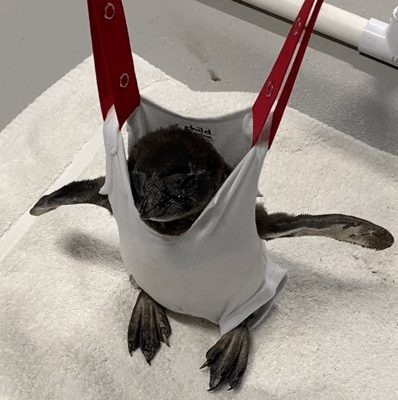
The goal was to strengthen her core and legs and move her from lying on her belly to sitting upright, bearing weight, and eventually walking, using a support sling to hold her in position while she built the muscle to hold it herself.
Rosie was eight months old when OdySea told her story in August 2020, and by then she was penguin number 39 in the colony.
Why it matters beyond one bird
African penguins are endangered, and as the first offspring of a new pair, Rosie was genetically valuable to the managed population, which is the unsentimental reason a great deal of effort went into a chick that could not sit up.
The sentimental reason is the one the team gave. “All penguin chicks are adorable,” Peranteau said. “But there was something special about Rosie that made her extra endearing to us right from the start.”
Hand-rearing and intensive intervention have become routine tools in penguin programs: Aquarium of the Pacific hatched a Magellanic chick to two rescued parents under similar close supervision.