
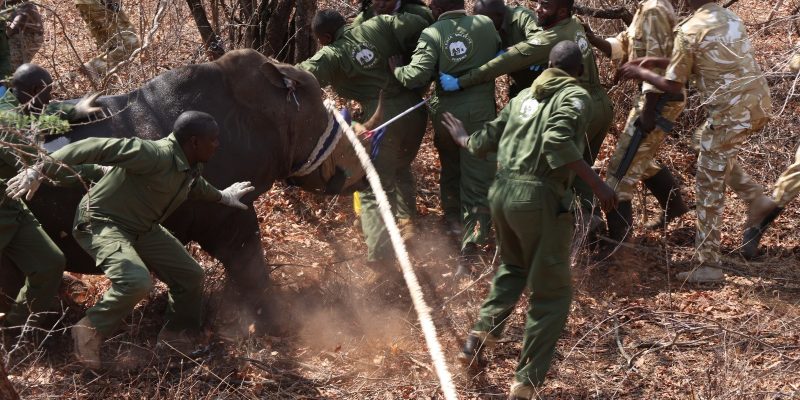
On World Rhino Day, September 22, 2026, Kenya launched the expanded Tsavo West Rhino Sanctuary: 3,200 square kilometers inside Tsavo West National Park, which the Kenya Wildlife Service says makes it the largest rhino sanctuary in the world. The number that explains why it was needed is the old one. Before the expansion, nearly 150 rhinos were living in 92 square kilometers.
A sanctuary that worked too well
The service is unusually candid about the problem it was solving. The old Ngulia sanctuary inside Tsavo West had kept its rhinos safe from poachers and had then run into a different limit: breeding slowed, territorial conflicts increased, and the service says those conflicts sometimes had fatal consequences. In its own words, the sanctuary had become a victim of its own success.
That is not a Tsavo peculiarity. The Tsavo Trust, which has worked this rhino range alongside the service for years, puts it in national terms: a stable black rhino population normally grows between 5 and 9 percent a year, and the rate drops as a population approaches the carrying capacity of its habitat, because breeding slows and fighting increases. Six of Kenya’s eight fenced rhino sanctuaries are currently holding more rhinos than their habitats can sustain and are registering exactly that drop. At least fifty black rhino calves are born in Kenya every year, and they all need somewhere to grow up.
So the expansion is not a bigger fence around the same idea. It is the release valve for a national breeding program that had filled its containers.
What was actually built
240 kilometers of secure fencing, 47 new water points, and microchip tracking that lets rangers account for individual animals across an area thirty-five times the size of the old sanctuary. Tourism and Wildlife Cabinet Secretary Rebecca Miano launched it. The service credits the funding to the Kenyan government through the Ministry of Tourism and Wildlife, the Kenya Wildlife Service itself and the National Treasury, together with conservation partners including the Sheldrick Wildlife Trust and the Tsavo Trust.
Water is the part that is easy to skim past and hardest to do. Forty-seven water points is what turns 3,200 square kilometers from a map into habitat an animal can actually use in a dry season.
Which zoo is behind this?
One, and it takes two steps to get there, which is the kind of chain worth following rather than giving up on.
The Kenya Wildlife Service names the Tsavo Trust as a conservation partner on the expansion. The Tsavo Trust, in turn, publishes the partner list for the Tsavo Rhino Program on its own site: the Kenya Wildlife Service, the Wildlife Research and Training Institute, the Tsavo Trust, the USFWS Rhinoceros and Tiger Conservation Fund, the Wildlife Conservation Network’s Rhino Recovery Fund, WildLandscapes International, Re:wild, and the Zoological Society of London.
The Zoological Society of London runs ZSL London Zoo and ZSL Whipsnade Zoo, and its involvement here is not a donation made at a distance. The society says it has worked with the Kenya Wildlife Service for thirty years on flagship species including the black rhino, and has worked in the Tsavo Conservation Area for many years specifically to protect it. Its field manager in the Tsavo Conservation Area, Moses Wekesa, leads a team of six full-time monitoring and implementation staff. The society’s stated work in Kenya includes exactly the things this sanctuary now needs at scale: wildlife monitoring and law-enforcement training, SMART-based patrols, habitat assessment and management, and fitting collars and transmitters. More than 500 rangers in Kenya have been trained to use SMART through that program, across 16 partner organizations and roughly 20,036 square kilometers.
So a zoological society in north London has staff on the ground in the rhino range that just got thirty-five times bigger. That is the shape of connection this beat exists to find, and it took a two-step trace through a Kenyan trust’s partner page to see it, because the government release naturally credits the government.
The Tsavo Trust also publishes the operating number behind that partnership: annual support to the Kenya Wildlife Service in the Tsavo West rhino range of at least $350,000, which over five years has paid for 1,393 aerial patrol hours covering 158,802 kilometers, rhino horn transmitter and ear-notching work on 35 animals, eight sand dams, and joint teams that made 779 arrests.
For scale, the Association of Zoos and Aquariums reports that its 235 accredited and certified members spent approximately $372.4 million on conservation across 139 countries in 2025. No published breakdown isolates the African share and we do not print one.
The Sheldrick Wildlife Trust, the other partner the service names, has no zoo funding we have been able to verify, which is consistent with what we found the last time we traced it.
Where Kenya’s rhinos actually stand
The service says Kenya holds nearly 78 percent of the world’s remaining Eastern black rhinos and is working toward a national target of 2,000 rhinos by 2037. The Tsavo Trust says Kenya holds just under 1,000 black rhinos, about 80 percent of the subspecies. The two are describing the same thing from slightly different angles and both are worth having.
The historical line is the one that makes the sanctuary legible. Kenya’s Black Rhino Program was launched in 1984, after the national black rhino population fell from an estimated 20,000 in 1970 to fewer than 300 animals. Since 1989 the service has managed the country’s rhinos as a single metapopulation rather than as separate herds, which is why a space problem in one sanctuary is a national problem and a solution in Tsavo West is a national solution.
A note on the numbers
The IUCN Red List assessment for the Black Rhinoceros, Diceros bicornis, was made by R. Emslie on January 14, 2020 and lists the species as Critically Endangered under criteria A2abd+4abd, with 3,142 mature individuals and, notably, an increasing population trend. A separate Green Status assessment published in 2024 puts the species’ recovery score at 24 percent, meaning a species that is climbing but is nowhere near restored across its former range.
Two things follow for the figures in this story. The Red List’s 3,142 is a 2020 count of mature individuals across the whole species, not a current total of all black rhinos, and the percentages quoted by the service and the trust are about the Eastern subspecies, Diceros bicornis michaeli, which has no separate current global entry on the Red List at all. So the Eastern black rhino numbers in this piece come from Kenyan national reporting rather than from an assessment, which is the honest place to put them. Nobody here is overstating anything: a Critically Endangered species with an increasing trend is precisely what forty years of this program was supposed to produce, and the overcrowding it has now caused is the most welcome problem in African rhino conservation.
The service has published nothing further about the sanctuary since the launch, and its newest item of any kind as of this writing is dated September 28, 2026.
We covered the other half of Kenya’s rhino arithmetic recently in the first year of a single orphaned black rhino calf. Tsavo West is the same program seen from the top, where the question stops being whether a calf survives and becomes where 150 of them are going to live.
Quick answers
- What did Kenya launch on World Rhino Day 2026?
The expanded Tsavo West Rhino Sanctuary, 3,200 square kilometers inside Tsavo West National Park, which the Kenya Wildlife Service says is the largest rhino sanctuary in the world. Tourism and Wildlife Cabinet Secretary Rebecca Miano launched it on September 22, 2026.
- Why was the expansion needed?
Space. Nearly 150 rhinos were living in a 92-square-kilometer sanctuary. Breeding slowed, territorial conflicts increased and the service says those conflicts sometimes had fatal consequences. It describes the old sanctuary as a victim of its own success. Six of Kenya's eight fenced rhino sanctuaries are currently over the carrying capacity of their habitat.
- What was built?
240 kilometers of secure fencing, 47 new water points and microchip tracking for individual animals. The service credits the Kenyan government through the Ministry of Tourism and Wildlife, the Kenya Wildlife Service and the National Treasury, with conservation partners including the Sheldrick Wildlife Trust and the Tsavo Trust.
- Which zoo is behind it?
The Zoological Society of London, which runs ZSL London Zoo and ZSL Whipsnade Zoo, and it takes two steps to see. The Kenya Wildlife Service names the Tsavo Trust as a partner; the Tsavo Trust's own partner list for the Tsavo Rhino Program names the Zoological Society of London. The society says it has worked with the service for thirty years on black rhino and has a field manager and six full-time staff in the Tsavo Conservation Area.
- How many black rhinos does Kenya have?
The Kenya Wildlife Service says Kenya holds nearly 78 percent of the world's remaining Eastern black rhinos and is targeting 2,000 rhinos by 2037. The Tsavo Trust puts the national figure at just under 1,000 black rhinos, about 80 percent of the subspecies. Kenya's population fell from roughly 20,000 in 1970 to fewer than 300 before the national programme began in 1984.
- What does the IUCN Red List say?
The Black Rhinoceros, Diceros bicornis, was assessed by R. Emslie on January 14, 2020 as Critically Endangered under criteria A2abd+4abd, with 3,142 mature individuals and an increasing population trend. A 2024 Green Status assessment puts its recovery at 24 percent. The Red List carries no separate current global entry for the Eastern subspecies, Diceros bicornis michaeli, so the percentages quoted here come from Kenyan national reporting rather than from an assessment.