
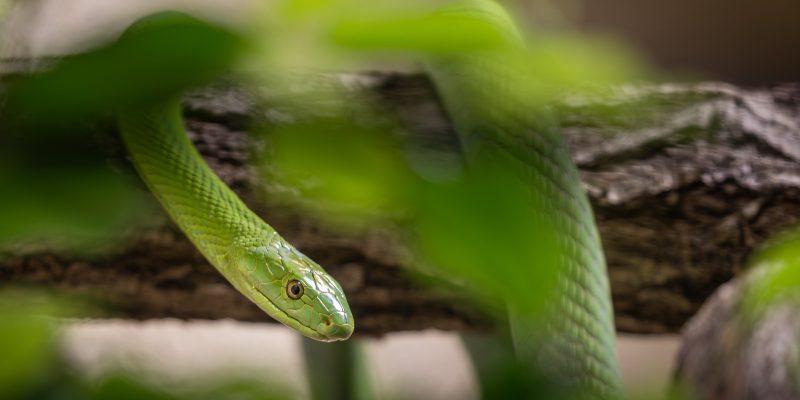
SAFARI PARK Dvůr Králové in the Czech Republic has added green mambas to its Venomous Africa exhibit, and now shows three mamba species side by side. The park announced the addition on July 8, 2026 and says the combination is unusual anywhere in the world.
The three are the green mamba, the West African mamba and the black mamba. Venomous Africa, which the park describes as the largest collection of African venomous snakes in the Czech Republic, sits alongside the adjoining Water Worlds section.
Three mambas, three habitats
Putting the three together is a lesson in camouflage that only works when you can see them at once. Green mambas live in lowland coastal forest and West African mambas in rainforest, and both are colored for fresh vegetation they vanish into. Black mambas come from savanna and rocky country, are gray to black rather than actually black, and disappear just as completely against dry branches and scrub. At around three meters, the black mamba is the longest venomous snake in Africa.
The two green mambas that arrived are young, not yet two years old. Adults reach roughly two meters, and the West African mamba is similar.
“Chovat tři druhy mamb vedle sebe je ale ve světovém měřítku opravdu neobvyklé.”
“Keeping three mamba species next to one another is genuinely unusual by world standards.”
Michal Podhrázský, zoologist at SAFARI PARK Dvůr Králové, in a statement translated from Czech
How you keep a room full of mambas
This is the part of the story that does not appear on the label. Mambas are fast, active snakes with strong neurotoxic venom, and the park is direct about the fact that they are dangerous in inexperienced hands, even though they do not seek out conflict with people.
So the pavilion runs on a layered protocol. During feeding, the building is closed to visitors. Keepers always work with the required safety equipment. And in standard situations, staff and venomous snakes are never in the same space at the same time.
That last rule is the one worth noticing, because it is a design constraint as much as a procedure. A terrarium built for a mamba has to be serviceable from outside the animal’s space, which shapes the hardware behind every pane of glass in the hall.
What else is in there
Venomous Africa and Water Worlds also hold Cape cobras, forest cobras, Nitsche’s viper, the rough-scaled bush viper and boomslangs. The park says most of these species are difficult to keep, partly because many come from places with a shifting seasonal climate that has to be simulated inside a terrarium.
Its evidence for being able to do that is a breeding record: the only repeated boomslang breedings in the world, plus Czech and European first breedings in other species. Podhrázský also points to the team’s success with cool-climate vipers from central and eastern Africa.
Why this counts as an exhibit story
A new animal on display is not usually news. A collection that lets a visitor compare three closely related species in one room is a different thing, because the comparison is the exhibit. Kölner Zoo made a similar bet when it opened its Drachenhaus for Komodo dragons, and Wilhelma in Stuttgart built a dedicated terrarium for San Francisco garter snakes for reasons that were as much about interpretation as about the snakes.
SAFARI PARK Dvůr Králové is better known internationally for hoofstock and for its role in northern white rhino conservation. The reptile house is the part of it that specialists talk about.
The park did not give the size of the Venomous Africa exhibit, the number of terraria in it, or where the two green mambas came from.
Source: SAFARI PARK Dvůr Králové, July 8, 2026.
Quick answers
- What did SAFARI PARK Dvur Kralove add?
Two young green mambas, announced July 8, 2026. They join black mambas and West African mambas in the Venomous Africa exhibit, so the park now shows three mamba species side by side.
- Why is that unusual?
Zoologist Michal Podhrazsky says keeping three mamba species next to one another is genuinely unusual by world standards. The park calls Venomous Africa the largest collection of African venomous snakes in the Czech Republic.
- How do keepers work safely around mambas?
The pavilion closes to visitors during feeding, keepers always use the required safety equipment, and in standard situations staff are never in the same space as a venomous snake.
- What else is in the exhibit?
Cape cobras, forest cobras, Nitsche's viper, the rough-scaled bush viper and boomslangs. The park holds the only repeated boomslang breedings in the world.