
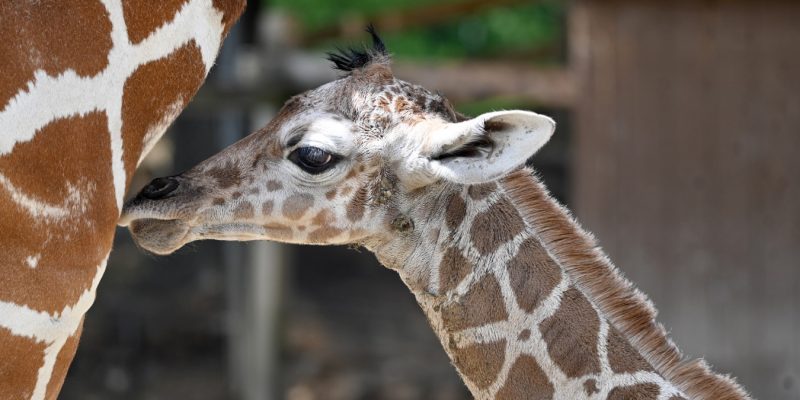
Giraffes give birth standing up, and the calf falls about six feet to the ground. At the Metro Richmond Zoo on the morning of May 9, 2026, a crowd of guests watched that happen in the open yard, because the mother declined to use the birthing stall.
The calf is a female reticulated giraffe, born to 14-year-old Chrissy and 9-year-old Bogey after a 15-month gestation. She arrived one day before Mother’s Day. She is the 24th giraffe calf born at the zoo since 2000.
The fall is the point, not the accident
It looks alarming and it is not. A giraffe calf emerges front feet first, followed by the head, neck and shoulders, and then drops. The fall severs the umbilical cord and the impact prompts the first breath. Calves are born standing nearly six feet tall and weighing 150 to 175 pounds, and they get up quickly: this one stood at 11:27 a.m., just over an hour after she was delivered at 10:25.
Staff confirmed active labor at 9:58 a.m., when the calf’s front hooves became visible. The usual arrangement at this zoo is a private birthing stall, for the comfort and safety of both animals. Once labor was underway it was clear Chrissy intended to deliver where she was, in front of visitors, and the staff adjusted around her rather than moving her.
Chrissy was bottle-fed here as a calf
The mother has a history at this zoo that is worth more than the birth itself. Chrissy was born on the property in 2011 and hand-raised on a bottle after her own mother did not care for her. Bottle-feeding an animal that is already taller than the person holding the bottle is an awkward proposition, and hand-raised hoofstock do not always integrate back into a herd or raise their own young well.
Chrissy did both. She joined the herd, and this is her third calf. The zoo describes her as protective, nurturing and comfortable around her keepers, and notes she has a reputation among the females there for quick deliveries.
Her previous calf, Clover, watched the birth from an adjacent space and stayed close to her mother throughout, then was immediately curious about her sister and could see, smell and lick her.
Where the reticulated giraffe stands
Reticulated giraffes are the ones with the sharply defined liver-colored patches separated by narrow cream lines, and they are native to Kenya, southern Ethiopia and Somalia. The IUCN Red List assessed the reticulated giraffe as Endangered in 2018, and the zoo’s release says so directly, which is worth noting because facilities more often overstate a listing than get it right.
On the population, the Giraffe Conservation Foundation puts the current figure at roughly 20,900 in the wild, down more than 40 percent from an estimated 36,000 about 35 years ago. That is a later count than the 2018 assessment, and the two are measuring at different moments rather than contradicting each other.
The wider giraffe picture is unsettled in a way that matters here. Giraffe was long treated as a single species with several subspecies, and how many species there really are is an open taxonomic question. The practical consequence is that the reticulated population has carried its own Red List assessment since 2018, separate from the figure people quote for giraffes generally.
Seeing her
Chrissy and her calf were expected to be outside most days, weather permitting, with the calf introduced to the wider herd and the larger habitat as she grew. She had not been named when the zoo announced her, and guests were invited to suggest names on the zoo’s social media posts.
This was a good year for reticulated giraffe calves in North American collections. Fort Wayne recorded one, and Gulf Breeze Zoo reported four in a single season.
Sources: Metro Richmond Zoo, “Giraffe Born Right Before Mother’s Day,” May 10, 2026; Giraffe Conservation Foundation, reticulated giraffe.
Quick answers
- Why do giraffes give birth standing up?
Giraffes deliver standing, and the calf falls about six feet. The fall severs the umbilical cord and the impact prompts the calf's first breath.
- How big is a newborn giraffe?
Nearly six feet tall and 150 to 175 pounds. This calf stood for the first time about an hour after birth.
- Is the reticulated giraffe endangered?
The IUCN Red List assessed the reticulated giraffe as Endangered in 2018. The Giraffe Conservation Foundation puts the current wild population at roughly 20,900.
- Who are the calf's parents?
Chrissy, a 14-year-old female born at the zoo in 2011 and hand-raised on a bottle, and Bogey, a 9-year-old male.