Drying mud is not soft ground. As a waterhole or a river pan goes down in the dry season it stiffens into something closer to setting cement, and an elephant that walks into it to drink can find it has closed around her legs. She cannot get the leverage to lift herself out, and the more she works at it the deeper she sits. That is the problem the Sheldrick Wildlife Trust flew two hours north to solve in Samburu, northern Kenya, in a rescue it described on October 26.
An adult female and her calf were stuck fast. The call came from contacts in Samburu, and the Trust’s pilot Roan loaded a Cessna 185 with the organization’s custom elephant straps and flew to them.
Why the calf came out first
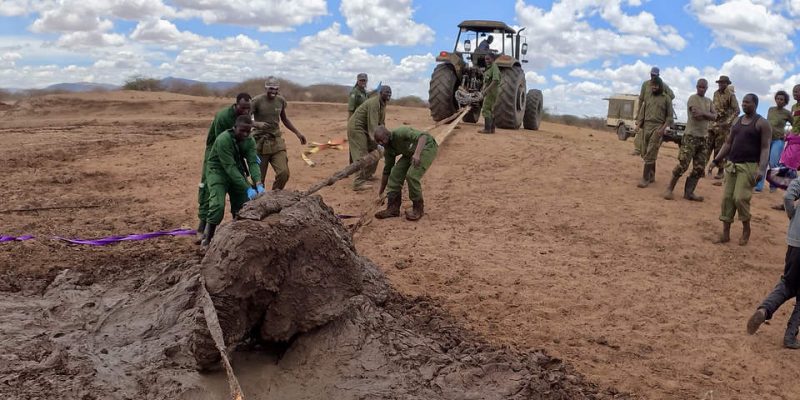
Because it was the easier of the two, and because the order is the whole technique. Working with personnel from Ol Malo, Loisaba Conservancy and the Kenya Wildlife Service, the team dug the straps in around the animals by hand, took the calf out first, and then turned to the adult, who the Trust says proved a much greater challenge. Both elephants got their bearings and walked off.
The photograph the Trust published shows what the straps are for. The adult is caked to the shoulder and sitting in a bowl of churned mud, the straps run out of that bowl across dried pan to firm ground, and the pulling power at the other end is a tractor. Around a dozen people are on their feet in the frame. This is not a job that a strap alone does, and it is not a job that a winch alone does either. Someone has to get down into the mud and work the webbing underneath an animal that cannot help.
This is a routine emergency
The Trust puts a number on it that is worth reading twice. “We have unique expertise in this kind of rescue operation,” it wrote. “Last year alone, our Aerial Unit helped extract 17 elephants from similar predicaments.”
Seventeen in a year is not a freak accident rate. It is a seasonal hazard with a season, and the season is now: the Trust notes that this is the height of the dry season and that conditions are difficult across the country. The same mechanism turns up in the Trust’s own history. The elephant Chyulu, whose wild-born calf we wrote about last week, was herself rescued as an infant in 2006 after being found stuck in a drying waterhole in the Kibwezi Forest.
The Aerial Unit that flew this one is the same operation whose monthly workload we covered in August: aerial patrol, veterinary support, and the awkward physical jobs that need an aircraft to reach them in time.
Which zoos paid for this one?
None that we can verify, and we went looking.
The Sheldrick Wildlife Trust names no accredited zoo or aquarium as a funder of this work, and the three organizations named in this rescue are a conservancy, a ranch and lodge, and a government wildlife agency. There is an accredited zoo in the neighborhood of this story, and it is worth naming precisely so that readers know what it is not: Loisaba Conservancy works with the San Diego Zoo Wildlife Alliance, which its own reticulated giraffe page describes as a collaboration to study and protect that species. That is giraffe research at Loisaba. It is not this elephant rescue, and the San Diego Zoo Wildlife Alliance has no part in it that we can find.
We say so rather than leave the connection hanging, because a zoo that funds one program in a place does not thereby fund everything that happens there. Across the sector the money is real: the Association of Zoos and Aquariums reports that 235 accredited and certified facilities spent roughly $372.4 million on conservation across 139 countries in 2025. There is no published breakdown of the African share of that, and we will not invent one.
What the species status says
The Trust made no conservation claim in this piece, so there is nothing to correct. The IUCN Red List assesses the African savanna elephant as Endangered, with a decreasing population trend. That assessment was made in November 2020 and published in 2022.
Against that, two animals out of the mud is a small number. It is also two more breeding-age animals than there were on the morning of the call, which is roughly how the arithmetic of this work goes.
The Sheldrick Wildlife Trust’s account of the rescue was published on October 26, 2026.
Quick answers
- Why do elephants get stuck in mud?
Because drying mud is not soft ground. As a waterhole or river pan goes down in the dry season it stiffens, and an elephant that walks in to drink can find it has closed around her legs. She cannot get the leverage to lift herself out, and struggling sets her deeper.
- How were the two elephants freed?
The Sheldrick Wildlife Trust flew custom elephant straps to Samburu in a Cessna 185. Working with personnel from Ol Malo, Loisaba Conservancy and the Kenya Wildlife Service, the team dug the straps in around the animals by hand and pulled the calf out first, then the adult. Both walked off afterward.
- How often does this happen?
Often enough to be a seasonal hazard rather than a freak event. The Trust says its Aerial Unit helped extract 17 elephants from similar predicaments in the previous year, and it notes that this rescue came at the height of the dry season.
- What is the conservation status of the African savanna elephant?
The IUCN Red List assesses it as Endangered, with a decreasing population trend. That assessment was made in November 2020 and published in 2022.
- Which zoos funded this rescue?
None that we could verify. The organizations named in the rescue are a conservancy, a ranch and lodge, and a government wildlife agency. Loisaba Conservancy does work with the San Diego Zoo Wildlife Alliance, but that collaboration is reticulated giraffe research at Loisaba and has no part in this elephant rescue that we can find.