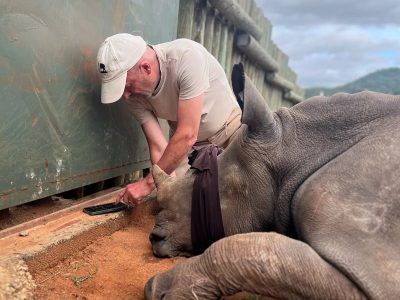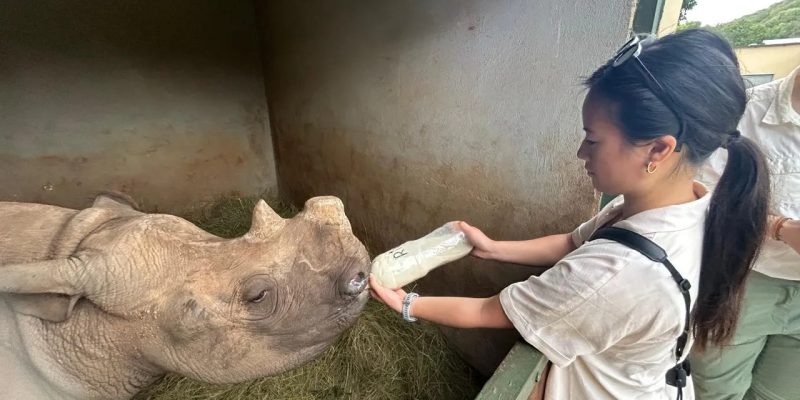
An orphaned rhino calf at Care for Wild drinks 16 to 18 liters of milk a day. A very young one takes it every two hours, through the night as well as the day, and the formula it gets is weighed out to a plan written for that individual animal and revised every time it is put on the scale.
The South African sanctuary published an account on October 15 of what actually goes into one of those bottles. It is the sort of thing a rescue organization rarely writes down, and it answers a question that comes up every time we cover an orphan rescue: what happens after the helicopter leaves.
There is no standard rhino bottle
Care for Wild says plainly that no single feeding plan fits every calf. The intervals are the first thing that changes. The youngest calves feed every two hours around the clock. As they get stronger the gap widens to three hours and the night feeds are gradually reduced.
The volumes move with age, weight, growth rate and condition. A calf between roughly four and 16 months averages about 16 liters a day, usually across five feeds of three to four liters each. Regular weighing is what drives the adjustments, which makes the scale as much a part of the care as the bottle is.
The sanctuary’s benchmark for all of this is what happens in the wild, and the wild turns out to be less tidy than the textbook. Rhino calves generally nurse until around 16 to 20 months. But Care for Wild’s rhino monitors, who follow rewilded mothers and their calves in the field, report considerable variation. Much of it depends on whether the mother has another calf. If she does not, some youngsters keep nursing until they are simply too large for it to be comfortable for her.
What is in the bottle
The milk powder is weighed to the calf’s plan, with supplements added where that individual needs them. Probiotics are a common addition. Water goes in, the mixture is whisked, and it is poured into a bottle fitted with a specialized rhino teat.
It is warmed to between 36 and 37 degrees Celsius, roughly 97 to 99 degrees Fahrenheit, to approximate body temperature.
The teat has an air hole, and the reason is a detail worth having. A rhino calf’s suckling action is strong enough to collapse a sealed bottle under the vacuum it creates. The hole lets air back in as the calf drinks, which keeps the bottle usable and reduces how much air the calf swallows.
Bottles, teats and every other piece of feeding equipment are washed and sterilized after each use. The written plan is what makes the care transferable: whoever is on shift mixes the same bottle for the same calf. Care for Wild’s own summary of it is that considerably more time goes into preparing the bottle than the calf spends drinking it.
Why the precision matters
An orphaned rhino is an animal whose nutrition stopped without warning. Everything that would normally be regulated by its mother, how often it feeds, how much it gets, how that changes as it grows, has to be reconstructed by people from weights and observation. Get it wrong in one direction and the calf does not grow. Get it wrong in the other and you have a gut problem in an animal that cannot tell you about it.
Care for Wild describes itself as the largest orphaned rhino sanctuary in the world, running rescue, rehabilitation, rewilding and protection. The milk kitchen is the unglamorous middle of that sequence, and it runs for well over a year per animal.
We have covered two other sides of the same operation this month: Satara, a Kruger orphan who has had her first wild-born calf, and the sanctuary’s account of horn trimming in the Greater Kruger. Satara is what the bottles are for.
Which zoo pays for it
We looked for an accredited zoo or aquarium behind this work and did not find one.
Care for Wild publishes a partners and sponsors page. The logos on it link out to Investec, Caterpillar Financial, Konica Minolta, Pepperl+Fuchs, Bisichi, TRACN4, the emergency service ER24, Mpumalanga Tourism, Sirius Group, the Oak Foundation, Virgin Unite, the Singita Lowveld Trust, Animal Survival International, South African National Parks, and the Rhino Recovery Fund, which is administered by the Wildlife Conservation Network. Alongside them sit Baby Rhino Rescue and Blankets for Baby Rhinos, two grassroots rhino charities; Rhino Conservation Partners, a Pennsylvania charity started by healthcare workers; and Rhinory, a Texas winery that keeps rhinos and is not an accredited facility.
Not one accredited zoological institution is on that list. That is a finding rather than a gap, and it is worth repeating each time it comes up: a great deal of the rescue and rehabilitation work in this region runs on money that has nothing to do with the zoo and aquarium sector, and saying so is more useful than inventing a connection. For comparison, the Association of Zoos and Aquariums reports that 235 accredited and certified facilities spent approximately $372.4 million on conservation across 139 countries in 2025. No published breakdown isolates what any part of that reached in Africa, and we are not going to estimate one.
Source: Care for Wild, post of 15 October 2026. The funder list was read from the sanctuary’s own partners and sponsors page.
Quick answers
- How much milk does an orphaned rhino calf drink?
About 16 to 18 liters a day. A calf between roughly four and 16 months averages around 16 liters, usually across five feeds of three to four liters each.
- How often are they fed?
The youngest calves feed every two hours, day and night. As they grow stronger the interval widens to three hours and the night feeds are gradually reduced. Every calf has its own plan, adjusted by regular weighing.
- What is in the formula?
Milk powder weighed to that calf’s plan, with supplements where the individual needs them. Probiotics are a common addition. Water is added, the mixture is whisked, and it goes into a bottle with a specialized rhino teat.
- Why does the bottle have an air hole?
Because a rhino calf’s suckling action is strong enough to collapse a sealed bottle under the vacuum it creates. The hole lets air flow back in as the calf drinks, and reduces how much air the calf swallows.
- What temperature is the milk?
Between 36 and 37 degrees Celsius, roughly 97 to 99 degrees Fahrenheit, to approximate body temperature.
- How long do wild rhino calves nurse?
Generally until around 16 to 20 months, though Care for Wild’s rhino monitors report considerable variation among rewilded mothers and calves. Much depends on whether the mother has another calf; if she does not, some youngsters keep nursing until they are too large for it to be comfortable for her.
- Which zoo funds Care for Wild?
None that we could verify. The sanctuary publishes a partners and sponsors page and no accredited zoological institution appears on it. The list is companies, private foundations, South African National Parks, the Wildlife Conservation Network’s Rhino Recovery Fund and several small rhino charities.