
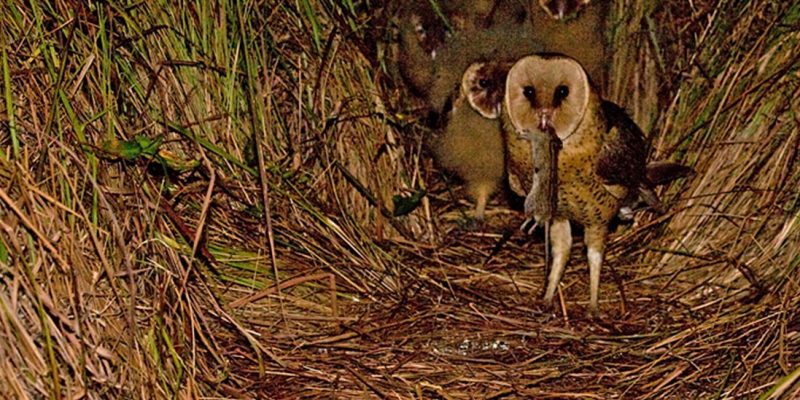
An African grass owl will not nest in just any grass. Across eight years of fieldwork in Gauteng and Mpumalanga, researchers following seven breeding females and monitoring 41 nests found that within an owl’s entire home range there may be exactly one patch that meets all of its requirements, and that if the right grass is not there, the bird leaves the territory.
The Endangered Wildlife Trust published a summary of the findings on August 31, 2026, written by Erin Adams and Lizanne Roxburgh of its Conservation Planning and Science Unit. The underlying study is Pretorius and colleagues, “African Grass Owl Nest Site Use and Nest Survival in Fragmented Grassland Landscapes,” in the African Journal of Wildlife Research, volume 56, issue 1, 2026.
Why is a ground nest a different problem?
Most owls people know about are cavity nesters or take over somebody else’s stick nest. The African grass owl is one of only two owl species in South Africa that lays its eggs on the ground, in a chamber hidden inside dense grass or sedge, reached by a tunnel the birds tread through the stems.
That changes the conservation question entirely. A cavity nester needs a hole, and a hole can be built and bolted to a pole. A grass owl needs a specific structure of living vegetation that has to be growing in the right place, at the right height and density, and has to still be there next season. You cannot put up a box for it. The habitat is the nest.
Nest site selection is the term for how a bird chooses, and it operates at two scales at once. Locally the bird responds to things like temperature, food and cover from predators. At landscape scale it responds to vegetation type, the size of the habitat patch and what surrounds it. For a species that builds nothing, both have to line up.
What the owls actually chose
The researchers tracked seven breeding females with radio and GPS tags and monitored 41 nests between 2009 and 2017, then compared where the nests were against the surrounding landscape.
The single strongest signal was one grass. Imperata cylindrica was present at 88 percent of the monitored nests, and the owls showed a clear preference for it over other grasses that were available to them. Where it was absent, birds were observed leaving their territories. That grass is also highly susceptible to fire, which means a fire regime that removes it can remove the nesting habitat with it.
The nests had a direction. They faced east-southeast, with a mean orientation of 102.16 degrees, which is the kind of detail that sounds fussy until you consider what a ground nest in an African grassland has to survive in terms of sun, wind and rain.
The owls nested near wetlands and avoided developed areas, which the researchers suggest reduces the risk from domestic and feral cats and dogs, a serious threat to any bird that puts its eggs on the ground. They avoided cultivated fields as well, and the likely reason is dinner: farmland is dominated by gerbils and other seed-eating rodents, while wetlands hold larger herbivorous rodents such as the vlei rat, which is one of the grass owl’s preferred prey. They also avoided woodland, mining areas and urban environments, possibly to reduce competition or conflict with other owls, including the barn owl.
One more finding matters for anyone managing a site: breeding pairs return to nest sites they have used before, as long as conditions there have not changed. Protecting a known grass owl nest site is therefore not a one-season intervention.
Two red lists, two answers
The trust’s write-up describes the African grass owl as “currently listed as Vulnerable on the IUCN Red List.” The global assessment reads differently. The IUCN Red List assesses the African grass-owl, Tyto capensis, as Least Concern, with a stable population, across a range that runs through eastern and southern Africa.
Vulnerable is the South African listing, from the country’s own regional red list of birds, and where the two disagree we default to the global assessment and name both lists. The gap is not an error so much as the entire reason regional red lists exist. A species can be secure across a continent and in trouble inside one country, and moist highveld grassland in Gauteng and Mpumalanga, which is where these owls were studied, is among the most heavily converted habitat in South Africa. The owls in this study are the ones the regional listing is about.
It does not change what the research found. An owl that needs one particular fire-sensitive grass, near a wetland, away from town, in a country that has ploughed and built over most of its grassland, is a conservation problem whichever category sits next to its name.
Tracing the zoological money
ZooReviews looks for the accredited zoos and aquariums behind field conservation, because they fund a great deal of it without their names reaching the coverage. On this study the trace turns up one institution, and it is not a funder.
The paper has eight authors. Five are at the Endangered Wildlife Trust in Midrand, one at the Department of Nature Conservation at Tshwane University of Technology, one at the Greater Kyalami Conservancy and one at Eskom, the South African power utility, whose interest in where birds fly and nest is direct and well documented. The eighth is Andre Botha, listed at the Hawk Conservancy Trust in Hoedspruit.
The Hawk Conservancy Trust is a bird of prey center in Andover, England, a member of the British and Irish Association of Zoos and Aquariums, open to visitors on 22 acres, and it runs a conservation and research program of its own, with field projects on raptors in southern Africa, Central Asia and Pakistan alongside kestrel monitoring at home. It supplied a co-author to this study. It is the only zoological institution anywhere in the work, and we found no zoo or aquarium named as a funder of the fieldwork, the tracking or the publication.
That is a thin thread, and we are calling it what it is rather than inflating it. But it is the shape the trace usually takes on raptor science: a visitor-facing collection with a research department that publishes, quietly attached to field studies thousands of kilometers from its own aviaries. We have seen the same pattern elsewhere in southern African raptor conservation, including the first chick hatched at VulPro, where the zoos behind the work were named outright.
What to do with a finding like this
The practical value of the study is that it turns a vague instruction, protect grassland, into a specific one. Look for Imperata cylindrica. Keep fire off it. Keep the wetland next to it. Keep the houses and the plough back. And do not assume that because a home range looks like grassland from a distance, an owl can nest anywhere in it, because the birds say otherwise: there may be one spot, and they will come back to it for years if it is still there.
Quick answers
- Where does an African grass owl nest?
On the ground, in a chamber hidden inside dense grass or sedge and reached by a tunnel the birds tread through the stems. It is one of only two owl species in South Africa that lays its eggs on the ground rather than in a cavity or an old stick nest.
- What did the study find that the owls need?
One grass above all. Imperata cylindrica was present at 88 percent of 41 monitored nests, and birds were seen leaving territories where it was absent. Nests faced east-southeast at a mean of 102.16 degrees, sat near wetlands, and avoided developed land, cultivated fields and woodland.
- How was the research done?
Seven breeding females were tracked with radio and GPS tags and 41 nests monitored in Gauteng and Mpumalanga between 2009 and 2017. The findings were published by Pretorius and colleagues in the African Journal of Wildlife Research, volume 56, issue 1, 2026.
- Is the African grass owl endangered?
It depends which list. The IUCN Red List assesses Tyto capensis as Least Concern globally, with a stable population. South Africa's own regional red list places it as Vulnerable, and the grassland these owls were studied in is among the most heavily converted habitat in the country.