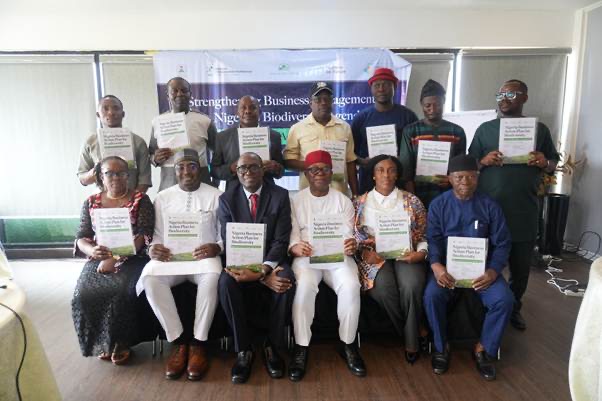
Nigeria now has a written set of instructions for companies that want to stop damaging biodiversity and cannot work out where to start. The National Business Action Plan for Biodiversity 2026 to 2030 was launched in Abuja on 16 September 2026 by the Nigerian Conservation Foundation with Natural Eco Capital, the Federal Ministry of Environment and other partners, and it does something national biodiversity strategies usually do not: it tells a business what to do on Monday morning.
The theme of the launch was “Mobilising Private Sector Leadership and Finance for Nature-Positive Growth in Nigeria,” and the room held government, business, finance, academia, development organizations and press.
What does a business action plan for biodiversity actually contain?
An operating cycle in eight stages: Govern, Scope and Screen, Locate, Evaluate, Assess, Commit and Plan, Act, Track and Disclose. A company works through it from establishing who inside the organization is responsible, through identifying where its operations touch nature and what that exposes it to, to acting, measuring and publishing the result.
The sequencing underneath is the familiar mitigation ladder: avoid harm where you can, reduce what you cannot avoid, and support restoration for what is left. What the plan adds is the insistence that each rung be evidenced rather than asserted, which is the gap between a sustainability page and an actual program.
It is also proportionate by design. A multinational, a bank, a single project and a small or medium enterprise are given different implementation pathways rather than one standard nobody but the largest companies could meet. Nigeria’s Small and Medium Enterprises Development Agency was at the launch and said it was ready to help extend the plan to smaller firms, which matters because those firms rarely have anyone on staff who has done a biodiversity assessment before.
Why a conservation foundation is writing to chief financial officers
Because that is where the decisions are. The plan translates Nigeria’s National Biodiversity Strategy and Action Plan 2025 to 2030 and the Kunming-Montreal Global Biodiversity Framework into things a company can be held to, and it hangs specifically on four of the global framework’s targets: policy integration (Target 14), corporate assessment and disclosure (Target 15), harmful incentives (Target 18) and resource mobilization (Target 19).
Dr Joseph Onoja, director-general of the Nigerian Conservation Foundation, presented it as a bridge between Nigeria’s biodiversity commitments and the commercial decisions that shape economic activity, and argued that nature functions as a form of capital for a business: it determines what resources are available, whether supply chains hold, whether operations continue and what the company is worth in the long run.
Dr Eugene Itua, chief executive of Natural Eco Capital, walked the room through the implementation manual and corporate toolkit, which is the part that turns the framework into a process a company can run. A recurring message from the platform was that biodiversity has to move out of the corporate social responsibility budget and into core operations, which is a polite way of saying that tree-planting photographs are not the deliverable.
Who pays for any of it
The plan is candid that commitments without financing go nowhere, and names the mechanisms it expects to see used: blended finance, green and sustainability-linked instruments, and payments for ecosystem services, each with safeguards, evidence and transparent reporting attached. Dr Emmanuel Akinwunmi, president and chief executive of Financing and Partnerships Africa Limited, made the point that the plan’s value will be decided entirely by what happens after the launch.
On the question this publication asks of every conservation story in the region, we found no accredited zoo or aquarium among the organizations behind this plan, and we are reporting that rather than reaching for one. The named parties are the Nigerian Conservation Foundation, Natural Eco Capital, the Federal Ministry of Environment, Business for Nature, the West African Capital Coalition Hub and a Business Advisory Group drawn from the private sector. The foundation’s own partner list names IUCN, WWF, BirdLife International and the RSPB, and no zoological institution. Zoo funding does reach Nigerian conservation in other forms, as it did in our reporting on the country’s vulture crisis, but it is not part of this.
What to watch for
The plan sets its own checkpoints, which makes it unusually easy to hold to account. Implementation scales in 2027. It is designed to line up with a planned mandatory reporting phase for large companies in 2028. An independent mid-course evaluation falls in 2029, and the cycle completes in 2030 with a successor strategy. Before any of that, the roadmap calls for a digital toolkit, corporate onboarding, baseline assessments, pilot initiatives and sector guidance.
The Business Advisory Group and its secretariat are explicitly a coordination mechanism, not a regulator and not an assurance provider, and existing regulators keep their own mandates. That is a sensible scoping decision and also the plan’s main risk: nothing in it compels a company that would rather not participate. The dates above are where that will become visible.
The launch is written up on the Nigerian Conservation Foundation’s site.
Quick answers
- What is the National Business Action Plan for Biodiversity?
A framework launched in Abuja on 16 September 2026 by the Nigerian Conservation Foundation with Natural Eco Capital, the Federal Ministry of Environment and other partners, setting out how companies and financial institutions in Nigeria should bring biodiversity into strategy, investment, risk management and operations. It runs from 2026 to 2030.
- What does the plan ask a company to do?
Work through an eight-stage operating cycle: Govern, Scope and Screen, Locate, Evaluate, Assess, Commit and Plan, Act, and Track and Disclose. Underneath it sits the mitigation ladder of avoiding harm where possible, reducing what cannot be avoided and supporting restoration for the remainder, with each step evidenced rather than asserted.
- Which global targets does it map to?
Four targets of the Kunming-Montreal Global Biodiversity Framework: Target 14 on policy integration, Target 15 on corporate assessment and disclosure, Target 18 on harmful incentives, and Target 19 on resource mobilization. The plan also translates Nigeria’s own National Biodiversity Strategy and Action Plan for 2025 to 2030.
- Does it apply to small businesses?
Yes, through proportionate implementation pathways that differ for large corporations, financial institutions, individual projects and small and medium-sized enterprises. Nigeria’s Small and Medium Enterprises Development Agency attended the launch and said it was ready to help extend the plan to smaller firms.
- Is it mandatory?
No. The Business Advisory Group and its secretariat are described as a coordination mechanism rather than a regulator or an assurance provider, and existing regulators keep their own statutory mandates. The plan is designed to line up with a planned mandatory reporting phase for large companies in 2028.
- What are the dates to watch?
Implementation scales in 2027, alignment with the planned mandatory reporting phase for large companies comes in 2028, an independent mid-course evaluation falls in 2029, and the cycle completes in 2030 with a successor strategy. Before that the roadmap calls for a digital toolkit, corporate onboarding, baseline assessments, pilot initiatives and sector-specific guidance.
- Is any zoo or aquarium involved?
None that we could find. The named parties are the Nigerian Conservation Foundation, Natural Eco Capital, the Federal Ministry of Environment, Business for Nature, the West African Capital Coalition Hub and a private-sector Business Advisory Group. The foundation’s own partner list names IUCN, WWF, BirdLife International and the RSPB, and no zoological institution.