
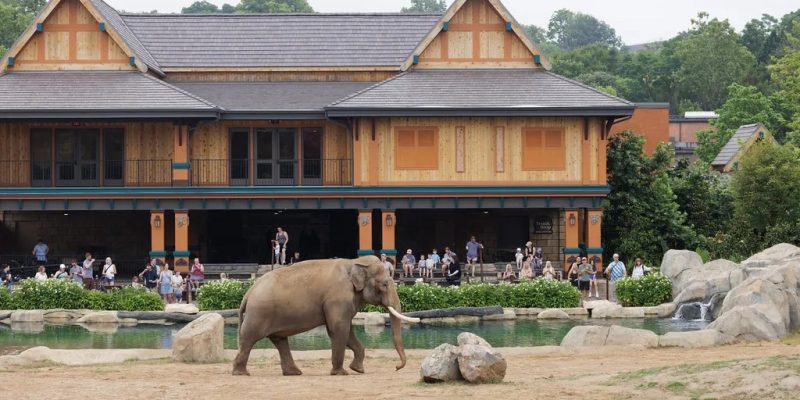
The Cincinnati Zoo & Botanical Garden has won Top Honors in the Association of Zoos and Aquariums’ Exhibit Award category for Elephant Trek, the largest habitat on its campus. AZA announced the award on Wednesday, September 30, at its annual conference in Portland, Oregon.
Elephant Trek is three pieces, not one space: a 3.8-acre outdoor habitat, a 15,000-square-foot Elephant Center, and a set of off-habitat care yards where keepers can work with an animal away from the main yard. Guest viewing runs along the edge of all of it.
“We are proud of what we built at Elephant Trek and thrilled to be recognized by our peers and the AZA Honors and Awards Committee for its excellence,” said Cincinnati Zoo director Dave Jenike. “Elephant Trek represents the future we believe is possible for Asian elephants, one rooted in exceptional care, meaningful conservation, and deeper public connection.”
What the judges were actually looking at
The physical layout mattered, but the zoo says design was one element among several. Applicants had to show that the goals for the exhibit lined up with their institution’s mission and with AZA’s strategic plan. Judges also weighed the quality of the messaging and learning materials inside the exhibit, animal and guest safety, the emphasis on conservation and sustainability, and the standard of animal care and husbandry.
That spread is worth noticing, because it is the difference between an architecture prize and this one. A handsome building that teaches a visitor nothing, or that gives keepers no good way to work, does not clear the bar.
Choice, and what protected contact means
The zoo built Elephant Trek around animal choice, enrichment, welfare research and what it calls advanced protected contact management. Protected contact is the husbandry standard most North American zoos now use with elephants: keepers and elephants are never in the same unrestricted space, and all handling happens through a barrier, with the elephant choosing to present an ear, a foot or a shoulder rather than being made to. It takes longer to train and it changes what a building has to be, because every panel, gate and chute is part of the method rather than an afterthought.
The care yards are the practical expression of that. An elephant that needs a foot checked, a blood draw or simply a quiet morning can be worked with somewhere other than the main habitat, without the whole herd’s day being rearranged.
Who else lives there
Elephant Trek is not only elephants. The complex also houses siamangs, Asian small-clawed otters, babirusa and rhinoceros hornbills, which makes a walk through it a tour of Southeast Asian species rather than a single-animal stop.
Asian elephants (Elephas maximus) are listed as Endangered on the IUCN Red List. The zoo attached no conservation status to its announcement, which is the more common failure in this direction: the listing is the reason the habitat exists, and it tends to go unsaid.
The sustainability side
The project kept legacy trees on the site, used naturalistic landscaping, and was built to LEED Platinum construction practices with water and energy efficiency strategies throughout. Cincinnati has form here. The zoo has spent years turning its own infrastructure into a talking point, including a community solar program that puts panels on other people’s roofs.
What is an AZA Exhibit Award?
It is the association’s annual recognition for exhibit design and the interpretation built into it, judged across design, messaging, safety, conservation emphasis and animal care. Top Honors is the highest result in the category. Founded in 1924, AZA accredits zoos, aquariums and related facilities across more than a dozen countries, and its awards are open to accredited members.
“Congratulations to the team at the Cincinnati Zoo for their hard work and dedication in achieving this remarkable recognition,” said Dan Ashe, president and chief executive of AZA. “This award recognizes the best of the best in the global aquarium and zoo community. The work being done at the Cincinnati Zoo further strengthens the impact of our entire community and is something Cincinnati can be proud of.”
It has been a good few weeks for the zoo’s conservation side as well, with four Asian giant tortoises hatching in late September.
Elephant Trek is open daily with the rest of the zoo, and the elephants are usually out on the big yard in the morning.
Quick answers
- What did Cincinnati Zoo win?
Top Honors in the Association of Zoos and Aquariums' Exhibit Award category, for Elephant Trek. AZA announced it on September 30, 2026 at its annual conference in Portland, Oregon.
- How big is Elephant Trek?
It is the largest habitat on the Cincinnati Zoo campus: a 3.8-acre outdoor habitat, a 15,000-square-foot Elephant Center, and off-habitat care yards.
- What is protected contact?
A husbandry standard in which keepers and elephants are never in the same unrestricted space. All handling happens through a barrier, with the elephant choosing to present an ear, a foot or a shoulder rather than being made to.
- What other animals live in Elephant Trek?
Siamangs, Asian small-clawed otters, babirusa and rhinoceros hornbills, alongside the Asian elephants.
- Are Asian elephants endangered?
Asian elephants (Elephas maximus) are listed as Endangered on the IUCN Red List.
- Is Elephant Trek open to visitors?
Yes. It is open daily with the rest of the zoo.