
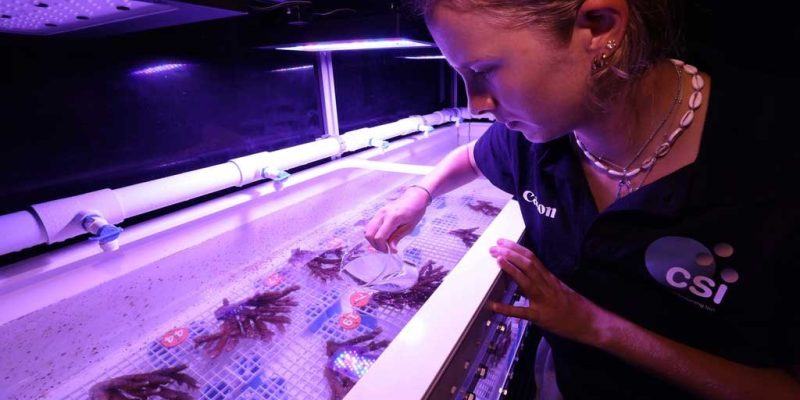
Eighteen coral colonies spawned over six nights in a laboratory on Praslin Island in the Seychelles, and the team watching them estimated more than a million embryos from the event, with roughly nine in ten eggs fertilized. Some of the larvae settled in the tanks and are now young corals. Nature Seychelles published its account of the work on November 25.
The spawning happened during an Innovations Lab held from October 22 to November 3 at the Assisted Recovery of Corals facility, known as ARC, which Nature Seychelles runs at Amitie on Praslin. Three organizations ran it together: Nature Seychelles, Coral Spawning International and Tropical Marine Center, with funding from Canon. It builds on a partnership the same group formed in 2025.
What spawned, and what that proves
The three species were Acropora abrotanoides, Acropora stigmataria and Acropora aff. tenuis. “Larvae developed and settled in the tanks, forming young corals,” said Dr Luca Saponari, one of Nature Seychelles’ Reef Rescuers.
The interesting part is not the first spawning. We covered that one in September, when a single species produced roughly 800,000 embryos and about 65,000 settled corals. ARC recorded that first success in November 2025 and another in February 2026. What this event adds is repetition from the same animals: the Acropora aff. tenuis colonies that spawned in 2025 stayed healthy in the tanks for a year and spawned again, in step with wild colonies outside.
That is the test a breeding facility actually has to pass. “It shows that Nature Seychelles can successfully maintain healthy, reproductive broodstock from one spawning season to the next,” said Dr Jamie Craggs of Coral Spawning International, who worked at ARC with Kate Craggs alongside Saponari, Viktoria Sturm, Akash Paunikar and two scientific interns, Oliver Klompe and Victoria Aase-Bjorka.
Why did corals spawn in the afternoon?
Most reef-building corals release eggs and sperm together on a handful of nights a year, cued by daylight, moonlight and seasonal temperature. A lab that can reproduce those cues can also move them. Coral Spawning International calls this phase shifting, and inside ARC’s spawning lab it pushed spawning into the middle of the afternoon. Colonies in the outdoor tanks spawned after dark, as they would on the reef.
Shifting both the hour and the season multiplies the chances to collect eggs and sperm, which is the bottleneck in sexual propagation. Nature Seychelles says the spawning lab is the only one of its kind in Africa and the Western Indian Ocean.
Corals hiding in the rubble
Reef rubble, the loose fragments of dead coral skeleton that shift with the swell, is usually treated as a bad place to plant anything. Using fluorescence photography, which makes coral tissue glow under particular wavelengths, the team found young corals already growing on it. They are now testing whether those naturally settled recruits can be identified, collected and raised at ARC.
If it works, it is a source of species and genetic lineages that a spawning program would otherwise never get hold of, and that would be ground down as the rubble moves.
What went back on the reef
Young corals raised from ARC’s 2025 spawning were planted in Cousin Island Special Reserve, where their early survival will be monitored. Most of the juveniles stayed at ARC on purpose: a strong El Nino is forecast for the next twelve months, and Indian Ocean reefs are exposed to it. We wrote about what that forecast means for African coasts earlier this month.
The team also used targeted microfragmentation, cutting individual young Acropora secale apart to multiply the number of colonies available for planting, and Nature Seychelles has trained local and regional specialists in the technique.
Canon’s part was the imaging. The team used underwater photogrammetry and fluorescence imaging on six plots in Cousin Island Special Reserve that were seeded directly with ARC larvae in 2025. Photogrammetry stitches hundreds of overlapping photographs into a scaled three-dimensional model, so repeat surveys can measure whether a coral grew or died rather than estimating it by eye. The team also photographed large Porites colonies for the global Map the Giants project and trained on TagLab, image-analysis software used in Seychelles for the first time.
“Imaging has the power to reveal what would otherwise go unseen, giving scientists new ways to understand, document and ultimately support the restoration of these vital ecosystems,” said Peter Bragg, Sustainability and Government Affairs Director at Canon EMEA.
The biobank question, again
Dr Nirmal Jivan Shah, Nature Seychelles’ chief executive, led a session on what it would cost to upgrade ARC into a coral biobank. He has been making this case publicly since at least October, when the organization asked for a coral bank ahead of the next bleaching event. His position has not changed and neither has the obstacle: national and international biobanks are under discussion and still need funding.
Craggs backed the site for it, pointing to ARC’s spawning facilities and expertise. “A biobank would be a natural fit,” he said.
Who paid for this
We trace the accredited zoos and aquariums behind conservation work in this region, because the money is often the only part of the chain anybody publishes. Here it is worth following carefully, because the honest answer has two halves.
No zoo or aquarium funds this. The money named is Canon, Nature Seychelles’ official imaging partner, which paid for the lab; the Adaptation Fund through the United Nations Development Programme and the Seychelles government, which Shah credits with five years of restoration work; SeyCCAT and the shipping group CMA CGM; and the Ministry of Environment, Climate, Energy and Natural Resources, whose funding carries the work to the end of 2026. Equipment came from ITC Reefculture, Advanced Aquarium Consultancy and Coral Spawning International. Not one of those is a zoological institution.
The method is a different story. The technique that made ARC possible was developed in a public aquarium. Dr Jamie Craggs is Principal Aquarium Curator at the Horniman Museum and Gardens in London, where he founded Project Coral in 2012. In 2013 that project worked out how to induce broadcast corals to spawn predictably in a closed system, and published the method openly. He co-founded Coral Spawning International in 2020 to build the systems, and the company says it has sent more than 80 of them to 19 institutions in 12 countries. Tropical Marine Center, the third organization in the Praslin lab, is one of Project Coral’s corporate partners and has worked with it on cryopreservation.
So the lineage runs through an aquarium, and that is worth saying out loud. The funding does not. Craggs was on Praslin for his company rather than for the museum, the Horniman is not a party to the Seychelles work, and no facility is attached to this article. The Florida Aquarium, which runs four systems on Project Coral’s protocols, is in the same position: a sibling of this work, not a funder of it.
For scale, the Association of Zoos and Aquariums reports that 235 accredited and certified facilities spent roughly $372.4 million on conservation across 139 countries in 2025. No published breakdown isolates what any one region receives, so we do not estimate one.
What this does not show
A million embryos is not a million corals. The settled recruits are weeks old, the outplants at Cousin have no survival figures attached yet, and Nature Seychelles has published none from this event. Shah’s own closing argument was not about the science but about money: an organization in a small country, he said, needs new partnerships and long-term funding to maintain infrastructure this specialized and this expensive. The spawning worked. The open question is who keeps the lights on after December.
Quick answers
- What happened at the ARC facility?
Nature Seychelles, Coral Spawning International and Tropical Marine Centre held a Canon-funded Innovations Lab on Praslin from October 22 to November 3, 2026. Eighteen colonies of three Acropora species spawned over six nights, with a reported 90 percent fertilization rate and an estimated one million-plus embryos.
- What is phase shifting?
Reef-building corals spawn on a few nights a year, cued by daylight, moonlight and seasonal temperature. By adjusting those cues in a closed system, Coral Spawning International shifted both the time of day and the season of spawning, which at ARC produced spawning in mid-afternoon. It creates more chances to collect eggs and sperm.
- Why did most of the young corals stay in the tanks?
A strong El Nino is forecast for the next twelve months and could affect Indian Ocean reefs. Some corals raised from the 2025 spawning were planted in Cousin Island Special Reserve, but most juveniles were held at ARC.
- Does an accredited zoo or aquarium fund this?
No. The funders named are Canon, the Adaptation Fund through UNDP, the Seychelles government, SeyCCAT, CMA CGM and the Ministry of Environment, Climate, Energy and Natural Resources. The spawning method itself was developed at the Horniman Museum and Gardens aquarium in London, but the Horniman is not a party to the Seychelles work.