
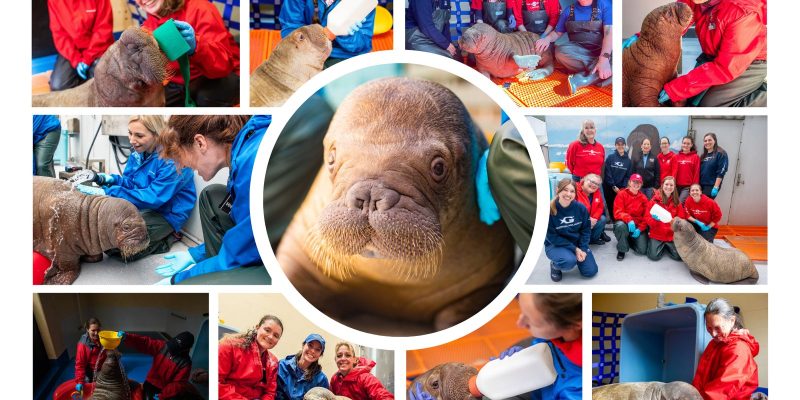
An orphaned Pacific walrus calf found on the beaches of Utqiagvik, Alaska has a permanent home. She is called Ukiaq, “autumn” in Iñupiaq, and she arrived at SeaWorld Orlando on September 18, 2024 weighing about 220 pounds.
She was a few weeks old when a herd left the area without her in July 2024. She was emaciated, dehydrated and covered in small surface wounds when the U.S. Fish and Wildlife Service cleared the Alaska SeaLife Center to respond.
Eleven calves in 26 years
The Alaska SeaLife Center in Seward is the only organization authorized to rehabilitate live stranded marine mammals anywhere in the state. Since it opened in 1998 it has admitted eleven Pacific walrus calves. Ukiaq was the eleventh.
Round-the-clock care for a walrus calf is not something one facility can staff alone. Within a day of the call, SeaWorld, the Indianapolis Zoo and Point Defiance Zoo & Aquarium had each sent a staff member north, with Georgia Aquarium and other AZA-accredited institutions adding people and remote support.
“As one of only four North American zoos and aquariums that are home to walruses, our staff are uniquely skilled to help provide care for this calf, and we were ready to pitch in as soon as the call came in,” said Malia Somerville, general curator at Point Defiance Zoo & Aquarium.
“Caring for an orphaned walrus calf is an incredibly demanding task, requiring unwavering dedication and expertise,” said Dr. Wei Ying Wong, the Alaska SeaLife Center’s president and chief executive.
Why she is not going back
A walrus calf nurses for up to two years and learns to find food on the sea floor from its mother and the herd around it. A calf separated at a few weeks old has no way to acquire either.
The U.S. Fish and Wildlife Service declared Ukiaq non-releasable, which turned the question from whether she could go home into where she should live instead.
SeaWorld Orlando was chosen for two reasons: staff experienced with the species, and an adult female walrus already there who could act as a surrogate.
“We are proud to have been able to quickly respond to the call for help, getting a zoological team with expertise in walrus care to the Alaska SeaLife Center within 24 hours,” said Dr. Claire Erlacher-Reid, senior veterinarian at SeaWorld Orlando.
“Uki’s journey to SeaWorld Orlando is only the beginning of her new chapter,” said Dr. Joseph Gaspard, vice president of zoological operations. “Our team is providing dedicated, 24/7 care to ensure her transition is as smooth as possible.”
She is acclimating behind the scenes before any guest viewing.