
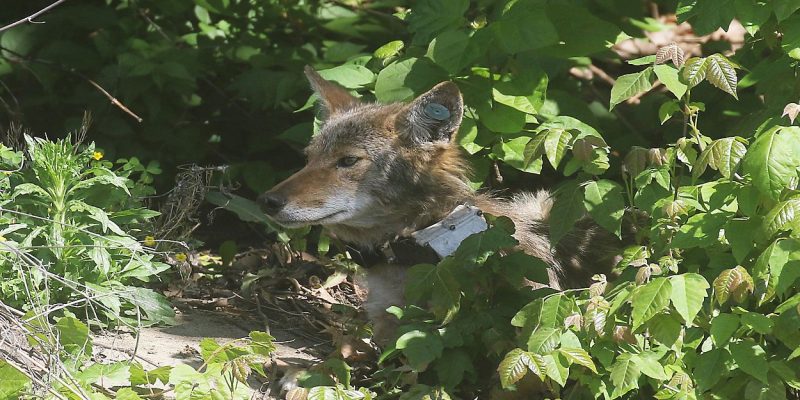
When a siren goes past the Akron Zoo, the resident coyotes answer it. Shilah and Kaliska, littermates who arrived in 2013 when Grizzly Ridge opened, respond to distant emergency vehicles with howls, barks and yips.
It reads as comic. It is ordinary coyote communication, and the zoo used it as the opening for something more useful: an account of what life is actually like for the coyotes living outside the fence.
Noise changes what animals can say
Persistent noise, sirens, traffic, construction, does more than stress urban wildlife. It interferes with the specific business of being an animal: finding food, finding mates, detecting predators, communicating with offspring.
Songbirds in loud environments raise their pitch and sing louder to be heard over the background. The evidence that this is a cost rather than an adaptation came from an unplanned experiment: during the COVID shutdown in San Francisco, with traffic noise reduced, songbirds began singing more softly, across a wider range of pitches and with more complex patterns. Given quiet, they went back to a fuller song.
Light moves them around
Artificial light at night disrupts circadian rhythms. Streetlights, porch lights and seasonal decorations push animals to forage, eat and sing when they should be resting.
Light also reshapes the map. The shadows cast by artificial lighting act as visual barriers, and animals will not cross between lit and dark zones, which can isolate populations in pockets of a city. For bats, feeding near lights means exposure to owls. For raccoons, opossums and insects adapted to low light, bright lighting is simply disorienting.
The wrong food, in quantity
Cities are not short of food. They are short of the right food.
A coyote evolved to eat rabbits and mice. What a city offers is pizza crusts and chips, high in starch, salt and sugar, and a diet of it produces the same outcomes it would in a person: diabetes, organ damage. Pet food left outdoors is no better, formulated for domestic animals, it leaves wildlife malnourished, and it concentrates animals in one place, which spreads disease and creates conflict.
Rodents poisoned with bait become a second-order problem, since whatever eats the rodent eats the poison.
What a zoo is for, on this subject
The animals in this story are not the zoo’s animals. Shilah and Kaliska are the way in, two coyotes people can watch closely, and the subject is the coyotes nobody bought a ticket to see.
That is a genuinely good use of a collection: the visitor arrives with an interest in the animal in front of them and leaves understanding the one crossing their street at night. Other institutions are working the same seam with the wildlife on their own grounds, from Nashville Zoo’s bird banding station to urban river monitoring in New York.