
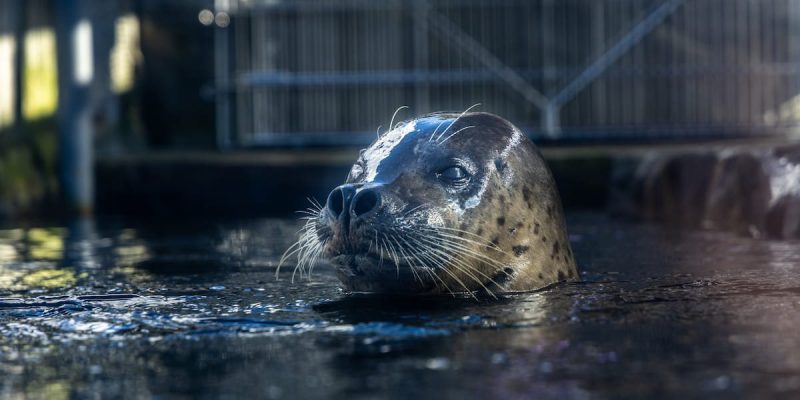
There is a new harbor seal at Pier 60. His name is Flounder, he was born at the Miami Seaquarium in 2013, and he is in Seattle because the Seaquarium closed in 2025 and every animal in it needed somewhere to go.
Flounder has lived his whole life in human care, so release into the wild was never an option for him. The Seattle Aquarium was identified as a good match on two counts: a long institutional history with harbor seals, and an existing group of two other males of similar age, Casey and Hogan, for him to live with.
Moving a Florida seal to Puget Sound
The first problem was temperature. Harbor seals range along much of both the east and west coasts of the United States and are comfortable across a wide band of conditions, but an individual animal is acclimated to the water it has been living in, and Flounder’s water was Florida’s.
So he went first to the aquarium’s off-site Animal Care Center, where staff lowered the temperature of his pool gradually over several weeks rather than moving him into Puget Sound conditions in one step.
The second problem was social. Harbor seals are semi-social: they will live together without friction in human care, but in the wild they spend most of their time alone. That biology cut in Flounder’s favor here, because it meant the animal care team could leave him on his own for a while without that being a welfare problem, and take the introduction to Casey and Hogan at whatever pace suited him.
He joined them in the main habitat in February. When aquarium teams introduce a new animal they watch for specific signals rather than a general impression: loss of appetite, and antisocial behavior. Neither appeared. The three seals cooperate during feedings, training sessions and health checks, and Flounder has been exploring the new habitat rather than hiding in a corner of it, which is its own indicator.
The eye drops, and why a seal gets them daily
Flounder has keratopathy, a disease of the cornea, which is the clear front layer of the eye. It is common in seals, common enough that his caretakers are now considering starting the aquarium’s other seals on eye drops as a preventative measure rather than waiting for symptoms.
He takes his drops daily and sits for regular eye examinations with the veterinary team. That cooperation is trained, not tolerated, and it is the difference between treating a seal’s eye condition daily and anesthetizing him for it. The Aquarium of the Pacific’s harbor seal Ellie had eye surgery in 2026, at the other end of the same problem.
How to tell him apart from the other two
Watch for the one floating upright. Flounder bottles, which is the term for a seal hanging vertically in the water with its head at the surface. It is normal harbor seal behavior, and Senior Animal Care Specialist Jake Smith notes that Flounder’s former habitat-mates preferred to bottle as well. Guests used to seeing seals swim and rest horizontally tend to find it surprising, and at Pier 60 it is the quickest way to pick him out of the group.
His diet is mostly herring and capelin, and the care team has been widening it. According to Animal Care Specialist II Lizzy Govas, who works closely with him, he is now “fully invested in ice treats,” which has turned out to be the lever for introducing new foods.
The IUCN Red List assesses the harbor seal, Phoca vitulina, as Least Concern, though it records the global population trend as unknown rather than stable. Flounder is not a conservation case. He is an animal who needed a home when his closed, and got a good one.
Source: Seattle Aquarium, Getting to know Flounder, the new harbor seal in our care, April 17, 2026. Red List category from the IUCN Red List of Threatened Species, version 2026-1.
Quick answers
- Where did the Seattle Aquarium's harbor seal Flounder come from?
He was born at the Miami Seaquarium in 2013 and moved to Seattle after that facility closed in 2025. Having lived his whole life in human care, release into the wild was not an option for him.
- How was a Florida seal acclimated to Puget Sound?
At the aquarium's off-site Animal Care Center, where staff lowered the water temperature in his habitat gradually over several weeks rather than moving him into colder water in one step.
- Why does Flounder get eye drops every day?
He has keratopathy, a disease of the cornea, which is common in seals. He takes drops daily and has regular eye exams. The aquarium is considering drops for its other seals as a preventative measure.
- How can visitors tell Flounder apart from the other seals?
He bottles, which means floating vertically with his head at the surface. It is normal harbor seal behavior but surprising to guests used to seeing seals rest horizontally. The aquarium's other two male seals are Casey and Hogan.