
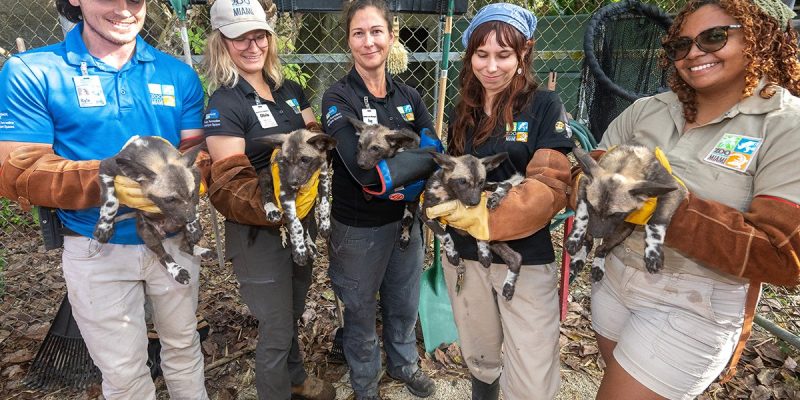
Five African painted dog pups were born at Zoo Miami on November 20, 2025, and spent their first eight weeks where nobody could see them. The zoo announced them in January 2026, after the veterinary team had finally been able to pick them up.
The litter is two males and three females, and it is the first for the mother, Uzuri, a six-year-old born at Zoo Miami herself. Her own mother, Little Foot, still lives at the zoo. The father, Cesar, is also six and came from the Brookfield Zoo outside Chicago. It is one of only three African painted dog litters born at accredited institutions in the United States in 2025.
Why the zoo waited two months to touch them
For the first weeks the pups were watched only through closed-circuit television. That is a deliberate choice rather than a precaution, and it has to do with how this species raises young.
Painted dogs den. A litter stays underground, and the pack’s behavior around the den is the thing that tells keepers whether it is going well. Going in early to check on pups risks the one variable that matters most, which is the parents’ willingness to keep doing what they are doing. So the cameras ran, staff watched, and only once they were satisfied that Uzuri and Cesar were caring for the litter properly did the animal health team go in.
The first handling was a full neonatal workup: physical examinations, deworming treatment, distemper vaccines and microchips for identification. The pups went straight back to the den afterward and were reunited with their parents. All five were healthy and developing normally.
They were named Gobo, Mokey, Wembley, Boober and Red, after the characters from Fraggle Rock.
What a painted dog pack actually does
African painted dogs live in packs of six to more than twenty. Only the alpha pair breeds, and a female can produce as many as twenty pups in a litter, all of them raised cooperatively by the whole pack rather than by the mother alone. That is the reproductive strategy in one sentence: the group concentrates its entire breeding effort into one litter and then everybody raises it.
The hunting is built the same way. Painted dogs have one of the highest success rates of any large carnivore, and they get it through coordination rather than power, taking down wildebeest and large antelope as well as warthogs and smaller prey. A dog that weighs 50 pounds does not bring down a wildebeest. A pack does.
The threats follow from the biology. Painted dogs are killed by landowners who see them as a threat to livestock. Their range is fragmented, which matters more for an animal that needs large territories and a functioning group than for one that does not. And they catch rabies and distemper from domestic dogs, which can remove an entire pack at once.
How many painted dogs are left?
Zoo Miami’s announcement says fewer than 6,000 remain in the wild. The IUCN Red List assessed the species in June 2025 and counts 1,676 mature individuals, with the population decreasing and the species listed as Endangered.
Those two numbers are measuring different things and both can be right. “Mature individuals” counts breeding-age animals, not pups and juveniles, and in a species where only the alpha pair in each pack breeds, the gap between a total headcount and a count of mature animals is unusually wide. Where the two conflict we default to the assessment, and it is also the more recent figure. The direction of the difference is the part worth noticing: the Red List number is smaller than the round one, not larger.
Which is the case for the litter. Three litters at accredited institutions in the United States in a year is not a large number either, and five pups from a first-time mother is a meaningful fraction of it. More American zoos are building for the species, not fewer: the Tulsa Zoo’s African Wilds, whose first section opened in 2026, has a named painted dog exhibit under construction among the pieces still to come.
The zoo planned to keep the pups off display with their parents for several weeks after the announcement, with the carnivore team monitoring their development, and expected to introduce them to the public in mid to late February 2026.
Source: Zoo Miami, Zoo Miami Welcomes African Painted Dog Puppies, January 16, 2026. Population figures from the IUCN Red List of Threatened Species, version 2026-1, assessment published 2025.
Quick answers
- How many African painted dog puppies were born at Zoo Miami?
Five, on November 20, 2025: two males and three females. They were named Gobo, Mokey, Wembley, Boober and Red, after characters from Fraggle Rock.
- Who are the parents?
Uzuri, a six-year-old female born at Zoo Miami, and Cesar, also six, who was born at the Brookfield Zoo near Chicago. It is Uzuri's first litter. Her own mother, Little Foot, still lives at Zoo Miami.
- Why were the puppies kept out of sight for two months?
They were watched only by closed-circuit television until staff were satisfied the parents were caring for them properly. Once that was confirmed, the animal health team examined them, gave deworming treatment and distemper vaccines, and implanted microchips.
- How endangered is the African painted dog?
The IUCN Red List assesses the species as Endangered with a decreasing population, and its 2025 assessment counts 1,676 mature individuals. Zoo Miami's announcement cites fewer than 6,000 individuals, which is a total population figure rather than a count of breeding-age animals.