
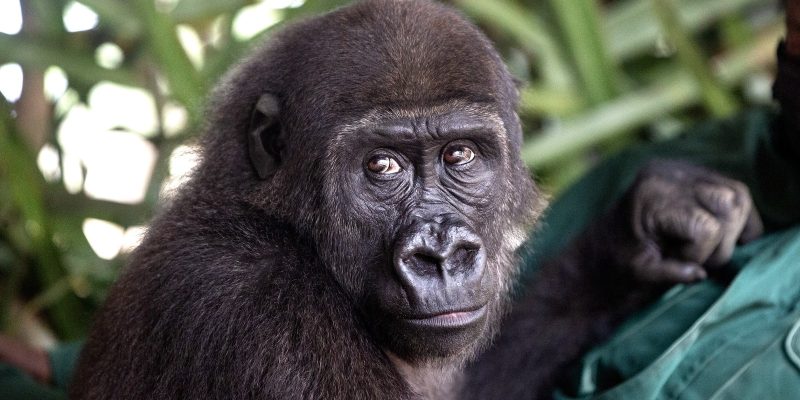
On September 21, a young gorilla named Bili was loaded into a crate in Calabar, in southeastern Nigeria, and driven for about twenty-two hours to Lagos. On September 22 she flew out of Murtala Muhammed International Airport on a DHL cargo flight, routed through Libreville in Gabon. She landed at Pointe-Noire, on the Atlantic coast of the Republic of the Congo, on September 23, and finished the journey by road to the Jane Goodall Institute’s Tchimpounga Rehabilitation Center.
The institute announced the move on September 29. Bili is a western lowland gorilla who was targeted by wildlife traffickers in Nigeria, recovered, and handed to the Pandrillus Foundation’s Drill Ranch in Calabar, where she had been cared for since 2023. Tchimpounga is where she will get specialist care now. It already holds one other gorilla, more than 150 chimpanzees and other animals injured or orphaned by the illegal wildlife trade.
What it takes to move one gorilla
The partner list on the release runs to eleven organizations and three government ministries, which is a fair measure of how hard it is to move a single CITES Appendix I primate legally across an international border.
Pandrillus built the crate, completed the export and import permits, the CITES documentation, the veterinary health certification, the IATA requirements and the customs processes, and coordinated the road transfer back to Lagos. The Nigeria Customs Service Special Wildlife Office handled security and regulatory support inside Nigeria. Nigeria’s Ministry of Environment issued the CITES permits, including one for the earlier DNA testing done to establish where Bili had come from. The Ministry of Forest Economy was the regulatory lead on the Congolese side. Focused Conservation was the rescue partner in Nigeria and provided in-country law enforcement technical support to the Customs Service on behalf of the United States government.
DHL Express flew her, acting through the Royal Foundation’s United for Wildlife Transport Taskforce, which it joined in 2014. “We are proud that DHL’s network and people could help bring all these elements together and support Bili’s journey to a safe, long-term home, with Bili’s safety and wellbeing at its center,” said Anthony Beckley, the company’s Vice President of Operations and Aviation for Sub-Saharan Africa.
Two people traveled with her the whole way: Dr. Rebeca Atencia, Executive Director and Head Veterinarian of the Jane Goodall Institute Republic of the Congo, and Imelda Effiong, her Pandrillus caregiver of three years.
Which zoo is behind this
One, and it is named in the release in a way that is easy to read past.
The long-term plan for Bili is not Tchimpounga. The institute says she is intended for the gorilla reintroduction program in the Lesio-Louna Gorilla Reserve, run by the Congolese Ministry of Forest Economy together with The Aspinall Foundation. The foundation is the British conservation charity that operates Howletts Wild Animal Park and Port Lympne Reserve in Kent, and the Lesio-Louna work is not a grant it writes from a distance. Its own account of the program says more than 75 western lowland gorillas have been rewilded at its projects in Congo and Gabon, and that 28 of those animals were born at the two Kent parks and sent south.
That is the connection worth stating plainly, because it is the one that matters to Bili. A zoo-bred gorilla and a trafficked orphan arrive at the same reserve by completely different routes, and the reserve exists in a usable state for the second partly because three decades of the first taught the foundation how to release gorillas and keep them alive.
Tony King of The Aspinall Foundation made the case for the program itself: “Over the past three decades the Lesio-Louna has demonstrated that orphan gorillas like Bili can be successfully rehabilitated and released, with wide-ranging benefits for wildlife, ecosystems, and people. Bili has started her journey but there is so much more ahead of her, her story will continue to inspire the world for years to come.”
No other zoological institution appears anywhere in the release or in the partner-roles note attached to it. The Jane Goodall Institute, Pandrillus, Focused Conservation and United for Wildlife are all non-governmental organizations, and DHL is a logistics company. We looked for further zoo or aquarium funding behind this transfer and did not find any. For scale on what the accredited sector spends on work of this kind, the Association of Zoos and Aquariums reports that in 2025 its 235 accredited and certified facilities spent approximately $372.4 million on conservation across 139 countries. No published breakdown isolates what any part of that meant for Africa, so we are not going to estimate one.
Why a gorilla ends up in a crate at all
Bili was taken young. That is how the trade works: an infant is portable and saleable and the adults around her are not, which is why a confiscated baby gorilla is usually the surviving end of a much larger event. The DNA testing Nigeria permitted was done to establish her origin, because a rescued animal whose population is unknown cannot be responsibly released anywhere.
The species is in serious trouble. The IUCN Red List assesses the Western Lowland Gorilla, Gorilla gorilla ssp. gorilla, as Critically Endangered under criteria A4bcde, with a decreasing population, in an assessment by Maisels, Strindberg, Breuer, Greer, Jeffery and Stokes published in 2018 as an amended version of a 2016 assessment. The parent species, Gorilla gorilla, carries the same category.
We have written before about what the far end of this arc looks like. Lulingu’s first wild birth in the eastern Congo came years after she arrived at a rehabilitation center as an orphan. Bili is at the beginning of that arc, and nobody involved is promising she reaches the end of it.
What happens next
Nothing quickly. Tchimpounga is a rehabilitation center, not a release site, and the institute describes the next phase as specialized veterinary care and rehabilitation in an environment suited to her physical, behavioral and social needs. Integration into the Lesio-Louna program is stated as an intention, not a date.
“Every rescue is made possible through collaboration,” Atencia said, “and Bili’s journey demonstrates what can be achieved when conservation organizations, government authorities, logistics experts, and supporters work together with a shared commitment to wildlife protection.”
The Jane Goodall Institute has published nothing further about Bili since the September 29 release, which remains the newest item in its press room.
Source: the Jane Goodall Institute’s September 29, 2026 release, and The Aspinall Foundation’s own account of its Congo and Gabon gorilla work.
Quick answers
- Who is Bili?
A young western lowland gorilla taken by wildlife traffickers in Nigeria and recovered, then cared for from 2023 at the Pandrillus Foundation's Drill Ranch in Calabar. On September 29, 2026 the Jane Goodall Institute announced her transfer to its Tchimpounga Rehabilitation Center near Pointe-Noire in the Republic of the Congo.
- How did she get there?
By road and air over three days. A roughly twenty-two-hour road transfer from Calabar to Lagos on September 21, a DHL cargo flight from Lagos to Pointe-Noire via Libreville on September 22, arrival on September 23, then a final road transfer to Tchimpounga. She traveled in a crate built by Pandrillus, accompanied by Dr. Rebeca Atencia of the Jane Goodall Institute Republic of the Congo and by Imelda Effiong, her caregiver of three years.
- Which zoo is connected to this?
The Aspinall Foundation, the British charity that operates Howletts Wild Animal Park and Port Lympne Reserve in Kent. It is named in the release as the long-term gorilla reintroduction partner in Congo and runs the Lesio-Louna program Bili is intended to enter with the Congolese Ministry of Forest Economy. The foundation says more than 75 western lowland gorillas have been rewilded at its Congo and Gabon projects, 28 of them born at those two parks. No other zoological institution appears in the release.
- What happens to her next?
Specialized veterinary care and rehabilitation at Tchimpounga, which is a rehabilitation center rather than a release site. Integration into the Lesio-Louna reintroduction program is stated as an intention and carries no date.
- Why was DNA testing involved?
Nigeria's Ministry of Environment issued CITES permits for DNA testing to determine Bili's origin. A rescued animal whose source population is unknown cannot be responsibly released, so establishing where she came from is a precondition for any future release.
- How threatened are western lowland gorillas?
The IUCN Red List assesses Gorilla gorilla ssp. gorilla as Critically Endangered under criteria A4bcde with a decreasing population, in an assessment by Maisels, Strindberg, Breuer, Greer, Jeffery and Stokes published in 2018 as an amended version of a 2016 assessment. The parent species carries the same category.