
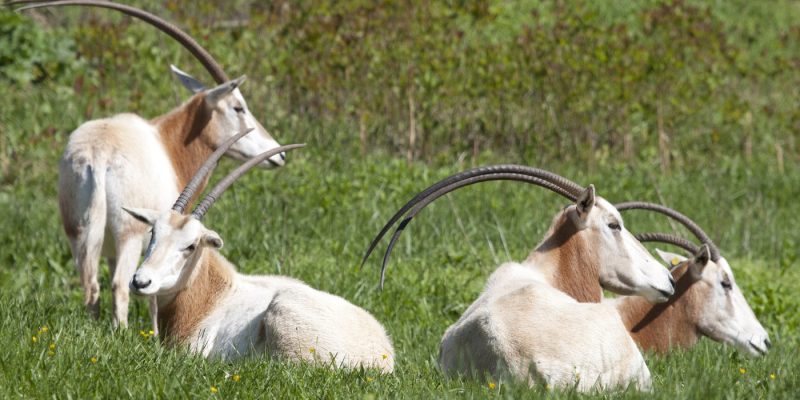
There are eighteen scimitar-horned oryx at the Smithsonian’s Conservation Biology Institute in Front Royal, Virginia. They are not there to be looked at. Most of the time nobody looks at them at all.
They are the test bed for the tracking collars that made the Chad reintroduction measurable, and their existence is the reason anyone can say how many oryx are now living wild in the Sahel.
What a research herd is for
Dolores Reed, curator of ungulates at SCBI, has worked on this since 2012, testing GPS and satellite collar designs and power sources for an animal that lives in one of the hottest and most remote environments on earth. A collar that fails in Chad cannot be retrieved and cannot be diagnosed. A collar that fails in Virginia can be.
“It’s easier for us to validate results when we can get data on 18 animals than if we only had one or two.”
Dolores Reed, curator of ungulates, Smithsonian’s National Zoo and Conservation Biology Institute
That is the whole argument for a research herd in one sentence. Statistical power is not something you can improvise in the field.
“In so many ways, the oryx have been a good test case for what works in conservation.”
Dolores Reed
Ten years of watching things move
Katherine Mertes, a research ecologist at SCBI, has spent close to a decade on movement analysis for the program, following the population from a founding group to more than 600 wild animals. The method developed on the oryx now extends to dama gazelles and addax, both of which are in far worse shape.
Two calves were born to the Front Royal herd this summer, Nova on July 8 and Zola on July 21, 2026.
The part that is easy to miss
The scimitar-horned oryx was downlisted from Extinct in the Wild to Endangered in December 2023. That decision required someone to demonstrate that the released animals were surviving, breeding and using the landscape as wild oryx do.
You cannot demonstrate that by looking. You demonstrate it with telemetry, and the telemetry worked because a zoological institution kept eighteen animals in Virginia for years so that the equipment could fail somewhere it could be recovered.
This is the unglamorous half of the conservation story and it is almost never the half that gets written about. It is also the half that only a zoo can do, because it requires animals, veterinary staff, and a decade of patience with no publishable result in sight.
The same logic underpins the reproductive science program at Cincinnati, where the output is a dataset and four frozen embryos rather than a birth.
Sources: Smithsonian’s National Zoo and Conservation Biology Institute; Sahara Conservation.