
In the 1970s there were about 70 Rodrigues fruit bats left alive. A cyclone had gone through what was left of their forest on a single small island in the Indian Ocean, and that was very nearly the end of the species.
Today there are more than 20,000 of them on Rodrigues Island. On Saturday, October 24, for ten dollars, you can stand in a Florida field and look at some.
The one day a year the gates open
Lubee Bat Conservancy sits on 110 acres about ten miles north of Gainesville and keeps more than 200 animals across a dozen species. It is not a zoo you can drop in on. It is a working conservation and research facility, and for most of the year the public is not there.
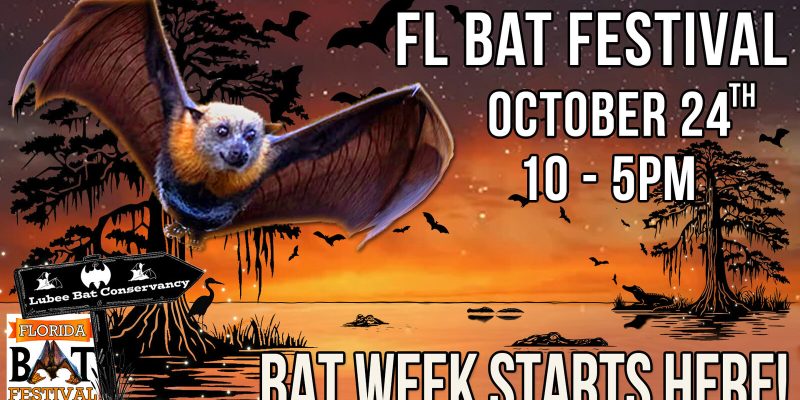
The Florida Bat Festival is the exception, and this is the 22nd one. Saturday, October 24, 2026, 10 a.m. to 5 p.m., last entry 4:30. Admission is $10 for anyone 13 and over, $5 for children 5 to 12, and free under 4. There is a separate beer garden ticket for adults, $25 to $45 depending on when you buy, with sponsor breweries including Veterans United, Swamp Head and Daytona Brew Club.
The festival opens Bat Week, the international awareness campaign that runs into Halloween. There are food trucks, live music, local vendors and conservation booths, family activities, and the bats themselves throughout the day. You can look at them. You cannot touch them, and Lubee is explicit about that, which is the correct answer.
What does a ten dollar ticket actually do?
All proceeds go to Lubee’s conservation and education work, and Lubee publishes what that has amounted to. Since 1989 it has funded 222 conservation projects, awards, conferences, PhD students and schools.
Some of what is running right now:
- Rodrigues Island, Mauritius. Support for the Rodrigues Environmental Education Programme, run with the Mauritian Wildlife Foundation, plus population monitoring and reforestation.
- Bougainville, Papua New Guinea. Work on the Bougainville monkey-faced bat, one of the least-known mammals on earth. Between 2016 and 2021 local monitors documented four roosts and four individual sightings. That is the entire recent record for the species.
- Solomon Islands. Backing for Zaira Village in its legal fight to stop logging on its own forest.
- Kenya. Population monitoring and community work on Hildegarde’s tomb bat.
- Fiji and New Caledonia. Cave roost identification and protection for five species, including the Pacific sheath-tailed bat and the New Caledonia long-eared bat.
- Florida and Georgia. 140 bat houses built and installed, with wildlife surveys attached.
None of that has a gift shop. None of it is going to sell a ticket on its own. A monkey-faced bat in Bougainville has no constituency, no cuddly branding and no chance of a fundraising campaign in its own right. It is funded because a fruit bat hanging upside down in Gainesville is charming enough that people will drive out on a Saturday in October to see one.
Seventy bats to twenty thousand
The Rodrigues recovery is the case study, and it is worth knowing before you go, because Lubee keeps the species.
The alarm was raised by a Rodriguan resident, Mary Jane Raboude, who told conservationists what was happening. Small founder groups went to zoological facilities that could breed them, and the animals were traded between institutions specifically to keep the genetics from collapsing. The Durrell Wildlife Conservation Trust ran the program that established those colonies. San Diego Zoo, Oregon Zoo, Prague Zoo and Copenhagen Zoo were among the facilities involved; Chester Zoo now holds the largest captive group, and Philadelphia Zoo, the Bronx Zoo, San Diego Zoo Safari Park and Disney’s Animal Kingdom are among the North American institutions keeping them. The Mauritian Wildlife Foundation built the education program on the island itself in 1998.
The IUCN’s 2017 assessment lists the Rodrigues flying fox as Endangered with an increasing population trend. Earlier literature described it as Critically Endangered. Around 20,000 animals now, from about 70.
Not one part of that was done by an organization that opposes keeping animals in human care. It was done by zoos, a wildlife trust, an island community and a woman who made a phone call.
The AZA line moved this year
One thing worth flagging for anyone who follows accreditation. Lubee was reaccredited on March 21, 2026, its fifth consecutive time through the process, and it is now listed as an Accredited Facility rather than a Certified Related Facility. AZA’s membership voted to fold the Certified Related Facility category into accreditation.
The inspection itself did not get easier. It is still the five-year on-site review of animal care, veterinary programs, keeper training, staffing, safety, conservation, finances and risk management. AZA president and CEO Dan Ashe called it the global gold standard when Lubee cleared it.
If you are going
Lubee Bat Conservancy, 1309 NW 192nd Ave, Gainesville, FL 32609. Saturday, October 24, 2026, 10 a.m. to 5 p.m. Buy the beer garden ticket early if you want one, since the price steps up.
Bring somebody who is afraid of bats. Twenty minutes with a straw-colored fruit bat eating a piece of melon tends to settle that, and the species Lubee works on need a larger constituency than they currently have.
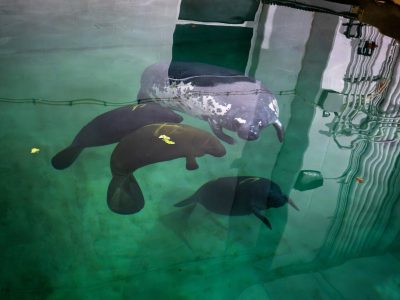
For the same argument with a different animal, ZooTampa’s manatee hospital is funded about two thirds by its own visitors. And a wild parrot population in Brazil was rebuilt on nest boxes paid for by a zoo in the Canary Islands.
Sources: Lubee Bat Conservancy, Florida Bat Festival; Lubee Bat Conservancy, Conservation Projects; Lubee Bat Conservancy, AZA accreditation; Association of Zoos and Aquariums; IUCN Red List, Pteropus rodricensis.