
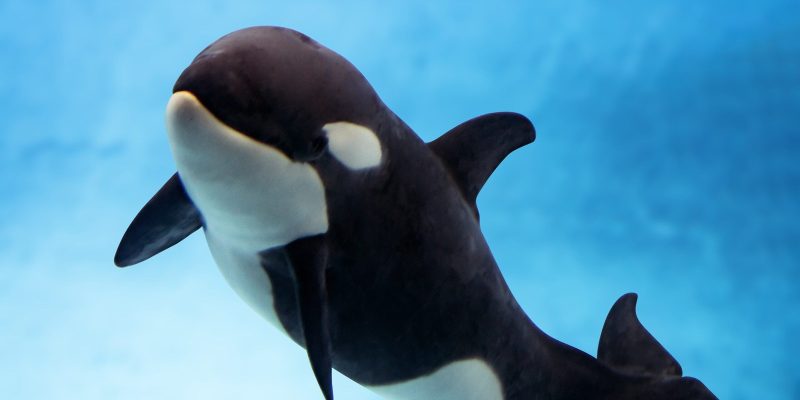
Teno turned one on April 1, 2026. He was born at Loro Parque on March 31, 2025, to a mother who cannot hear him.
Roughly half of orca calves born in the wild do not survive their first year, largely because their immune systems are not yet built. Teno did. The park reported steady growth, active behavior and early socialization, followed throughout by a team of keepers, vets and researchers. His name came from a public vote with more than 7,000 participants, after the Teno Massif on Tenerife.
That is the birthday. The more interesting story is his mother.
Morgan cannot hear
Morgan was found in the Wadden Sea in June 2010, alone, emaciated and dehydrated, weighing about 430 kilograms. She was rescued by Dolfinarium Harderwijk. Her family was never located.
Her trainers noticed early that she did not respond to sound cues. That observation was tested properly and published. A team led by Dr Klaus Lucke of Curtin University’s Centre for Marine Science and Technology, with Dr Javier Almunia of Loro Parque Fundación, Dr Dorian Houser of the U.S. National Marine Mammal Foundation and Dr James Finneran of the U.S. Navy Marine Mammal Program, ran auditory evoked potential testing, measuring brain response to sound. The results appeared in the peer-reviewed journal Aquatic Mammals on May 31, 2016.
The other orcas tested at the same facility produced brain responses. Morgan produced none.
“Multiple hearing tests subsequently conducted by our team at the facility in Spain confirm that Morgan suffers severe hearing loss.”
Dr Klaus Lucke, Curtin University Centre for Marine Science and Technology
Her hearing measured roughly 20 to 30 decibels worse than the other killer whales tested. The team’s conclusion was severe loss, possibly total.
What that means for an orca
This is the part that gets skipped in the campaigning, and it is the part that decides everything else.
An orca is an acoustic animal. It finds fish by echolocation, in water where sight reaches a few meters. It stays with its family by call, and every resident pod carries its own dialect. It coordinates a hunt by sound. Strip the hearing out and you have not removed a convenience, you have removed the animal’s primary sense, its navigation, its foraging and its entire social channel at once.
A deaf orca in the open North Atlantic cannot hunt effectively, cannot find a pod, and could not be found again by the people responsible for her. The Dutch Council of State, ruling on April 23, 2014 that her transfer to Loro Parque was lawful, cited exactly this class of reasoning: she is a social animal whose family had never been located, and as a young orca it was not clear she could feed herself.
“Release” for Morgan is not freedom. It is an unmonitored death from starvation, and the people who work with her know it.
The light system
What Loro Parque built instead was a way to talk to her. Since acoustic signals are useless, her team moved to visual ones, including underwater lights.
“Instead of the standard acoustic signals (whistles) to train the animal, they are now very successfully using visual signals such as underwater light.”
Dr Javier Almunia, Loro Parque Fundación
That is a genuinely novel piece of husbandry, and it did not exist before Morgan needed it. It is now knowledge available to any facility that ends up with a sensory-impaired cetacean, which is not a rare situation. A 2010 study in PLoS ONE found severe hearing loss in more than half of the stranded bottlenose dolphins tested. Acoustic disability is one of the working explanations for why cetaceans strand at all.
“Teno is proof that knowledge, dedication and love for animals can change destinies.”
Wolfgang Kiessling, president, Loro Parque
Why this calf matters beyond his own pool
There is an argument to make here, and we will make it plainly.
Charismatic megafauna are the reason people come through the gate. Nobody buys a ticket to see a Canarian land snail. But the gate revenue at Loro Parque funds Loro Parque Fundación, which has put more than 30 million dollars into over 300 conservation projects and counts 18 species pulled back from extinction. Twelve of those are parrots. Six are endemic Canary Island snails that no fundraising campaign on earth would have paid for.
That is the trade. An orca calf on Tenerife is part of what pays for Lear’s macaws going back to the Brazilian caatinga, for a compensation fund that stops farmers shooting them, and for the Macaronesia Marine Sanctuary proposal that the IUCN backed at 96.5 percent in October 2025. A sanctuary covering the waters of four archipelagos, carried by a park that critics would prefer did not exist.
Loro Parque has been sued, campaigned against and picketed over Morgan for more than a decade. The organizations doing that campaigning have not bred a Lear’s macaw, have not funded a snail recovery program, and are not the ones paying for cetacean distribution surveys in unstudied Atlantic water. Opposition is cheap. Field programs are not.
The relationship is older than the argument
People have kept company with animals for as long as there have been people. The bond that forms between a trainer and an animal they work with daily for fifteen years is not a marketing device, and the visitor who stands at the glass and decides that the ocean matters is not being manipulated. That is how conservation constituencies get built, and there is no substitute for it that works at the same scale.
Morgan is deaf, and she is alive, and she raised a calf. Teno is one year old. Both of those facts are the product of people who chose to do the work.
Sources: Loro Parque; Curtin University; Aquatic Mammals; Raad van State.