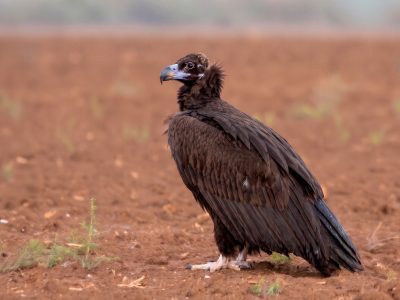

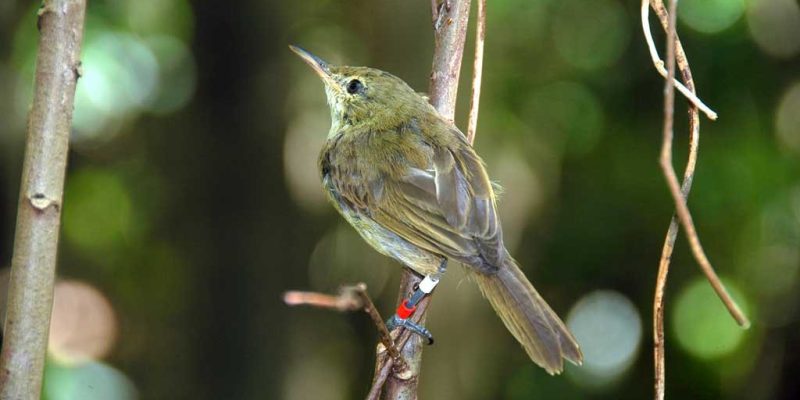
A small olive bird on a 29-hectare island in the Seychelles has become one of the best-documented wild animals on earth. Scientists have published a chromosome-level reference genome for the Seychelles warbler and imputed whole-genome sequences for 1,935 individually known birds from Cousin Island, every one of them tied to a life history recorded in the field. Nature Seychelles, which manages Cousin, announced the result on November 25.
The paper appeared on November 19 in G3: Genes|Genomes|Genetics, written by eighteen authors at the University of Sheffield, the University of Groningen and the University of East Anglia.
What is actually in the dataset?
Three things, and the combination is the point.
The first is the reference genome itself: about 1.08 billion base pairs assembled into 31 chromosomes, 29 autosomes and two sex chromosomes, with a scaffold N50 of roughly 18.7 million bases. That is a high-quality assembly for a wild passerine.
The second is population-scale sequencing. The team ran low-coverage whole-genome sequencing on 1,976 birds at an average depth of 2.65 times, then used imputation to fill in the gaps without needing a reference panel. That produced more than 18.5 million biallelic single-nucleotide polymorphisms, the positions where one bird’s DNA differs from another’s.
The third is the part no sequencing budget can buy. The Cousin Island warbler population has been monitored since 1985, and the blood samples in this study were collected from 1982 onward. Birds are individually marked and followed for life, so each genome sits beside a record of who that bird’s parents were, how long it lived, whether it bred, and what it was doing in each season of its life.
The quiet result: the old records were right
Before the genomics, parentage in this population was worked out from microsatellite markers. The new data let the team check thirty years of that bookkeeping against the DNA, and the headline from the audit is reassuring rather than embarrassing.
An initial run found disagreement with the old pedigree in 5.2 percent of cases. Most of that turned out to be mislabeled samples rather than wrong parentage: the team identified and corrected 41 DNA samples carrying the wrong identity, and found that 66 percent of the errors were concentrated in a single decade-old microplate, which points at one afternoon of pipetting rather than a systemic problem. Once those were fixed, agreement with the microsatellite pedigree rose to 99 percent.
Sixteen of 1,926 samples, under 1 percent, were duplicates or mismatched on sex. The authors are blunt that sample mix-ups are common in long-term field studies, hard to detect and under-acknowledged, and they recommend other projects run the same checks. Over 37 years of sampling, a sub-1-percent residual error rate is a good advertisement for the field and laboratory protocols behind it.
Why a conservation project wants this
The Seychelles warbler is a textbook bottleneck. Human disturbance in the twentieth century reduced it to a single population on Cousin, and the island held the entire species from 1920 to 1988. Conservation managers have since moved birds to Aride, Cousine, Denis and most recently Frégate in 2011, and the species now sits on five islands.
The IUCN Red List assesses the Seychelles warbler as Near Threatened, last assessed in 2021 under criterion B1a+2a, with about 3,000 mature individuals and an increasing population trend. The Red List’s own justification credits the increase to translocations and habitat management. Cousin itself holds roughly 320 birds.
That is the context that makes a genomic pedigree useful rather than merely impressive. When a population passes through a bottleneck, relatives are everywhere and a family tree drawn from field observation underestimates how related two birds really are. The paper found exactly that: genomic relatedness generally exceeded what the pedigree predicted, because pedigree arithmetic assumes the founding generation was unrelated and in a bottlenecked population it was not. Deciding which birds to move to which island, and which pairings to encourage, works better on measured relatedness than on inferred relatedness.
The authors list inbreeding, survival, disease resistance and adaptation to changing conditions among the questions the resource now opens. None of those answers is in this paper. This is the toolkit, published so other people can use it, and the authors say plainly that they are looking for collaborators.
Who paid for this
We trace the accredited zoos and aquariums behind conservation work in this region, because the funding is usually the only part of the chain that gets published. This time there is nothing to find, and the paper is specific enough that we can say so with confidence rather than by omission.
The funding statement names two national research councils and nothing else: the United Kingdom’s Natural Environment Research Council, for the genome sequencing and for earlier pedigree work, and the Dutch Research Council, for fellowships and a visitors grant. The acknowledgements thank the Seychelles Bureau of Standards and the country’s Ministry of Agriculture, Climate Change and Environment, Nature Seychelles and its wardens for facilitating research on Cousin, the fieldworkers and laboratory staff of the Seychelles Warbler Project, university computing services, and the NERC Environmental Omics Facility for sequencing support.
No zoo, aquarium or zoological society appears anywhere in the funding statement or the acknowledgements. We looked for one and there is not one. This is university-led, research-council-funded science done on an island owned by a bird conservation organization, and that is a complete and unremarkable answer.
For scale, the Association of Zoos and Aquariums reports that 235 accredited and certified facilities spent roughly $372.4 million on conservation across 139 countries in 2025. No published breakdown isolates what any one region receives, so we do not estimate one.
Where the data lives
The raw sequencing reads are in the European Nucleotide Archive under accession PRJEB100611, and the assemblies, annotation and SNP data are on Zenodo. The data availability statement carries a line worth quoting in full for what it signals about how this kind of work is now done: the authors write that the data stem from decades of close cooperation with local representatives, and they encourage prospective users to recognize the Republic of Seychelles’ sovereignty over its data.
Cousin Island was bought by BirdLife International in 1968 and has been managed by Nature Seychelles since 1998. We have written about the Aldabra giant tortoise hatchlings emerging on the same island this month, and about a genomic family tree for the Hawaiian honeycreepers, which is the same tool pointed at a far unhappier situation.
What this does not say
A reference genome does not save a bird. The warbler’s recovery was produced by habitat management and by physically carrying birds to other islands, and it was already working before anybody sequenced anything. What the genome changes is the quality of the next decision, not the direction of the trend. The honest description of this paper is the one its own authors use: it is a resource, and the findings come later.
Quick answers
- What did the study produce?
A reference genome for the Seychelles warbler assembled into 31 chromosomes, about 1.08 billion base pairs, plus imputed whole-genome sequences for 1,935 individually known birds from Cousin Island and more than 18.5 million single-nucleotide polymorphisms.
- Where was it published?
In G3: Genes|Genomes|Genetics on November 19, 2026, by eighteen authors at the University of Sheffield, the University of Groningen and the University of East Anglia. DOI 10.1093/g3journal/jkag307.
- What is the conservation use?
The species passed through a severe bottleneck, so field pedigrees understate how related birds really are. Measured genomic relatedness can inform which birds are moved between islands to maintain genetic diversity, which is the lever that drove the recovery.
- What is the conservation status of the Seychelles warbler?
The IUCN Red List assesses it as Near Threatened, last assessed in 2021 under criterion B1a+2a, with about 3,000 mature individuals and an increasing trend. It survived on Cousin Island alone from 1920 to 1988 and now occupies five islands.
- Does an accredited zoo fund this work?
No. The funding statement names grants from the United Kingdom’s Natural Environment Research Council and the Dutch Research Council and nothing else, and no zoo, aquarium or zoological society appears in the acknowledgements either.