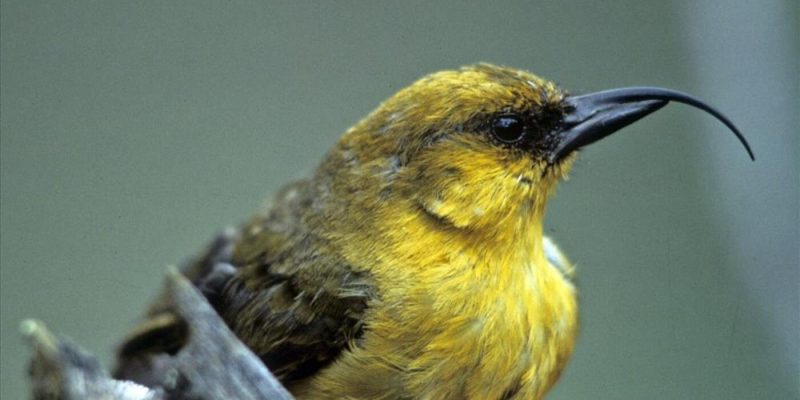
More than sixty species of Hawaiian honeycreeper evolved from a single ancestral finch that reached the islands and found nothing much already living there. Seventeen are left. A study published on August 3, 2026 in the Proceedings of the National Academy of Sciences has, for the first time, put nearly all of them into one family tree, including the ones that no longer exist.
The work came out of the Smithsonian’s National Zoo and Conservation Biology Institute and the National Museum of Natural History, and most of the birds in it were sampled from museum drawers.
Why this tree was hard to build
Hawaiian honeycreepers are the standard example of adaptive radiation, which is what happens when one species arrives somewhere empty and diversifies rapidly into many, each taking up a different way of making a living. The bills are the giveaway: some are short and conical for seeds, some long and curved for nectar, and the ʻakiapōlāʻau has a bill that functions as two different tools at once, a short straight lower mandible for chiseling bark and a long curved upper one for extracting what is underneath.
The speed that makes the radiation remarkable is also what makes it hard to reconstruct. When lineages split rapidly and then keep exchanging genetic material, the branching pattern does not resolve cleanly, and that matters for more than tidiness: you cannot measure how much evolutionary history has been lost if you do not know how the lost branches attached.
The team worked with the 17 living species, 18 more that were present when Europeans reached the islands in 1778, and two known only from fossil bones.
The answer is a net, not a tree
The study’s title calls the radiation reticulated, and that word is the finding. A reticulated phylogeny is a net rather than a branching tree: lineages split, and then some of them rejoin and trade genes before splitting again. Draw it honestly and you get a mesh with loops in it.
The team found that most honeycreeper species originated in a burst roughly 2.5 to 3.5 million years ago, at about the time the island of O’ahu rose. Their reading is that a brand new island offered unoccupied habitat with room for populations to separate, and that those populations then fed new genetic material back into lineages on the older islands. The researchers confirmed genetic mixing between the ʻōʻū (Psittirostra psittacea) and the Lānaʻi hookbill (Dysmorodrepanis munroi), and found that the ʻamakihi (Chlorodrepanis spp.), a group of close relatives spread across different islands, are still sharing genetic material today.
Hybridization between two species is usually an evolutionary dead end. Here it appears to have been one of the engines.
What the losses actually cost
“The findings are bittersweet because while we have a much better understanding of the relationships between the Hawaiian honeycreepers and the role hybridization played in their evolution, they also show we have lost more Hawaiian honeycreeper lineages than we previously knew,” said Michael Campana, genomicist at the Conservation Biology Institute and the study’s lead author.
That sentence is the practical result. Counting extinctions by species undercounts the damage when the species that disappeared were not evenly spread across the tree. Losing two birds from the same twig costs less evolutionary history than losing two from opposite ends, and until the tree was resolved there was no way to say which had happened. It turns out to have been worse than the species count suggested.
The Smithsonian release puts the number of surviving species at 17. The paper itself is more careful with the word, describing 17 extant taxa, and noting that four of the 17 are near extinction. Habitat loss, introduced predators, introduced disease and climate change are doing the work.
The specimens did the heavy lifting
Nearly all of this came from museum collections in the United States and Europe, sampled with minimally invasive techniques: small pieces of skin cut from preserved specimens, and in some cases DNA recovered from fossil bone.
“I marvel at the amount of genetic data that my colleagues recovered from tiny bits of epidermis cut from old museum specimens of extinct honeycreepers,” said Helen James, curator of birds and chair of vertebrate zoology at the National Museum of Natural History. “They even succeeded at getting genetic data out of small fossil bones of the honeycreepers. This really highlights how improvements in genetic sequencing have transformed traditional natural history museum collections into vast repositories of historical and comparative genetic information.”
That is an argument about what a collection is for. A drawer of nineteenth-century bird skins was assembled by people who could not have imagined genome sequencing, and it now holds data about extinct animals that exists nowhere else on earth. The specimens are the only surviving copy.
What the team does next
The group is turning to the diseases. Avian malaria and avipoxvirus, both introduced, are the proximate reason honeycreepers have been pushed up the mountainsides into the shrinking band of forest that is still too cold for mosquitoes. The team wants to understand how the birds and the pathogens have each evolved since the introductions.
“The genomic data we generated for this study should also be useful for understanding the morphological evolution of the honeycreepers, as well as to offer clues about how the genomic variation of some honeycreeper species may have influenced their ability to survive disease,” said Robert Fleischer, scientist emeritus at the Conservation Biology Institute and the study’s senior author.
That is the part with a use. If some honeycreeper lineages carry variation associated with surviving avian malaria, that is information a recovery program can act on, and the Conservation Biology Institute’s work on disease-driven amphibian declines in Panama is the same problem in another taxon: a pathogen moves, a fauna that never met it collapses, and the question becomes whether anything in the surviving population is resistant.
The paper is Campana and colleagues, “Reticulated adaptive radiation and phylogenomic diversity loss in the Hawaiian honeycreepers,” PNAS 123(32), doi:10.1073/pnas.2536533123.
Source: Smithsonian’s National Zoo and Conservation Biology Institute, August 3, 2026.
Quick answers
- How many Hawaiian honeycreeper species are left?
Seventeen. The Smithsonian puts it as 17 surviving species; the paper itself describes 17 extant taxa and notes that four of them are near extinction. More than 60 species evolved in the group originally.
- What is adaptive radiation?
What happens when one species reaches a place with few competitors and diversifies rapidly into many, each adapted to a different way of making a living. The Hawaiian honeycreepers are the textbook example, which you can read off their bills.
- What does a reticulated family tree mean?
That the branches rejoin. Lineages split, then interbreed and exchange genes before splitting again, so an honest diagram is a net with loops in it rather than a simple branching tree.
- Where did the genetic material come from?
Museum collections in the United States and Europe. Researchers used minimally invasive sampling, including tiny pieces of skin from preserved specimens and DNA recovered from fossil bone.
- When did the Hawaiian honeycreepers diversify?
Most species originated in a burst roughly 2.5 to 3.5 million years ago, around the time the island of O‘ahu formed.
- What is killing the surviving honeycreepers?
Habitat loss, introduced predators, climate change and introduced disease. Avian malaria and avipoxvirus in particular have pushed the birds up the mountains into the band of forest still too cold for mosquitoes.